

New Year's is a scary holiday. While Halloween has ghosts and ghouls, New Year's has something much scarier. It has self-reflection, admittance of faults, and resolutions to improve oneself. I've never had much fear of the first two. I am perhaps the most self-critical person you could ever meet; I once cried for hours after not getting the lead kangaroo in my second grade play. No, what scares me most is not the reflective character of New Year's, it is a commitment to change. Not because change represents a step away from the familiar, but because it always brings with it the possibility of failure.
In this country, we have an overwhelming distaste for hypocrites. People who, according to Merriam-Webster, "act in contradiction to [their] stated beliefs or feelings." The English essayist and famed anti-hypocrite, William Hazlitt, sums up the Anglo distaste of hypocrisy in two simple sentences,"the only vice that cannot be forgiven is hypocrisy. The repentance of a hypocrite is itself hypocrisy." Indeed, Hazlitt's firm stance on hypocrisy continues in the modern United States. Here, it is often proverbially stated that one should prefer to be an honest sinner, than a lying hypocrite.

Fig 1. Hatred of hypocrites has been noted in many North Pole elf cultures.
I first learned what hypocrisy was at a very young age. One of my aunts, a constant smoker, who had failed to quit many times, would often pull me aside and say, "Now Alex, don't be like me. I'm a hypocrite. I keep telling you not to smoke, but I can't put the cigarettes down myself." My aunt hated herself for smoking, but she hated herself even more for being unable to quit. In line with this attitude, I figured that a hypocrite must be worse than the evil cigarettes I had heard so much about. Considering I used to read through the dictionary with my father at the age of 5 (now you know why I will end up in therapy), it wasn't long before I discovered the meaning of this new word. Like cigarettes, I suddenly grew to hate it. Hypocrisy became an evil word - hypocrite - the worst possible person to be.
Generally, we don't think of hypocrites as being people with addictions. After all, nicotine is one of the most addictive substances in the world. Should we really expect people to quit before they can speak out against its ill-effects? No, hypocrites are the people who claim to be morally upright but stray from their standards. Hypocrites are the fitness junkies who tell us to go on diets while eating massive chocolate doughnuts. Hypocrites are people who resolve to change, or to achieve some goal on New Year's, but fail to achieve those goals.
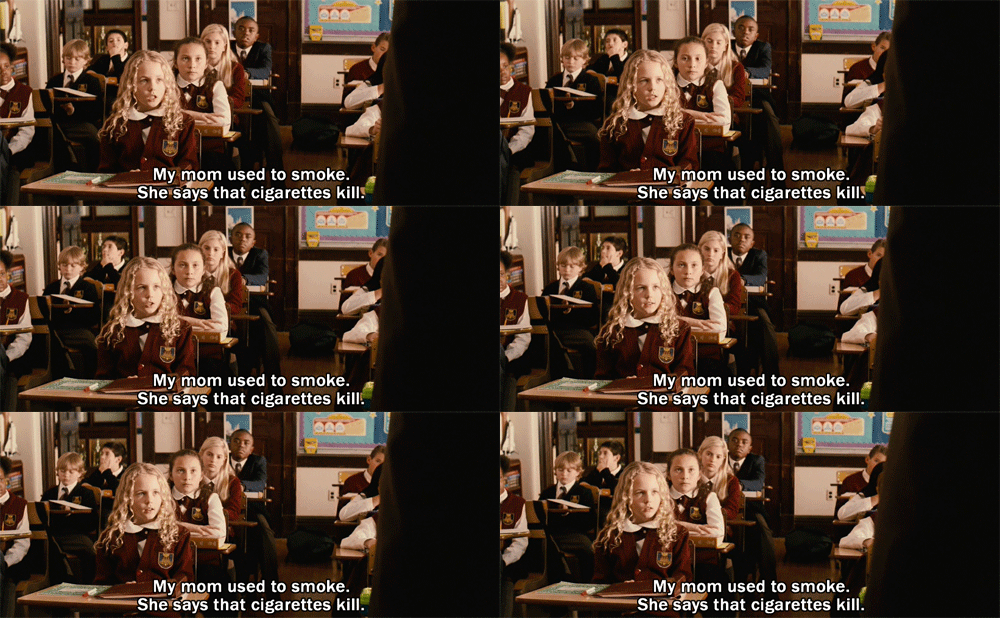

Fig 2. Nick Naylor in "Thank You For Smoking" exemplifies a morally reprehensible hypocrite.
Wait, what? I said it. I'm afraid of New Year's because it turns me into a hypocrite. When someone publicly proclaims their New Year's resolutions, it isn't a simple statement of I am going to do X. It represents an opinion about X. If I say I want to lose 10 Ibs this year, I am saying that I value my fitness. Consequently, a failure to uphold this goal by getting milkshakes at Maxwells every night would make me a hypocrite. I'd be acting in a way that contradicted my stated beliefs and values. If we look at every New Year's resolution I've ever made ever, I am about as big of a hypocrite as you can get. For example in 2013, I wanted to:
1. Stop writing research papers at the last minute - LOL
2. Stick to a regimented workout routine - Does dancing at parties count?
3. Become a first string rugby player - Thanks for crushing my dreams, Coach.
4. Become a better person - Freshman Alex would be horrified at Sophomore Alex.

Fig 3. Aw. Young, hopeful, lanyard-ed, freshman year Alex.
Needless to say, none of these were accomplished. But is the strict accomplishment of our resolutions all we value? Is there anything wrong with sometimes acting out of sync with our stated beliefs and values? Perhaps, we are a little too hard on the hypocrites.
Here, I want to focus on resolution No. 4 Become a better person. At Colgate, I've noticed an interesting phenomenon, which I have ironically dubbed "the nice guy effect." The name is a misnomer. Anyone can experience this phenomenon, regardless of gender. I simply think the name is funny because 'nice guys' are notorious at whining about their depressing lives. The effect is simple. If two equally immoral actions are committed by two seperate people, one person who tries really hard to be morally upright, and another who doesn't, the one who doesn't strive to be moral will often be forgiven, while the person who claims to be moral will suffer assailments on their character. This may seem counterintutitive, but ask around, and look at your own experiences - you might find that they fit this mold.
The reason for this phenomenon is simple. When the morally ambivalent commits an immoral action, they have simply made a mistake. They didnt know any better, or they simply acted in accordance with their character. They were true to themselves. We can simply tell them what they did wrong (if they care to hear), and forgive them so they can learn from their mistakes. However, when a person who claims to uphold high moral virtues falters, this shows a lapse in character. They've deceived us. They aren't who they claim to be. Obviously, this person doesn't deserve our forgiveness because they don't care about being morally upright anyway. In the words of Hazlitt, "the repetence of hypocrisy is itself hypocrisy."
The problem with this view on hypocrisy is easy to see. It prevents any sort of personal progress, be it social, physical, or moral. None of us are perfect people. We all fall short on our goals, roles, aspirations, and values. In fact, the ancient Stoics claimed that the only way a person could be virtuous is if they expunged every single one of their false beliefs. Their reasoning? One false belief can impugn a person's entire system of knowledge, so that they can't be sure how one should act in every instance. Simply, we do not have enough knowledge to act correctly in every instance, nor enough restraint to achieve our every goal. Therefore, if we state our values and goals outloud, we are doomed to be hypocrites. There is no way to live fully up to our own standards.
Fig 4. In fact, we see them every day when we look in the mirror.
For this reason, it may be better to stay ambivalent about our values and beliefs, only asking for forgiveness when it is clear that we hurt others. But this would bring us to the point of moral nihilism. We would simply be doing whatever we want, hoping that people will forgive us. At the same time, forgiveness would lose its own value because no one would ever change after repenting. It does not make sense to forgive someone who isn't concerned with changing to be a better person. Further, none of us would be able to inform each other about the correct ways to act. Should I care about fitness? Should I value my grades? Is it wrong to brutally murder someone? I dont know because we're all either hypocrites or morally ambivalent.

Fig 5. Problem with moral ambivalence? More 'F*** Boys.'
The way out of this dilemma is simple: We should not be afraid to be hypocrites. What we care about when we create resolutions is not necessarily the full completion of a standard. The thing we care about is progress. It is a genuine attempt to be a better, more improved person that we can be proud of. So what if you lose 8 Ibs instead of 10 because you decided to participate in Sundae Sunday at Frank Dining Hall? What we hope to achieve with our resolutions is not perfection; it is the development of habits that help us reach human excellence (Don't look impressed. I stole this straight from Aristotle). Likewise, we should learn to forgive people who fall short of their own standards, so long as they are actively trying to achieve them. And, we should forgive ourselves.

Fig 6. Thinking of hypocrisy in this way could save most of us from being immoral hypocrites.
Instead of following Hazlitt, perhaps we should heed the words of American humorist, Don Marquis, "a hypocrite is someone who - but who isn't?" According to Don Marquis, a hypocrite is a person who says one thing and does another, but that would make us all hypocrites. What we should really care about is the intent and effort needed to achieve our goals. For this reason, don't be afraid to dream big this New Year's. Set resolutions you believe in! Set resolutions you may not achieve! And, don't be afraid of failure. We all have haters. We have all been judged. Stay principled, and don't let anyone dislodge you. New Year's is scary, but its precisely the horror of admitting our faults and doing something about them that makes it such a powerful holiday. Take advantage of it, and don't be afraid to be a hypocrite.
Fig 7. Example of impossible New Year's resolution.