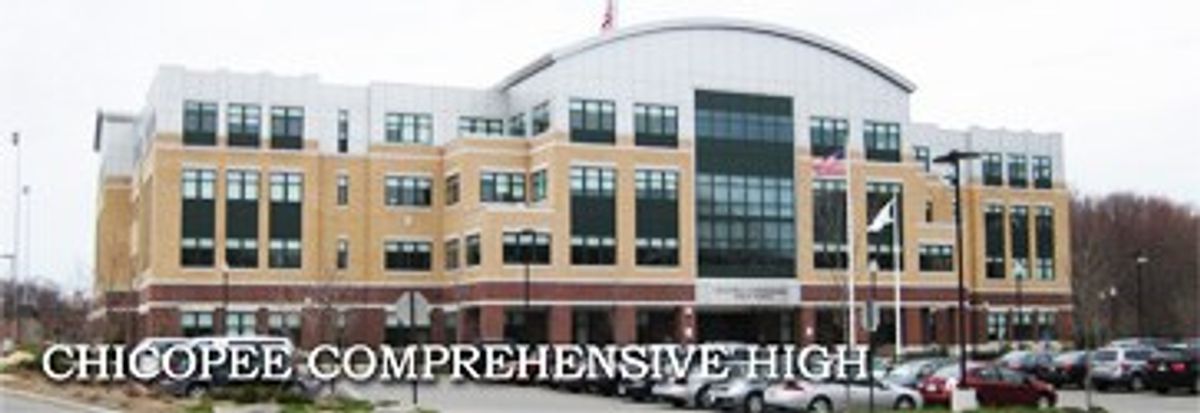
One might read the title and immediately pose the question: Don't you go to Princeton? Isn't that, like, a good school? Well, every rule has its exception. This is not to paint me as an exceptional student but as an anomaly. Kids from Chicopee, Massachusetts, don't go to Ivy League schools, never mind the number one school in the country.
If one is a prospective high school valedictorian, one tends to look up and down at those at the head of the class in the years above and below them. In doing so, I had role models in older classes and young rivals people loved to compare to me. In my time here, it's become clear to me that any of these students could have done just as well at a school like this, if not better. However, even though many of them apply ambitiously to the Harvards and the Princetons and the typical Ivies, I am the first student from Chicopee Comprehensive High School in recent memory to have accomplished admission into one of these schools. I talk to many students at Princeton who list the number of kids from their schools that got into Princeton or other Ivy League schools. However, when I walked around school the day after my acceptance, it was clear the teachers hadn't seen anything like it in a long time.
Chicopee, Massachusetts, is split into two high schools: Chicopee Comp (short for Comprehensive) and Chicopee High. As you can imagine, this leads to quite the sports rivalry. In my knowledge, the only other student from the entire city who made it into an Ivy in the past five years was a student from Chicopee High who now wears the sad color of Crimson in Cambridge, Massachusetts. As I said before, there was no shortage of brilliant, dedicated students to come from Chicopee schools in this time period. What, then, makes Ivy League admissions committees so reluctant to take a chance on students from our town?
In attending an event to introduce students from Western Massachusetts who were accepted to Princeton, I was informed that one of the other students was from Northampton High School and all of the rest were from Deerfield Academy. The alumnus who interviewed me for Harvard was from Northampton, as well, and his son currently attends Harvard as a graduate from the same school. I know many kids from Northampton, as it is a town not significantly different from my own.
I, then, came to understand the concept of name recognition among schools. Legacies have an advantage if they have successful parents because the admissions committee thinks, well, if their mother or father was a good student here and was successful, what's the risk in taking their son or daughter? This process works the same way for schools. If Princeton accepts three students from a certain high school over four years, and these students work hard and achieve success in school, then the admissions committee will look positively on applicants from that school in the future.
In the case of Chicopee Comp and Chicopee High, there has been no precedent set at Princeton, Harvard or any other Ivy that leads to yearly admittance for one or two brilliant students. People like me get in by padding our resumes and having a whole lot of luck, and it becomes our job to prove the ability of the next valedictorian who wants to apply to Princeton. I even know of a few students in the grades below me who would be a perfect fit at a school like this, and so, for me, the pressure is on to create a legacy for Chicopee Comprehensive High School, so they can have a chance to make it big.