Preparing for my semester in Bhutan was a stressful and often terrifying experience, which—more than once—left me in the fetal position completely consumed by panic.
"Why on earth am I going halfway around the world? I don’t know the first thing about Bhutan! I can barely make friends at home, how will I possibly make them in Bhutan? I seriously have to wash my clothes in a bucket? I am so, so not cut out for this…"
Of course, I can only admit to such fears and insecurities now that I was officially a resident, albeit temporary, of the Land of the Thunder Dragon.
In an effort to be completely transparent with you (much easier to do from the other side of a computer screen), I will let you in on a secret. I am not sure I could have listed more than one thing I was excited about when it came to studying in Bhutan prior to departure. Even during my first few weeks in the country I couldn't find much I was excited about. I was that consumed with nerves and anxiety. The only blip of moderate excitement on my radar before I left home was the thought of purchasing my very own kira.
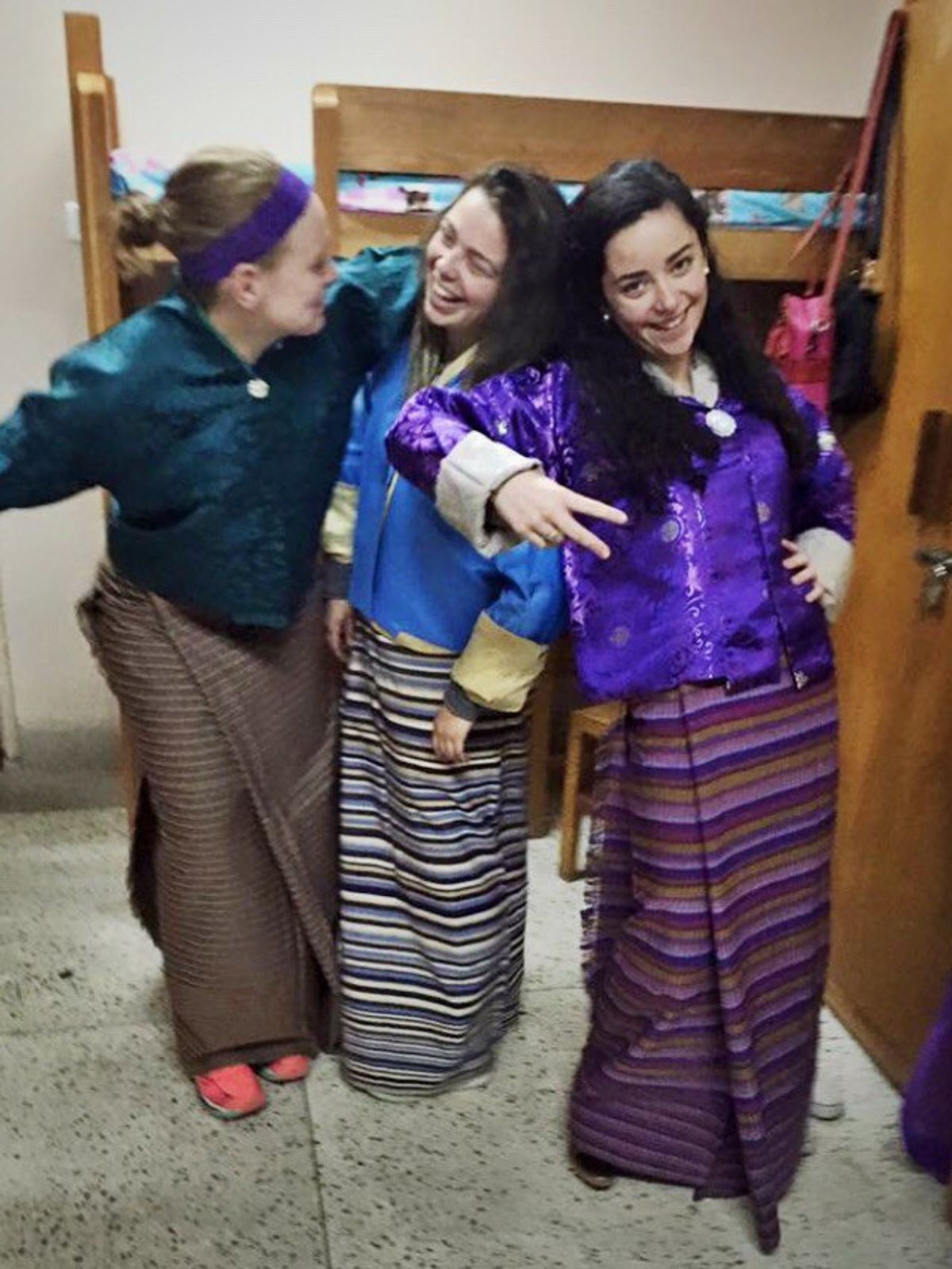
Within Bhutan, residents are expected to wear the traditional dress while at work and school. For men this knee-length, wrap-around robe is called a gho, whereas the women wear what is called a kira. In actuality the kira is merely the long skirt, which is held in place with a belt, called a kera. The outfit is completed with a two-layer jacket of sorts. The inside piece, or wonchu, is typically made of a lightweight silk material. The outer layer, known as a tego, is made of a heavier cloth and is often brightly colored or embroidered with patterns of dragons and flowers. The sleeves of the wonchu and tego are rolled up to give the appearance of a jacket with large cuffs of a different color or pattern. The entire look is pulled together with a broach that clasps the tego and wonchu closed.
How, you may ask, do I know so much about this traditional and beautiful style of dress? Well, it is certainly not because I did the appropriate research before traveling to a country that I knew next to nothing about. In fact, if Hermione Granger had known just how little I had read about Bhutan prior to this trip she would have had my nerd status revoked with no questions asked.
Luckily, I found that my Bhutanese counterparts were willing to ignore my ignorance in favor of teaching me about their culture themselves. I also found discussion with fellow humans to be a very viable replacement for books. One night, about a week into the semester, my new Bhutanese friends offered me a hands on practical in Bhutanese culture–they wanted to dress me up in their kiras. I have never felt more like a princess, which is not a feeling I have ever sought out. Actually, I felt most like Mulan, Disney’s greatest anti-princess to ever be born into animated existence.
Do you remember the scene in Mulan when our heroine is dressed and made up before being sent to a matchmaker to find her a husband? Our little kira fashion show was like that, only without the underlying sexism and pushy elders.
I tripped over my kira as my friends tightened it to the point of barely being able to breathe. My hands were invisible and rendered useless on account of the purposefully too long sleeves of the wonchu. I was literally spun around as not one or even two but three of my classmates perfectly folded my cuffs and fluffed my collar. All I was missing was a lucky cricket.
The borrowed kira made me feel beautiful, but it also made me feel accepted. I felt a part of the kingdom and also a part of a group of friends. When one finds herself in unfamiliar territory this is really the best we can ask for. Sometimes it really is nothing more than the age-old game of dress up that can bring people of such different backgrounds together.