


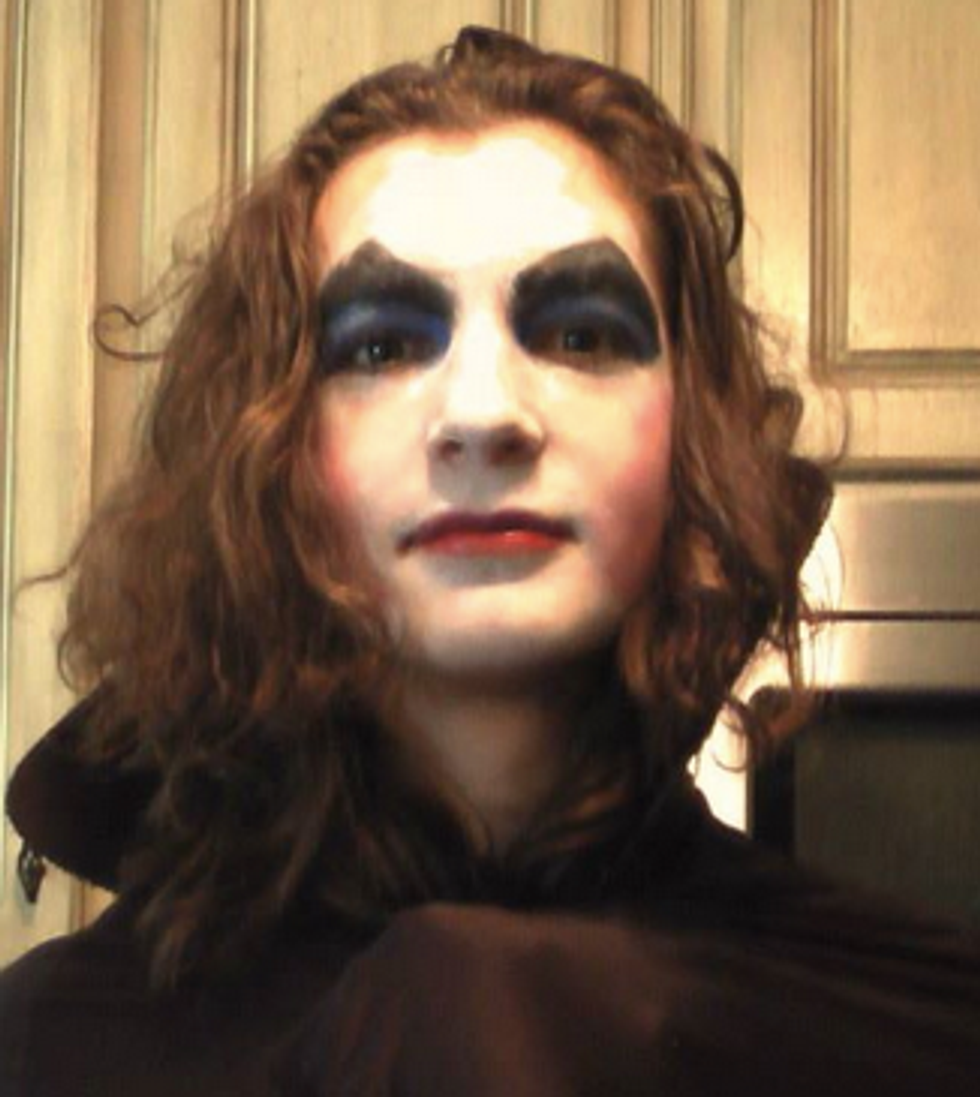
The entire month of October always leads up to the last single day, with everyone preparing accordingly. A costume could be either the goal or the method when it comes to Halloween, or simultaneously both for people who are in those in-between ages and want to go out and get candy and look good while doing so. When kids grow up, costumes become less and less a means to candy, and more and more a form of expression. Just look at a kid who dresses up as Captain Hook for their first Halloween, wearing a fragile fabric coat and shirt gotten for cheap at Party City. They grow to dress as the opposite gender just to see if anyone could tell.
No one did, by the way. It could be due to a number of reasons: for one, it was in 6th grade, and I was a late bloomer, I still had the androgynous traits of prepubescent childhood. Of course, I was also a very effeminate person in general, with long wavy hair and eyelashes that confused people about my gender regardless of my attire. I guess it only makes sense that when I went the full way, I was so convincing that no one would believe me when I said I was a boy. That was, of course, save for those who did know me. I only went through with the costume with the knowledge that I was going to trick-or-treat in another friend’s neighborhood, one where most would be unable to recognize me. Even then, of course, a handful of people still recognized me through the thinly veiled white base and black eye-liner (not exactly a full-fledged disguise). Exchanges with these people ranged from amusing to downright nasty (and marked the only time in my adolescents that I ever used a swear word).
One person was an old nemesis, a boy who I had an unfortunate history with. The interaction was such that, thinking back even now, I’m left scratching my head. He gave a double take before simply laughing, shaking his head, and saying “Fucking hell Julian.” Whether it was a compliment or insult, I will never know.
It wasn’t until sophomore year of high school that I once again attempted a less-conventional costume. I had dressed up as a “Grave Digger,” and walked around my neighborhood with a shovel and wheel barrel while shouting, “Bring out your dead!” The costume consisted of skeletal makeup and all around creepy image at first sight. Near the beginning of the night, I went with the typical "spooky scary skeleton" tactic, what most people went with during the pagan holiday. However, somewhere through the night, I decided to change it up by acting in contradiction to my appearance, and used humor heavily instead. Throughout the night, I wound up going around as a “Dead Body Collection Business” person who was trying to convince people that if they have dead bodies (or more humorously, don’t) they should give it to me. One particular instance was making a deal with the devil. The man dressed as the devil stated he only takes people’s souls, and I responded “Exactly! You take the soul, I take the body. It’s a mutually beneficial relationship! Industrialization! Collective progress!” I ended up making the man break character slightly as he giggled uncontrollably. I was far more comfortable with acting unlike myself, despite everyone there already knowing who I was.
Skip a few years into my senior year, October the first. A small reflection made me realize with small horror that that was the last year of my childhood, and thus the last year I could conveniently dress up and trick-or-treat. The idea that all my future possible Halloween costume ideas were all at an end that night was dreadful, until I realized I didn’t have to dress up just one day. I ended up using all my future Halloween costume ideas by dressing up every day of the month, calling it the "31 Days of Halloween Challenge."
My days would begin like so: wake up, scramble around the house naked looking for costume parts, put said costume together, then race out to catch my bus with a breakfast bar in my mouth. I would go to school, come back home, put some basic costume stuff together for the next day, then go to sleep. The process was so ingrained in me that putting together a complex costume took no more than 20 minutes in the morning. Unlike the typical unchanging pattern I found myself in during the school year, everyday suddenly had a different flavor to make the day a little bit more enjoyable. The costumes definitely brought a lot of attention to me. I enjoyed the attention, but most because it made me interact differently. No longer was I just slumping through each day; suddenly, I could run through the hallways, cape flowing, singing the 60s Batman theme song while dressed as Adam West, and it would feel completely justified. When people talked to me, I could build off of the confidence that I felt in the new attire to be a bit more...me.
The school, on the other hand, had different ideas. A few days into the challenge, I was lectured by my Forensics teacher for what I was doing. I was a senior, I’m an example for all the other students to look up to. What were they to think if a senior is acting the way I was? What example did I set for them? She wasn’t alone in her concerns. Faculty members kept a close eye on me at all times, making sure I kept to the rules, ready to administer punishment when I wore something not school appropriate (how dare I wear a hat to school).
This conflict reached its climax when it came time to take the senior picture. I was dressed up as the Heath Ledger Joker that day, and was thoroughly denied participation rights to be in the senior picture. The picture consisted of all the seniors lining up to make a giant “2015” for the year we were graduating. I took a picture of my face in front of all the seniors standing, then later posted it onto the school Facebook page with the captions “They told me I couldn’t be in the senior picture. I told them how I got these scars.” There was much praise and laughter.
Costumes became less of a once-a-year thing, and more of an "any special occasion" thing. When there was a chance to dress up, I would take it. Example: if it was spirit day at school, I would dress up as a literal spirit. This garnered many interesting reactions. Some hated me for it, thinking I was just a “distraction” or an attention whore, while others enjoyed it. After a certain point in time, most people were used to it, to the point where people found it unusual whenever I wasn’t in costume.
Costumes became more of a form of expression in my later years. They turned from “dressing up as someone/something other than yourself” to “dressing up differently than everyone else.” Somehow, it evolved into something central to who I was, and how I interacted with others. During senior graduation, most people had described me as “someone who isn’t afraid to be 100 percent themselves all the time,” almost always referencing my extensive costume catalog.
How something as simple as dressing up can end up defining a person, I still don’t know. However, it’s something that has ended up defining me, and becoming a central part of my identity.
















