
This semester, I am taking a course I never thought existed until I found out freshman year that Hunter College offered it. The course is called “The Vampire in Lore & Literature.” Pretty cool, right? It’s a course all about vampires: in literature, film, and in folklore. Last week, I had to watch the entirety of the film “Nosferatu,” which I was very interested in watching. Prior to college, I knew very little about “Nosferatu.” I pretty much only knew that it was the first vampire film. And, truthfully, “Nosferatu” is unlike anything I’ve ever watched and here’s what I’ve learned.
First, let’s start with some background info. “Nosferatu, eine Symphonie des Grauens” is a 1922 German Expressionist silent-horror film. It was an unauthorized adaptation of Bram Stoker’s “Dracula.” (You’ve been living under a rock if you’ve never heard of Dracula.) Because the studio could not obtain the rights to the novel, numerous names of characters and storyline details were changed. Stoker’s heirs even sued over the adaptation and a court ruling actually ordered that all of the copies of the film be destroyed. Now if that were the case, we would have never heard of “Nosferatu.”
Thus, despite the court order, a few copies of “Nosferatu” survived and the film came to be regarded as one of the most influential masterpieces of cinema. What are the odds? The English adaptation came out in 1929, and the title was translated as “Nosferatu, A Symphony of Horrors” or simply, “Nosferatu.” Both the English adaptation as well as the original German version can easily be found on YouTube, if you’d like to watch it.
I personally don’t have much experience watching silent films, because I find them difficult to watch. That was indeed the case when I started watching “Nosferatu.” There is dialogue but it’s more like the mouthing of words and you aren’t hearing any words being spoken. Due to this, it was difficult for me to comprehend everything that was going on. Every now and then, I would hear eerie sounds, which definitely built up suspense throughout the film. It also made me keep the volume lower than I usually have it. I was grateful that at least some text would appear which gave a little info on what was going on.
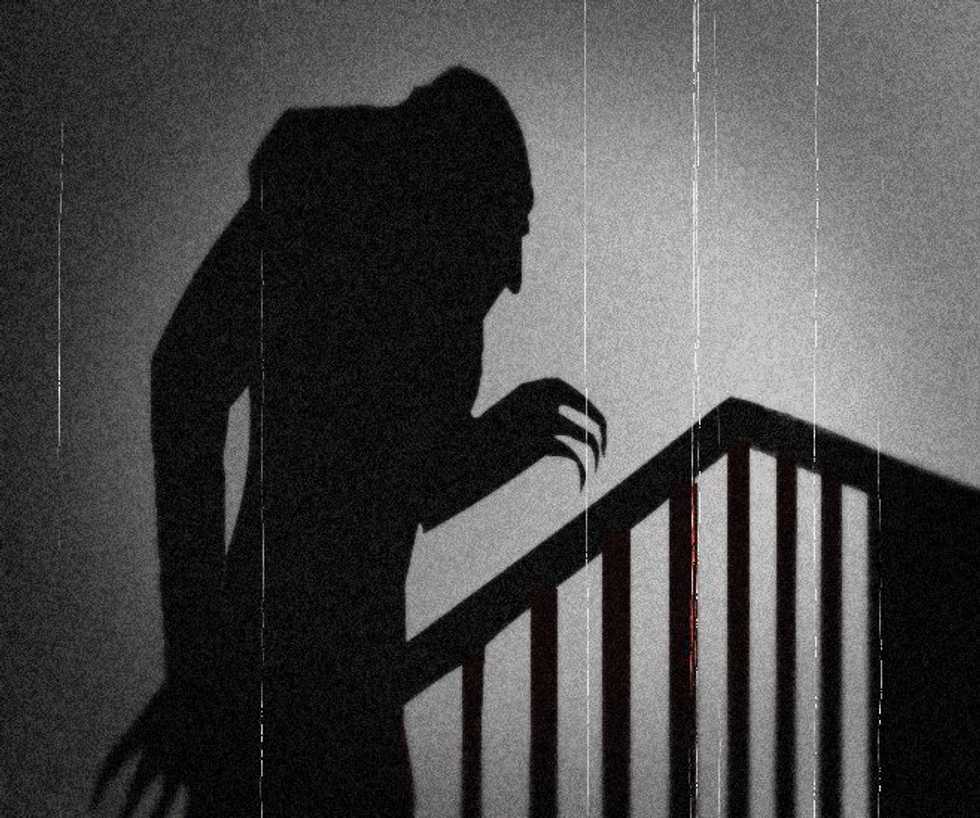
The film also is of course in black and white, and ideally it is best to watch with no lights on, which is exactly how I watched it, from beginning to end. (Afterwards, my eyes hurt like hell.) The film plays around with lighting, especially with the haunting effect of shadows. Nosferatu is unlike modern vampires who do not have a reflection in the mirror and do not have a shadow. Nosferatu is more like a phantom, a supernatural being that is closer to a ghost that can fade in and out of a room.
He is especially spooky, with his ghoulish appearance. He is very pale and has a bald head, with pointed ears, claw-like fingers, and eyes sunken into his skull. There is an iconic moment of him slowly rising up from a coffin, and that moment is unforgettable (shown below, slightly faster than the original).
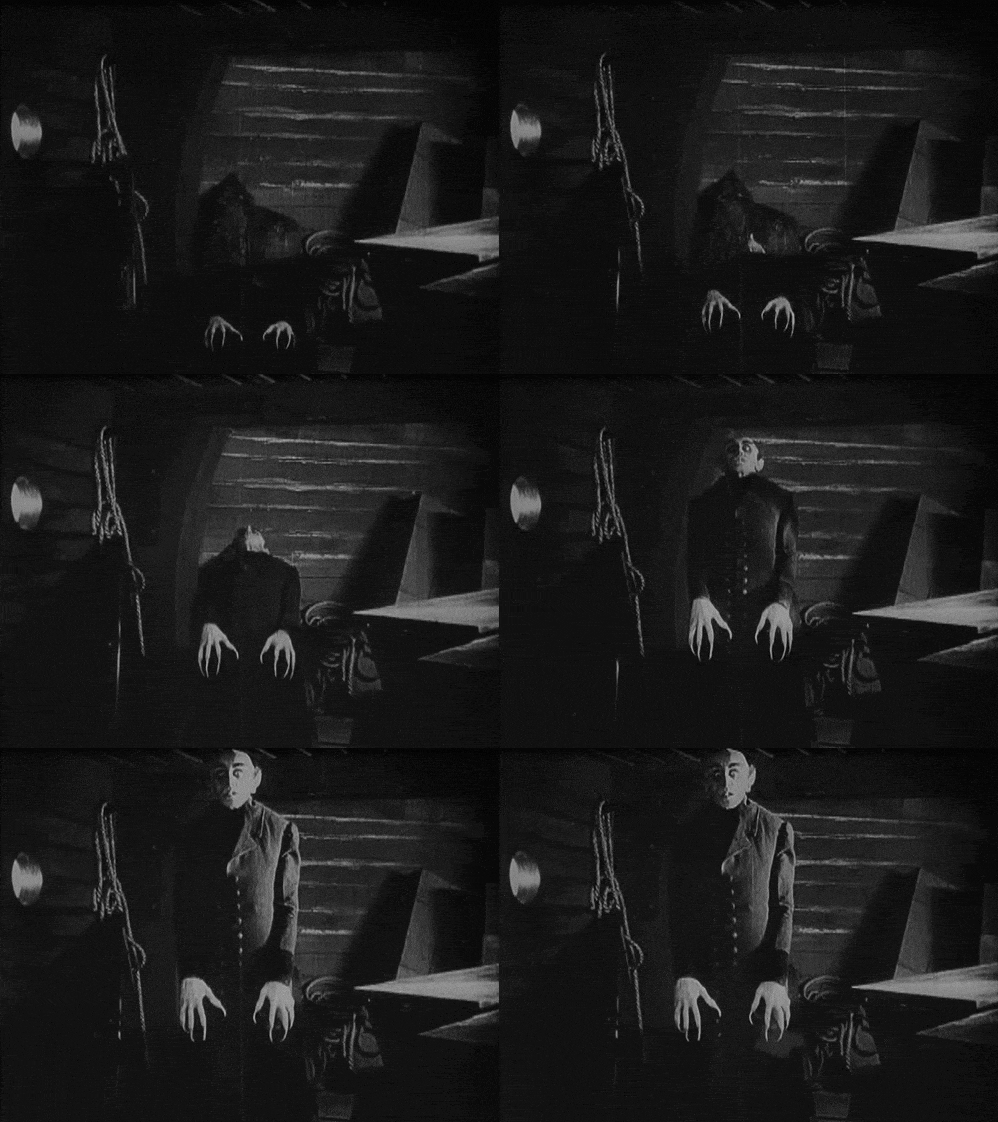
I won't retell the entire plot, but I do have to say that I was rather surprised by his behavior and overall his vampire nature. It is quite intriguing to see how different Nosferatu is from the modern manifestations of the vampire.
And, it may be just me -- but I do think Nosferatu dies way too easily at the end. (Sorry to break it to you, if you didn't know, but it's kind of obvious that he dies at the end.)
If you enjoy silent films, horror films, or anything about vampires, definitely check out "Nosferatu." I promise you won't regret it.

















