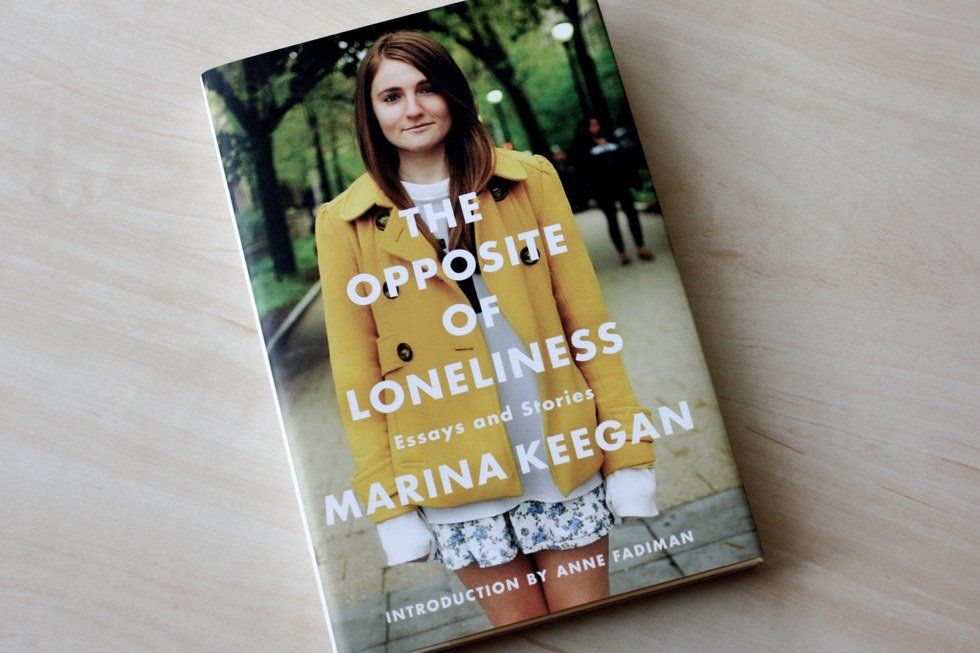
I found "The Opposite of Loneliness" at the perfect moment. It was May. I was a senior in high school, trying to deal with all the tumultuous emotions that inevitably come with leaving something really precious behind, while simultaneously trying to find the stamina to move forward into the unknown abyss of college. I couldn’t fathom the imminent train rides and thousands of miles that would separate me from my friends, leaving the classroom of the teacher who helped shape the person I was, and adapting to people, places, and perspectives that would certainly be different from the ones I occupied for the last eighteen years. Spring was quickly moving into summer and students were easily adapting to their new role as graduates, but I was perfectly content with staying exactly where I was.
Of course, I didn’t. But Marina Keegan did. Playwright, essayist, fiction writer, and soon-to-be staff for The New Yorker, Marina Keegan lost any chance of moving forward when she was tragically killed in a car accident just five days after graduating magna cum laude from Yale University. Left behind, however, was a posthumous collection of essays and short stories written during her four years at Yale—The Opposite of Loneliness—discovered just as I was about to leave my four years of high school.
“We don’t have a word for the opposite of loneliness, but if we did, I could say that’s what I want in life. What I’m grateful and thankful to have found at Yale, and what I’m scared of losing when we wake up tomorrow and leave this place.”
In her essays, Marina speaks so much of life, and ironically, of death, chronicling the fears and hopes of an existence that would follow after graduating from college. And as I lugged the book around the hallways of my high school, I thought of what those stories would mean to me. While reading her reminiscence over the memories made in her first car in “Stability in Motion,” I imagined the memories about to be made in my own first car; the tears, the laughter, the frustration, the ten-page papers, and the empty food containers that would one day make up the story of me and that car (and when I said goodbye to my first car this past month—complete with all the memories I had hoped it would contain—I thought of Marina’s story). In "Even Artichokes Have Doubts," where she contemplates the fine line between success and happiness, I thought about the personal decision I had made to take a career of happiness over one based on money, Marina’s aspiration for a life of consequence and meaning only endowing the assurance I had in the choices I was making. And when silently nodding my head over my identification with the fear she felt over leaving the solace and comfort of college in her title story, “The Opposite of Loneliness,” I thought about the prospect of leaving the consolation and home that had become high school, anxious about everything and nothing that could possibly lie ahead.
Where her essays spoke of a life to look forward to, her short stories depicted the diverse and tumultuous lives given to the people she imagined, to the people she perhaps knew. “Cold Pastoral” illustrates Claire as she contemplates all that was unsaid after the death of her it’s-complicated college boyfriend, Adam; “The Emerald City,” displays emails sent over the course of three months from William to Laura, but none from Laura to William; and “Hail, Full of Grace” follows Audrey as she reminisces over the child she gave up and the boy left behind. In every story, I found a little of myself, the people I knew, and even the people I hoped to never know.
“But it became clear very quickly that I'd underestimated how much I liked him. Not him, perhaps, but the fact that I had someone on the other end of an invisible line. Someone to update and get updates from, to inform of a comic discovery, to imagine while dancing in a lonely basement, and to return to, finally, when the music stopped.”
It’s been almost two years since I’ve read The Opposite of Loneliness—almost four since Marina died—and I’m about to complete my sophomore year of college. But when I think about this book, I’m transported back to the seventeen-year-old who was afraid to leave the past, reading the stories of someone who had so much hope for the future. Marina’s stories remind me of the person I was, the things I had hoped to do, and the places I would be. With that, I carry this book with me everywhere.