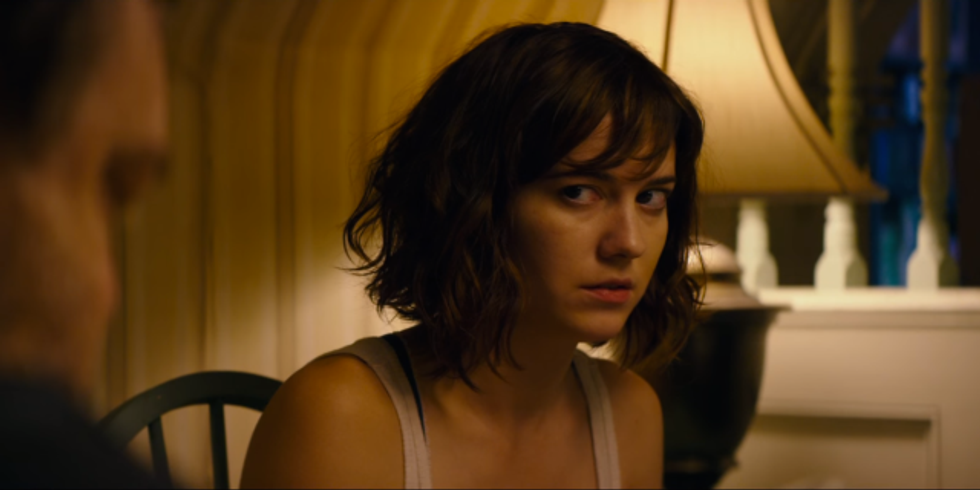
Last weekend, I had the great pleasure of viewing the latest cinematic production from Bad Robot, the seemingly next entry in a “Cloverfield” franchise, “10 Cloverfield Lane.” And while at first, I thought I might write another review to take its place among the many who are praising the film’s direction, acting and overall cinematography, I think that there is one incredibly vital aspect of the film that can serve as a guide for all of us writers who want to see better characters in fiction. Michelle (portrayed by Mary Elizabeth-Winstead, who you might remember as Ramona Flowers from “Scott Pilgrim v. The World”), the main protagonist, quite simply has an excellent arc of development over the course of the film, and not only is completely amazing, but very human. I’d attempt to preserve the important plot twists in this article, but it’s impossible to discuss what makes Michelle so compelling as a character without talking about the rest of the characters, plot and so on.
So if you haven’t already seen the film, spoilers ahead.
At the beginning, Michelle is very simple, almost barely two-dimensional. The movie starts off suddenly in media res, as she packs up quickly and drives off into the unknown, after having had a fight with her fiancé. She seems afraid, uncertain, looking over her back constantly and is as lost on the road as she is in her own life. The crash happens, and all is blackness. This is what we have to work with. Granted, the film’s opening is very compelling, as Michelle wakes up in a cell handcuffed to a bar, connected to an IV drip and her leg is broken. Thankfully, she’s clothed, and nowhere in the movie do we get a sense that she is going to be sexualized or assaulted for dramatic tension. Although I was skeptical of her agency as a character within the setting, her first instinct is to escape her cell by calling for help with her damaged iPhone (which she ingeniously retrieves by using her IV drip’s stand). She fails, but her subsequent encounters with Howard and Emmett are endlessly intriguing. She’s reasonably skeptical of Howard’s claim that there has been a chemical attack and immediately sets to devising a plan to get the keys to escape the bunker. This too, does not succeed, when she realizes that there is an actual threat outside.
Nowhere does the director make our protagonist’s mentality a consequence of the male characters’ presence, but rather we see Michelle make her own decisions and conclusions. You might think, due to the structuring of the cast, the film would fail to pass the Bechdel Test. Though it actually does, (Michelle encounters the infected woman who begs to be let into the bunker) even if it didn’t, that shouldn’t downplay the fact that Michelle isn’t at all a damsel-in-distress or another cliché thriller protagonist. At no point does she entirely trust her captor / protector Howard, and even when she realizes that she is in mortal danger despite the seeming normality at times, she is always looking for ways to escape. Although Emmett does assist her in constructing a bio-hazard suit out of a trashed shower curtain, she largely does most of the work and does end up escaping in a very innovative fashion, crawling through the vents and through an alternate exit to the outside. But it is really her Macguyver-like defeat of the alien vessel with a Molotov cocktail that cements Michelle’s sheer skills in this movie. I honestly can’t gush enough about how much I loved her development. How has she changed? What really sets Michelle aside from other characters? Well, her final decision to take a car and drive towards Houston instead of evacuating with other civilians in Baton Rouge is a pretty big deal. The time spent in the bunker has hardened her, and she’s convinced that helping the human resistance fight against the aliens is worth it.
This might all seem like a plot summary, but there are two key lessons to note here. Michelle is a whole person, with motivation and fully realized character, just like any of the male characters, if not more so. The other is that the movie doesn’t try to prop up the protagonist any more heroic than is necessary – she starts out non-committal and a bit stupid if we’re being honest. But we grow with Michelle, and by the time the aliens start spewing toxic gas and Howard’s bunker goes up in flames, we’re ready for those plot twists. We’ll take on anything with her. For those who need pointers on how to craft a well-developed female character, look no further than “10 Cloverfield Lane.”