


I remember when I was 9, after being in my first musical, I told my mother that I wanted to be an actor when I grew up. "You can't do that," she said. "Look on TV. They don't hire people that look like us to be in television shows and movies." And while what my mom was saying was part of a larger plot by South Asian parents everywhere to convince their children to become doctors and engineers, she still had a point.
In the last decade, things have gotten a lot better when it comes to Asian representation in the entertainment industry. If I want a fellow Asian person to look up to in the media, I have a lot more options than just Apu from "The Simpsons."
But while there are more a lot more Asians visible on the screen today than in the past, one problem still remains: the idea that Asian men cannot be the objects of sexual desire. Typically when Asian males are featured on television, they are portrayed as either too highly emasculated to be seriously considered as a romantic interest, or just completely asexual.
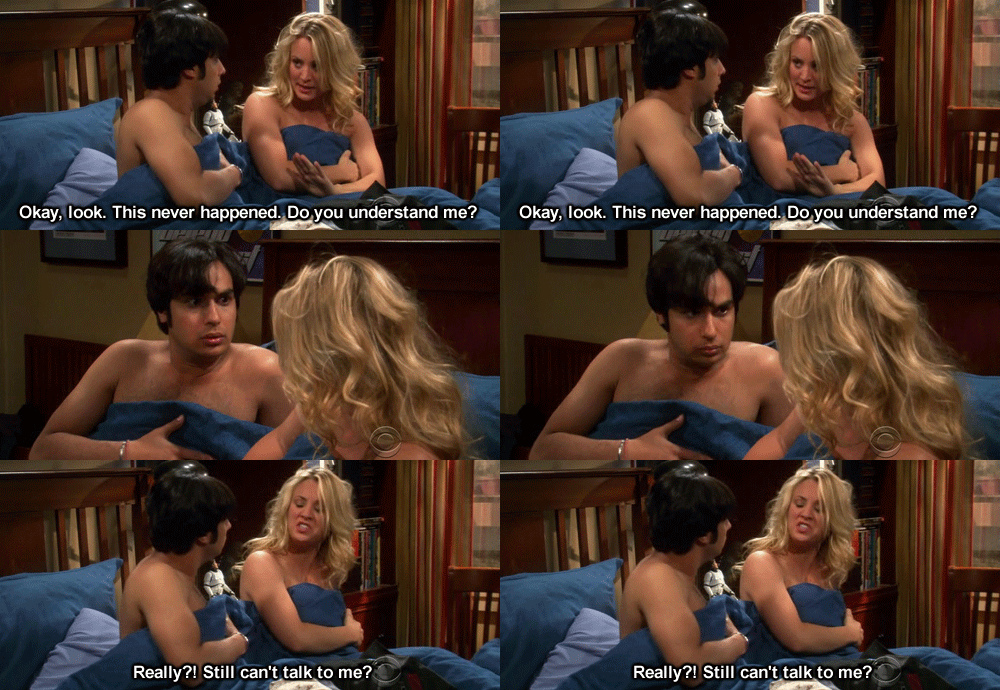
Just look at Raj from "The Big Bang Theory" or Han from "2 Broke Girls." The inability of both characters to get with women is underscored by constant jabs at their heterosexuality, which form running jokes throughout the series. In fact, even when it is implied that Raj slept with Penny during Season 4, he still finds himself unable to talk to her because she is a girl.
But why is this happening to Asian men? In a time when Priyanka Chopra's Alex Parrish can have a complicated on-again, off-again relationship with Jake McLaughlin's Ryan Booth on "Quantico," or Maggie Q's Nikita Mears can manage to score Shane West's Michael Bishop on "Nikita," why is it so hard for Asian men to find love on TV? And there have to be some examples of Asian men being in successful romantic relationships, right?
Well, it's hard to find examples of Asian men on television in explicitly romantic situations. First, you have to consider whether the relationship is used for comedic purposes, such as that of Ben Chang and Shirley from "Community." If not, then you have to consider whether the role is Asian-specific or not.
For example, it's great that Raza Jaffrey was able to play Karen Cartwright's boyfriend on the first season of "Smash." But his casting seemed due to the desire to add in a (poorly done) Bollywood number into the show rather than a need for an Asian actor. And what about big actors?
John Cho and Kal Penn have become well known enough that it's not some sort of unbelievable risk for them to be involved in romantic relationships on screen. And while it's great that Aziz Ansari's Dev Shah was coupled with Noel Wells' Rachel on "Master of None," it's important to keep in mind that he had to write that role for himself. But if you take all this into account, what does this leave us with then in terms of Asian men being the subject of sexual desire on television in recent history? Harry Shum Jr. from Fox's "Glee."

The truth is, I don't know why this trope seems to be so popular. Of course, Asian men have historically been portrayed as inferior when it comes to masculinity, especially during periods of anti-Asian sentiment in America (e.g., the Japanese in WWII, the Vietnamese during the Vietnam War, the Koreans during the Korean War).
But could these 20th-century ideas really have still carried over into the new millennium? Or perhaps producers and casting directors simply thought that shows with Asian men as romantic leads don't make money. While I suspect a mixture of both, it ultimately does not matter. Either way, it is important that as audience members we demand to see more diverse roles for Asian men, lest they continue to be type-cast into the same characters we've seen over and over again.

















