

Wednesday afternoon. I had just come back from class and settled deep into my dorm chair, ready to write my second article for Odyssey. At first, I thought I'd write a little something about Valentine's Day, but it wasn't such a pressing idea. I wanted something...substantial. With the 2016 Presidential Elections on everyone's minds, maybe a piece about good ol' Bernie Sanders? As I mulled over my options, I checked Facebook. Mindlessly scrolling through the site, I noticed something out of the corner of my eye; over in the "news" section on the top right, a headline stated something along the lines of: "NPR: Media Group Omits Israel from Map."
Roughly 130 words into this piece, and I remain no less baffled as when I first read those words.
Being Israeli has always been a source of pride for me, and while I've never been a victim of any hate crimes, it hurts me to see things like this. The image (which can be found below) is a product of freelance artist, Patric Sandri, who stated: "It was not my political intention to draw the map that way at all. I had a very short time for creating the illustration. If you work under time pressure, mistakes can happen." Perhaps if this mistake was truly due to time constraints, he'd have left the map with no label of Israel at all. However, including "Palestine" as the label is indeed another story. Sandri further explained that the NPR staff did not notice any mistakes after he submitted his work.
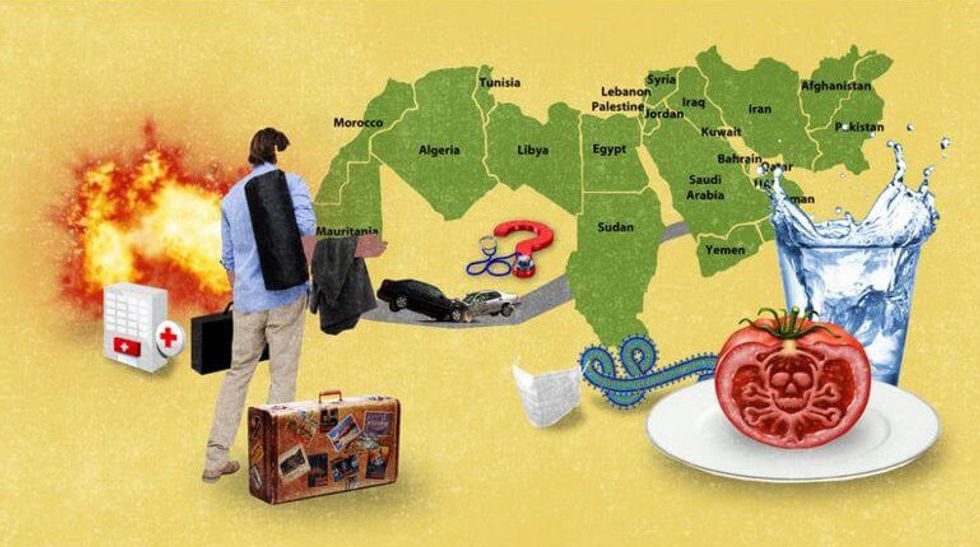
After receiving critical emails regarding the image, NPR removed it, and in its place published an editor's note that reads:
"...The map had a number of errors. The countries of Cyprus, Israel and Turkey were either not shown or not labeled; the label for 'Palestine' should have read 'Palestinian territories'; and Afghanistan and Pakistan were mistakenly included. NPR apologizes for these errors."
So while NPR recognized the plethora of other errors littered within this map, notice that they remained adamant on Israel's labeling. Perhaps this is why, as Sandri stated, the NPR staff hadn't noticed any errors after he submitted the image: to them, the difference between Israel and Palestine is not a mistake based on a mere word so much as one rooted in their political beliefs.
But Why?
NPR's article reminded me of conversations I had with people during Israel's Operation Protective Edge, where many of my friends who knew my nationality wanted to hear what I had to say about Israel's war crimes (more on that below). Was a Palestinian state justified?
The 2014 Israel-Gaza Conflict, also known as Operation Protective Edge, was a military operation launched by Israel on July 8, 2014, in the Hamas-ruled Gaza Strip. It was the result of Hamas rocket attacks which targeted Israeli cities and infrastructure, resulting in the retaliation of Israel in the form of numerous airstrikes as well as invasion. The Palestinian rocket attacks and the ground fighting resulted in the death of thousands of people, including many Gazans. More specifically, 66 soldiers and six civilians were killed, along with 469 soldiers and 87 civilians wounded. In dire contrast, the UN Human Rights Committee reported 2,251 Gazan casualties, with a massive 65 percent of that number constituting civilians.
No doubt the difference between either side is alarming. More than that, it makes Israel look like a villain. Albeit the statistics above represent merely a single instance of what might encourage an opinionated news station like NPR to not include Israel on a map, this conflict comes most recently to mind. So, could I blame people for questioning Israel's legitimacy? What kind of democratic country kills innocent citizens? Sadly, such questions arise from misconceptions created by the media. Allow me to elaborate:
During the 50 days of conflict when 4,594 rockets and mortars were fired at Israeli targets, Iron Dome systems intercepted 735 projectiles that it determined were threatening, achieving an intercept success rate of 90 percent. This explains the skewed death tolls from Operation Protective Edge. Israel's short-range air defense system prevented nearly a thousand successful rocket strikes by Hamas.
Moreover, NPR—interestingly enough—had reported that thousands of people fled a border town in the Gaza Strip after Israel dropped leaflets warning of an imminent strike on a Hamas rocket-launching site which was embedded within civilian living areas. This was a common practice by the IDF (Israeli Defense Forces) amid speculations that Hamas was using Gazan civilians as "human shields" to prevent Israel from destroying their rockets.
This instance proves that merely looking at the death toll doesn't always tell the whole story.
Advocating For Awareness
The last thing I want to do is undermine the deaths of the Gazans. The last thing I want to say is that Israeli leaders were totally and utterly just in their actions and that it's not "our" fault that we have such advanced technologies as the Iron Dome protecting us from rocket fire. I vividly recall my mother crying softly as she watched news of more and more Israeli soldiers—aged 19, 20 at the most—dead every single day for nearly eight weeks. As such, I can only imagine the pain that Gazan families felt. The ugly reality is that in war, there are no winners.
I believe that as consumers of mass media it is important for us to be aware that we may not always see the full scope of a story. Question what you see—or as with the narrative between Israel and NPR—what you don't. Do some research.
And most importantly, stand up for what you believe in.