The Middle East region is no stranger to war -- it is perhaps the most fought-over portion of the earth in history. An eternal frontier of empires, the tract that stretches between Anatolia and the Fertile Crescent has served as a stage of the most tragic of historical drama: the slaughters at the hands of the Assyrians; the razing by the Mongols; the cleansing of 1.5 million Armenians; the forced migrations of the Kurds; the fatal incompetence of the British and French.
In the first decade and a half of the 21st century, we have seen an intensification of these conflicts -- aided by the outside meddling of Western powers -- in the Arab world, and in particular Iraq and Syria. What we have now, as a result of this, is a refugee crisis such that the world has never seen.
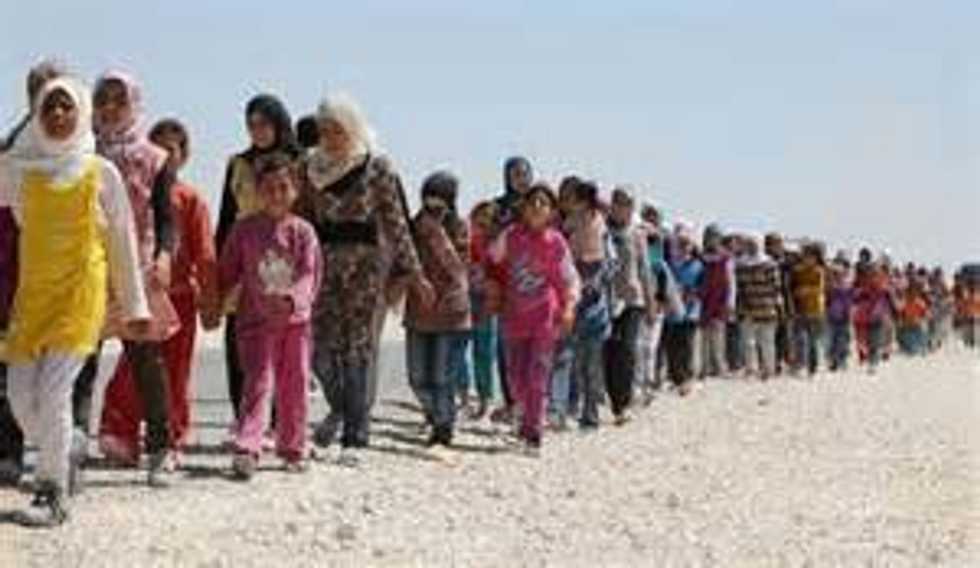
The UNHCR set the number of people forcibly displaced in 2014 at 59.5 million. Globally, one in every 122 humans is now either a refugee, internally displaced, or seeking asylum. In its annual Global Trends Report, the UNHCR detailed how in region after region, the number of refugees and internally displaced people is on the rise. In the past five years, at least 15 conflicts have erupted or reignited: eight in Africa (Côte d'Ivoire, Central African Republic, Libya, Mali, northeastern Nigeria, Democratic Republic of Congo, South Sudan, and this year in Burundi); three in the Middle East (Syria, Iraq, and Yemen); one in Europe (Ukraine); and three in Asia (Kyrgyzstan, and in several areas of Myanmar and Pakistan). Over 50 percent of refugees are children.
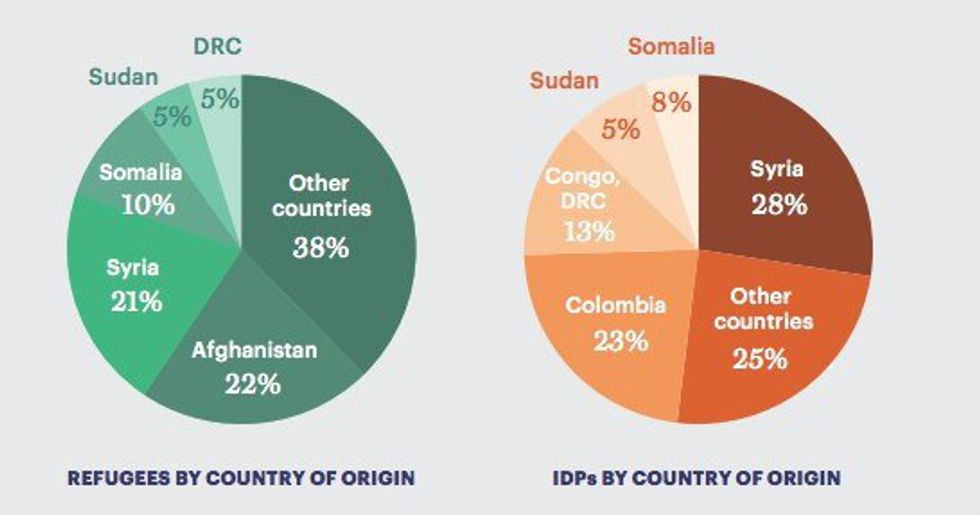
The largest contributing population, at 3.88 million, comes from Syria. (Doubtless this number has risen since recorded.) This is unsurprising, given the destruction of homes and lives that the civil war has produced. Assad barrel-bombs cities known as rebel strongholds. ISIS capitalizes on instability by taking forcible hold of regions like Raqqa. Outside powers like France, Russia, and the U.S. conduct bombing campaigns to promote their own interests, knocking out valuable infrastructure like water treatment plants and electrical grids.
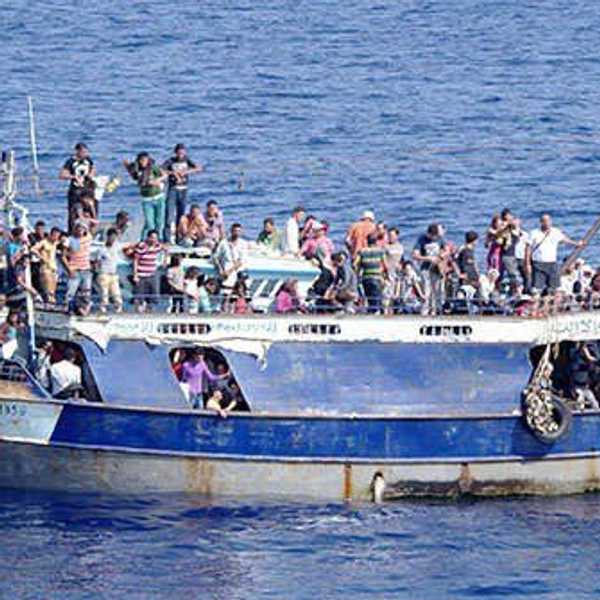
So Syrians leave their homeland in droves. And they begin to arrive on the shores of Europe by rubber dinghies -- mostly in Greece (728,910 in 2015) and Italy (144,000).
The countries of the E.U. are infinitely more hospitable, but refugees’ arrivals are not met with the cheery demeanor of concierge states. In fact, what these soldiers of misfortune encounter is more persecution, more fear, more opprobrium. Hungary erected razor-wire fences on its borders and passed legislation making illegal border crossing a crime punishable by up to five years prison. Macedonia has begun construction of its own wall. Slovakia has claimed it cannot take in non-Christians because they “have no mosques.” Anti-immigrant, fascistic rallies are held across Europe, from Germany to France, as scare tactics to ward off refugees who are depicted by politicians as “swarms” and “hordes” -- suggesting an invasion of multitudes more insect than human.
This type of rhetoric has direct parallels in the discussion of Jewish refugees in the years preceding World War II and the Holocaust. High Commissioner for Human Rights Zeid Ra’ad Al Hussein commented that the sort of language being used echoes that of the 1983 Evian conference, where countries like the U.S. and U.K. refused to take in substantial numbers of Jewish refugees on the grounds that they would destabilize their societies and hamper their economies.
“If you just look back to the Evian conference and read through the intergovernmental discussion, you will see that there were things that were said that were very similar. If we cannot forecast the future, at least we have the past as a guide that should wisen us, alert us to the dangers of using that rhetoric.”
The cyclical nature of history presents itself. Europe seems to be the same tinderbox it was less than a hundred years ago, and the tension is palpable. Speaking of coming full circle, much of this refugee crisis is merely the chicken coming home to roost. Most of the countries that supply the refugees are ex-colonies whose histories have been mired in violence and instability since their inception. Most significantly (at least to European powers) is the historical involvement in the Levant. The French and British Sykes-Picot agreement in 1916 that arbitrarily divided up the region without thought given to tribal lines, religious sectarianism or previous claims to territorial ownership. As a result, the twin forces of nationalist dictatorships and oppressive Islamist states developed out of the instability and sense of Arab grievance. Many of these governments persisted under the aegis of Western powers, and in 2011 the widespread attempt to overthrow these institutions known as the “Arab Spring” mostly failed, sending the Arab world back into chaos.
We in the West will continue to suffer from blunders such as these (and more recent ones like the Iraqi invasion), just as the people who reside there do. Ultimately, they are in different ways; our sufferings are more likely to be collateral or retributive, whereas a Middle Easterner’s will be much more poignant and direct. Nevertheless, we should not allow our ideologies and emotions cloud our judgment. Humanitarian concerns untouched, it still is logical to take in the disaffected and downtrodden refugees: While taking prospective members from the ranks of terrorism, it also helps stabilize relations with Muslims, showing the meaning of our professed values.