A.J. Heschel, one of the leading Jewish theologians and experts on the prophetic texts of the Old Testament, wrote in his book, "I Asked for Wonder,"
"We worry a great deal about the problem of church and state. Now what about the church and God? Sometimes, there seems to be a greater separation between the church and God than between the church and state."
As I read through Jonah today a seed was planted - and just now, as of this writing, it came to fruition. The seed bore fruit, and the fruit is this: Heschel is right.
We aim for Christian ends, as a church body. We want to see people behave righteously, usually, and we want everyone to be Christian. In that end, our goal and God's are very similar. However, I am ashamed to write, I think we look much more like the nations of this world than the kingdom of God.
We use the weapons of this world to try and enforce the spiritual renewing of the mind which can come only from above. We do our best to legislate morality in the public sector, to ban any kind of private iniquity while our lives simply don't match up to the rules we enact. Our stances on behavior are well-known, not because having those standards is wrong (far from it: woe be to us if they ever grow lax!), but because we begin our dialogue with them. In our politics, our relationships, and our minds we have learned what the world is supposed to look like, but not how to get there.
So we're making it up as we go! We have tried scientific study on the best way to make the vision of the Bible come alive. We have asked psychology how our minds work, and tried to discipline them with the latest tips and tricks to obey our vision of the will of God. We use the immense powers of the government to mandate away the kinds of behaviors we don't want to see in Christians, so that everyone will behave like the redeemed. We have turned to logic and philosophy, sociology and statistics, anything that will help us accomplish our goals.
It is here that I want to charge us with error: We have read the Bible to find out what is wrong with the world, and we have then picked up the systems that came out of that brokenness and tried to fix them. God has given us the tools to get there as well, and told us our methodology; let us not throw off the support of his ordinance with the crutch of our own understanding.
Do you want society to be more Christian? Express the commandments and principles which God has asked you to model.
God has commanded you not to steal? Leave it to the state to determine what is stealing, and whether they will punish it. Simply make a point not to steal from the state by committing tax fraud.
God has commanded you not to have any other god? Don't outlaw members of another faith - merely be on guard not to, in time, worship the gods of your nation, whether they be power, or freedom, or money, or national identity; party, creed, or any other created thing. In the ancient world, the bull symbolized power and wealth, and so one would make a golden bull and call it master. Today, the gun and the dollar hold the same function, yet we glorify the gun and build shrines to them in our houses, and we glorify the dollar and give sacrifices to financial security in the form of innumerable savings accounts and bonds. Is this not worship? What have you given away, and what have you kept for yourself?
Has the Father commanded you to work? Then do not outlaw laziness - model humble and diligent service, and do not grow prideful from it, lest God topple the works you do and hand them to another.
Let me tell you what I saw in Jonah:
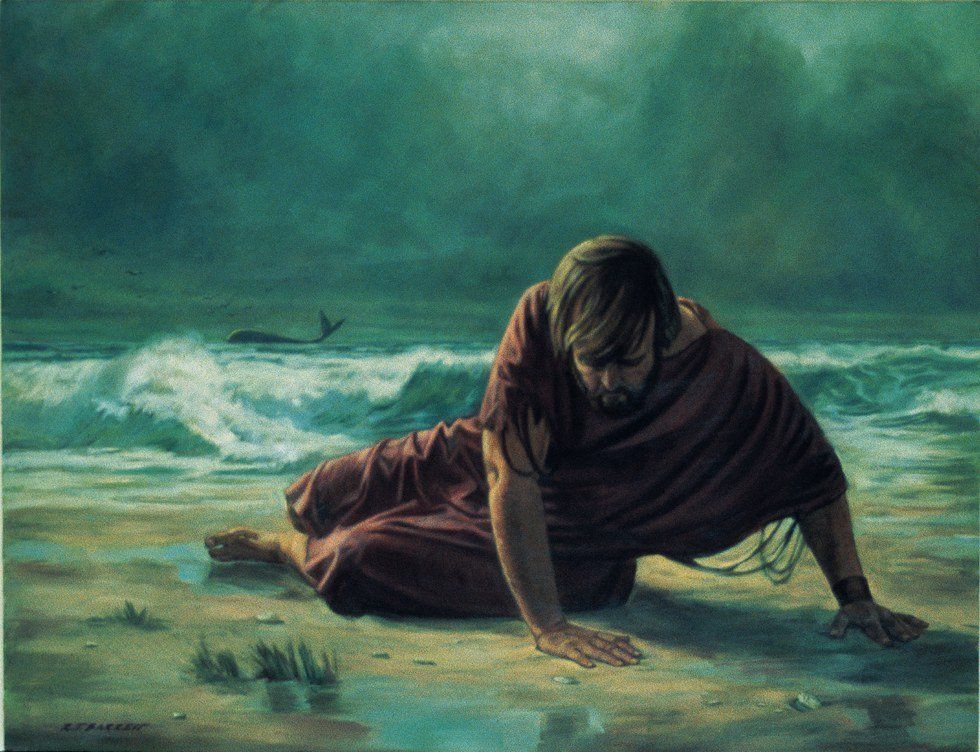
A man, a true prophet, is called to preach for repentance and love. He knows that God will save the people who he preaches to, and he doesn't want them saved, so he tells God that he would rather die and flees to the sea. God spares his life, and using him, spares Nineveh's. Five words in the Hebrew out of his mouth, spoken to a third of the most wicked city on the planet, and the whole place turns to the Lord. Then Jonah, horrendously upset that God has done this, sits on a hill and grows bitterly upset that Nineveh will not be destroyed.
Now, to be fair, the Ninevites were wicked beyond imagining. In my readings through the NIV Application Commentary, I learned that the Assyrians built an empire of fear and carved into stone monoliths description of the various tortures and mutilations they used, because they were intensely proud of them. They would skin people alive and stitch the skins together over mounds of the carcasses of their enemies, and mount eight heads at a time onto pikes. They make ISIS look good.
Yet, God says that the Ninevites don't know their right hand from their left, and he will spare them with their cattle, who have certainly done no wrong. He chastises Jonah for choosing the comfort of the shade God has provided over the lives of the people God wishes to spare.
God wishes to spare our enemies as well - but if we do not spare them, as his ambassadors, they will never know that. A major theme in Jonah's book is that Jonah knows that God's steadfast love, as he says in chapter 4, is everlasting and will extend to all who repent - yet he does not share that message, and he is not willing to be an example of it. The Ninevites and the sailors only hoped that God was merciful, but they received God's mercy, and Jonah, his rebuke. He is left the antagonist at the end of the story, not Nineveh, and God, as always, is the hero.
Jonah's sin was this: he wanted to create a world where violence and evil didn't happen, a goal we can all get behind. But he wanted God to make that world through violence and disaster. The Hebrew word for evil and disaster are the same: r'a, a common double meaning used throughout Jonah. God wanted repentance from Jonah as well as the Ninevites, and Jonah, wanting the world to look like he imagined God's kingdom should, was unwilling to do what God had asked. So, in God's words, the last verses of Jonah:
"You pity the plant, for which you did not labor, nor did you make it grow, which came into being in a night and perished in a night. And should not I pity Nineveh, that great city, in which there are more than 120,000 persons who do not know their right hand from their left, and also much cattle?"
Christians, we pity ourselves, and try to enforce our will on the world, though we are but a vapor in the wind while we are here; should not God pity our enemies, who are denied the witness of what God's love looks like for all eternity because we never show them?