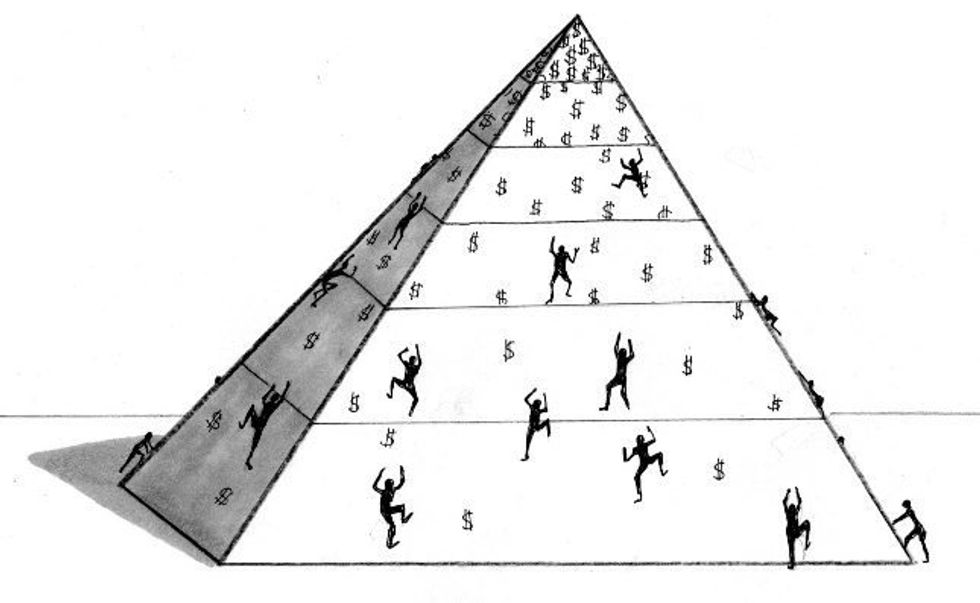
The HOPE scholarship is great. It really makes the difference between me being able to go to the number one school in the world for my degree and not being able to. It allows tens of thousands of Georgia students to pursue their dreams for reduced or little cost. But there are flaws with it. Flaws that are representative of the flaws within the entire financial system in this country.
College costs a lot of money. Between tuition, room and board, food, and fees, GT costs roughly 25,000 a year to attend, and that's in-state. I can't even imagine being out of state. Some parties seek to lessen this financial burden on students by ''making college free.'' And if their system truly made it free, it would work. But there is a saying in economics: "There is no such thing as a free lunch." There is no such thing as free. Someone has to foot the bill. Free things at career fairs are paid for by the company. Free food is paid for by the restaurant. "Free" college would be paid for by the government, and therefore, the burden would be transferred from students and their parents... to students and their parents.
Where does the government's money come from? It doesn't just appear. It comes from taxes, mainly income taxes. And where do these income taxes come from? Well, due to our flawed progressive income tax system, the bulk of the government's money, and, therefore, this free money, is sapped from America's middle class. This silent majority is in the awkward middle tax bracket. They are too rich to be able to qualify for grants from the government and too poor relatively to be able to send their kids to college with little to no burden.
And if someone succeeds financially, they are artificially leveled by the government in order to support people they have never met and will never have any interaction with. Yes, some people are born with natural advantages, such as strong financial backgrounds. But the majority of people who are middle class or relatively well off are there from either a worthwhile university degree, a trade skill, entrepreneurial spirit/skills, or some other self-elevating merit.
The myth that every person who makes more than $60,000 got there mostly by natural advantage is not only asinine but also plain insulting. As someone who is going to university to work in the STEM field, this is to say that I got where I am today mostly due to outside forces, not by my own merit. And yes, I was born with advantages. I'm from a middle-class family in a decent school district. But these advantages were created by my parents, who both work incredibly hard and have STEM degrees at worthwhile universities.
The second issue with this idea of free college is that it is universal. No matter the university or major, you get to study off of the backs of others. It doesn't matter if you're at MIT studying STEM or at a community college getting an English degree — it's free. And I simply don't agree with that. Why should the people of this glorious country be forced by the government to pay for someone that's just reinforcing a cyclical career choice?
Something like an English or History degree, especially at a sub-par or mediocre school, is just reinforcing the existence of these degrees, as the only thing you can do with them is teach. And yes, we need teachers. My father is a teacher. So perhaps an English degree at an Ivy league is worthwhile for the people to pay for if the idea of government-paid-for university is being considered. But honestly, if it's not a STEM degree, I cannot find any argument for forcing people to pay for it, unless it's from a top tier school. The argument against this is that college is a right, not a privilege you have to achieve. But it simply isn't, and I'll explain why below.
Most people aren't meant for college. There will always be the working underclass. There have to be construction workers, maids and tradesmen. And there's nothing wrong with these career choices. They are contributors to society, and that's okay in my book. But this is why trade schools exist: for people interested in a skill or perhaps not meant for academia. Many countries in the East have a system just for that reason, which the US is in dire need of adopting. In Japan, every student takes a battery of tests at the end of each schooling period (grade school, middle school, high school.) These tests determine what school they go to, and ultimately their career choice. This meritocracy in the purest form filters out people who are simply not meant for university. Instead, they are pushed towards trade school, where they can learn a valuable skill and contribute to society.
My brother is a welder. He is going to make more than I will when I get out of university. He is going to contribute to and be a valuable member of society. I'm incredibly proud of him and respect him, along with all the men and women that go into these fields. They can do so many amazing things that I never will be able to. Nurses, welders, plumbers, electricians, etc. The world needs these people. And filtering people to these fields is objectively the best practice in existence. Hell, a welder in South Dakota makes six figures. Plumbers get paid 100 dollars an hour. There's so much merit in these fields. So believe me when I say that these worthwhile fields are just as valid as a university degree in a STEM field. And for the majority of the population, this is the most valuable and respectable pathway for them.
So yes, I can say I believe in government assistance with college tuition. But not assistance to people who are not pursuing STEM degrees, and especially not people who are not pursuing STEM degrees at sub-par schools. This country desperately needs to adopt this system of meritocracy, as it will allow us to rise as a nation, much like Booker T. Washington and other envisioned so long ago. Self-elevation is the only way.