


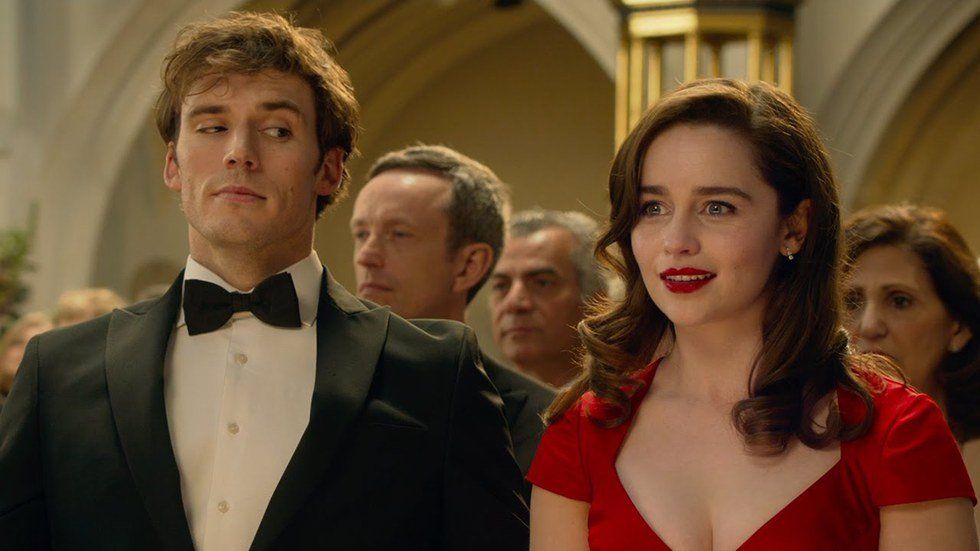
Recently, I went to the movie theater to see “Me Before You” with my friends. Now, I have never read the book this movie is based off of. Some of you might be gasping at the fact that I saw the movie before I read the book, but I’m sorry. It happens to the best of us. Taking out the book factor, multiple qualities about this movie piqued my interest.
The first quality:
One of the main characters is disabled. As a disabled person myself, I am always eager and curious to see how disability is represented when it is present in films.
The second quality:
The presence of a relationship between an able-bodied person and a disabled person. This ties with the first quality, but I also grew up witnessing a similar relationship between my parents (my dad being in wheelchair, like myself.)
The third quality:
This one is not as important as the first two. I’m merely just a sucker for romantic movies.
Prior to viewing this movie I thought “Hey, let’s see what the reviews are like” and boy, did I learn a lot.
Before I dive into this review I want to make a few things clear.
As I mentioned before, I did not read the book. Please know that this review is purely off the screen adaptation and the articles that I have read. I am completely aware that the screen adaption most likely left out details and situations that the book contained.
Since this is a review, know that this article will contain spoilers. If you have not seen the movie, or have not read the book, I would stop reading now while it is safe.
Lastly, though I am disabled, my disability is a lot different from the main character’s. The reason I am letting this be known is that my knowledge is limited on his disability. My goal here is to not spread misinformation or misrepresent those who do have the same disability as the character.
OK, now that that’s been said, let’s dive in shall we?
“Me Before You” focuses around two characters, Lou Clark and Will Traynor. These two characters meet when Clark applies for the position of being Will’s caretaker. Will, a wealthy young businessmen, has previously been in an accident leaving him paralyzed. Due to this accident, Will’s life is completely altered. For 30+ years he lived an adventurous life, filled with riches and independence.
Though Will is disabled, that does not mean he cannot continue to live an adventurous, fulfilled life. However, Will struggles with that realization and his decision on how to handle his new life comes as a shock to many.
When Lou and Will finally begin to hit it off in the film, Lou quickly learns that Will is choosing to end his own life. Yep, that’s right. This movie focuses on legal suicide assist. Instantly, this can become an uncomfortable topic for people. A heavy topic as well. But, it is something that exists.
Finding out that Will gave his parents six months to change his mind, Lou takes it on herself to show Will that he can still live a happy life. If you pay attention to Lou’s research montage, you can see she looks up sports that disabled people can play, as well as trips, concerts and so on that Will can experience.
For the rest of those six months, Will and Lou create wonderful memories with each other and Will, a dark, sarcastic character, seems to be in a brighter mood. However, despite his smiles and the love that has blossomed between him and Lou, Will still stands with his decision. He wants to die.
Will’s unchangeable decision, brings on fury from disabled activists. Reading an article by The Guardian, activists feel that this movie is presenting the thought that being dead is better than being disabled. Tweets have been written expressing that viewers are tired of seeing disabled people killed off, that they have the same disability has Will, but are living boldly.
I completely understand the anger behind these tweets and activists. “Me Before You” is not the first movie where a disabled person wants to choose death over living life with a disability (i.e. "Whose Life Is It Anyway?). With that situation being portrayed multiple times in the film world, you have to wonder what kind of message is being spread to the disabled and non-disabled communities.
Though, I can see why activists are angry, I am not personally offended by the movie. If anything I’m more personally offended by Hollywood, and their decision to keep promoting this message in their films.
Towards the end of Will’s six months, he lets Lou know that he’s aware of the life he can live. He understands that he can live a good life with Lou, that it’s fully possibly. Will still does not want that life, because at the end of the day he doesn’t believe it is his.
This realization is what prevents me from being fully upset with this film. I don’t see Will as a poster image for the disabled community. He’s someone that has made a sound decision that no one could change.
Like The Guardian suggested, maybe he should’ve talked to a psychiatrist before making this decision. Maybe he needed more examples. However, there’s a part of me that knows that I can not relate to Will’s mindset. There’s a part of me that knows no one can tell this character how to feel.
There’s been cases where people have made the decision like Will has. For example, "The Sea Inside" is based on the true story of Ramón Sampedro, who fights for his right to die. As I stated before, it’s a heavy topic. It can be hard to understand; especially if you’re an outsider looking in.
On the flip side, people in similar positions as Will or Ramón Sampedro have and do pick the choice to live. That realization to live that full life is present and obtainable and they go for it.
At the end of the day, what I take away from this movie and from the activists, is that there needs to be better representation of the disabled community in films.
Yes, “Me Before You” is not the first movie to focus on this situation. Yes, I said that real life cases of assisted suicide exist. Still, that does not mean that this message, this image, needs to keep being used to represent the disabled community.
We can live fulfilled lives! We can live boldly! We can go on adventures, fall in love, go to college, raise families, we can do anything we set our minds to! Show that image of us in films. Show us laughing, working, and being parents. Show us being successful. Most importantly, show us in a positive light where we’re not solely being used to inspire able-bodied people.















