
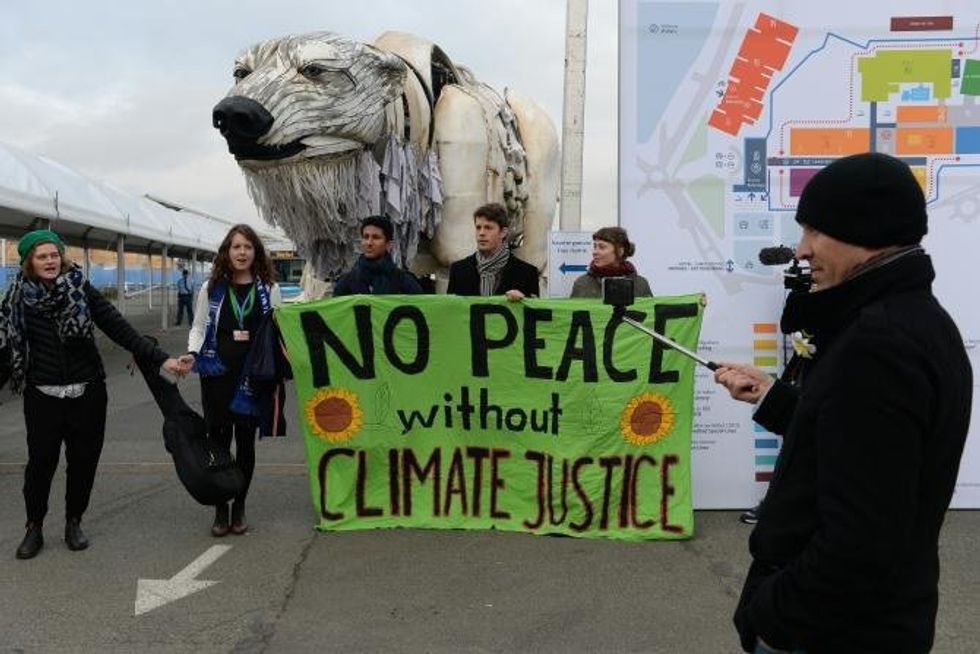
Over the last weekend, basically every country in the world reached a fairly groundbreaking climate deal in Paris at the United Nations climate change conference, after world leaders have been trying to shake on a climate deal for decades. Regardless of any controversy, if you have eyes and a sentient brain, it really is pretty obvious that earth has been feeling the effects of global warming and climate change, mostly exhibited through increasingly warmer winters, rising sea levels, and droughts, over the past ten years. So this conference has been sort of a long time coming.
The UN agreement included 185 countries whose purpose is to cut greenhouse gas emissions and to keep global temperatures under the microscope henceforth, along with a pledge of $100 billion a year to help developing countries meet their climate-focused goals. Furthermore, it is finally putting a spotlight on the negatives of the fossil fuel era, since the primary source of these emissions into our atmosphere are coal, oil, and gas.
On many counts, the agreement is extremely positive since the world, as a whole, is finally taking some action to lower the chances of ecological collapse. President Obama called the deal "the most ambitious climate change agreement in history," and he's right, as it's also one of the most far-reaching and team-oriented efforts possibly ever, from a political standpoint. Meanwhile, the GOP is worried about how many jobs will get cut in industries such as coal, with some members unsure how much human activity really influences global warming. Furthermore, if a Republican wins the election, there is a possibility the recent agreement could be reversed, but enough about that.
What's good about this agreement? Well obviously, this is the first time that many developing countries have pledged to cut emissions. It's a big deal since, in the past, many of them have been reluctant to make any constructive changes, despite many of them being hit hardest by natural disasters that have been pretty much directly caused by climate change. Additionally and ideally, the agreement really could result in less carbon pollution and more jobs, and thus general positive economic growth, driven by low-carbon and green investments.
What's bad? To begin with, the agreement is pretty vague, and there is little way to know whether it's enough to reverse damage that could cause an insurmountable crisis years ahead. Also, we really can feel the environment damage now, as 2015 is predicted to be the warmest winter on record. Responses on social media have been varying, but a common theme I've been seeing is "the world is ending and this is our fault!!!" However, I'd like to take the time to address that: though we humans could probably all be doing more to live a greener life (reduce, reuse, recycle), this overwhelming climate change cannot really be attributed to an individualized fault. What's most contributed to such drastic climate change is large corporations continuallyy drilling off-shore and doing God-knows-what for fossil fuels with little to no concern for the environment and receiving a get-out-of-jail free card for it. The agreement offers a chance to "balance" human emissions with "sinks," such as new trees, but new trees really aren't going to reverse a ton of damage.
However, as reported by NBC, the bulk of this "beautiful" and "historic" agreement is really just a foundation for the world's future environmental action, so how this manifests in the long-run is yet to be seen. So fingers crossed for success and lots of hope that this isn't just for show.