

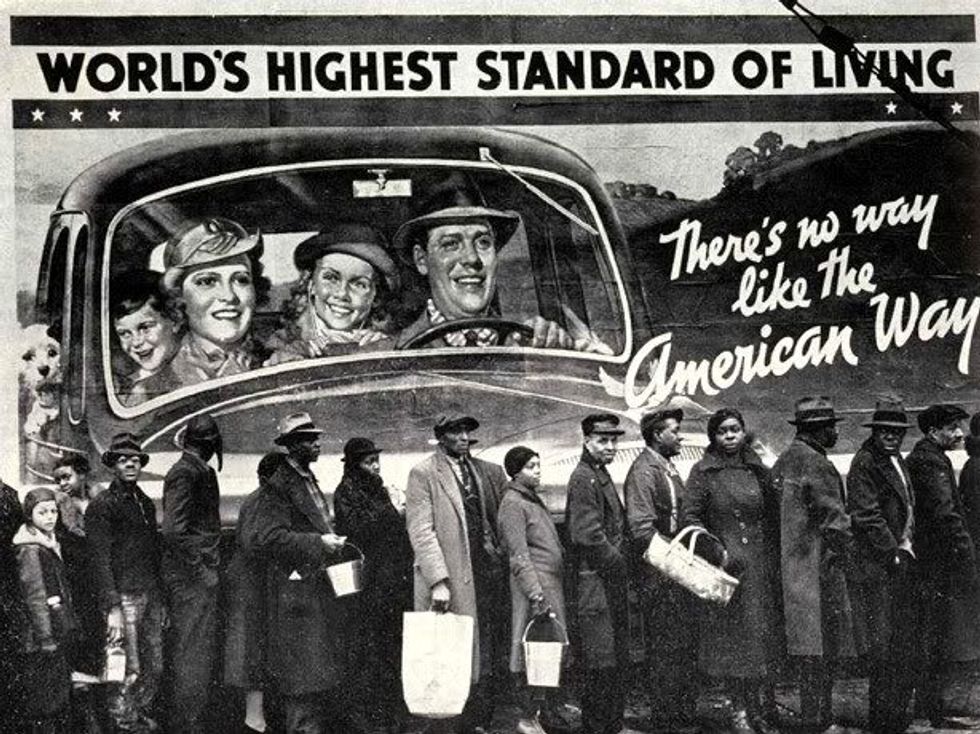
In his historical, individualist, idealist approach to examining how religion (Protestantism) influenced modern capitalism, Max Weber concludes that the underlying ideology of the economic system, as held by Benjamin Franklin, is to increase one’s wealth at all costs: “a duty of the individual of the increase of his capital, which is assumed as an end in itself” (Weber, 1905). In short, hard work is its own reward; there is no end goal. This is a variation on the Protestant work ethic, dispelling the idea of salvation from amassing wealth as proposed by Richard Baxter. Benjamin Franklin also believed that “any man can earn prosperity, economic security, and community respect through hard work and honest dealings with others” (“Franklin and the American Dream,” n.d.). This, of course, is the idea of the American Dream, something that arose from the systems of liberty and capitalism that the United States was founded upon. However, many American authors, particularly those in the 20th century, believed that such a thing—or parts of it, at least—was unattainable, the sham of the American Dream only reinforcing the “Spirit of Capitalism”: money is the only tangible thing to be reaped from hard work, everything else is just an illusion.
There is perhaps no greater apocryphal ideal the in the United States than the concept of the American Dream. Although the term is associated with Benjamin Franklin’s autobiography, it gained prominence thanks to the writings of a certain individual. Since 1867, Horatio Alger was convincing his fellow countrymen that hard work and perseverance would lead to riches and success, regardless of class or background. While Alger wrote more than 100 stories, but those involving Ragged Dick are his most famous because they contained the notion of the “Self-Made Man.” In this “rags-to-riches” bildungsroman, the character escapes poverty and gained middle class respectability in New York during the late-19th century. “The Alger hero [became a] synonym for spectacular rise to fame and wealth" (ChemKnitsBlog2, n.d.) is an effective summary of the writer’s impact on popular U.S. culture.
It was especially pertinent for the influx of immigrants arriving in the country with nothing to their names. During 1870 and 1900 almost 12 million came to America from Germany, Ireland, and England in search of better lives. However, many employers would take advantage of them, paying them less than the average worker (Library of Congress, n.d.). In addition, social tensions would arise between newcomers and Americans. The promise that things could get better would seem like a godsend, especially coming off the Industrial Revolution, which had made multi-millionaires out of Carnegie, Vanderbilt, Morgan, and Rockefeller.