

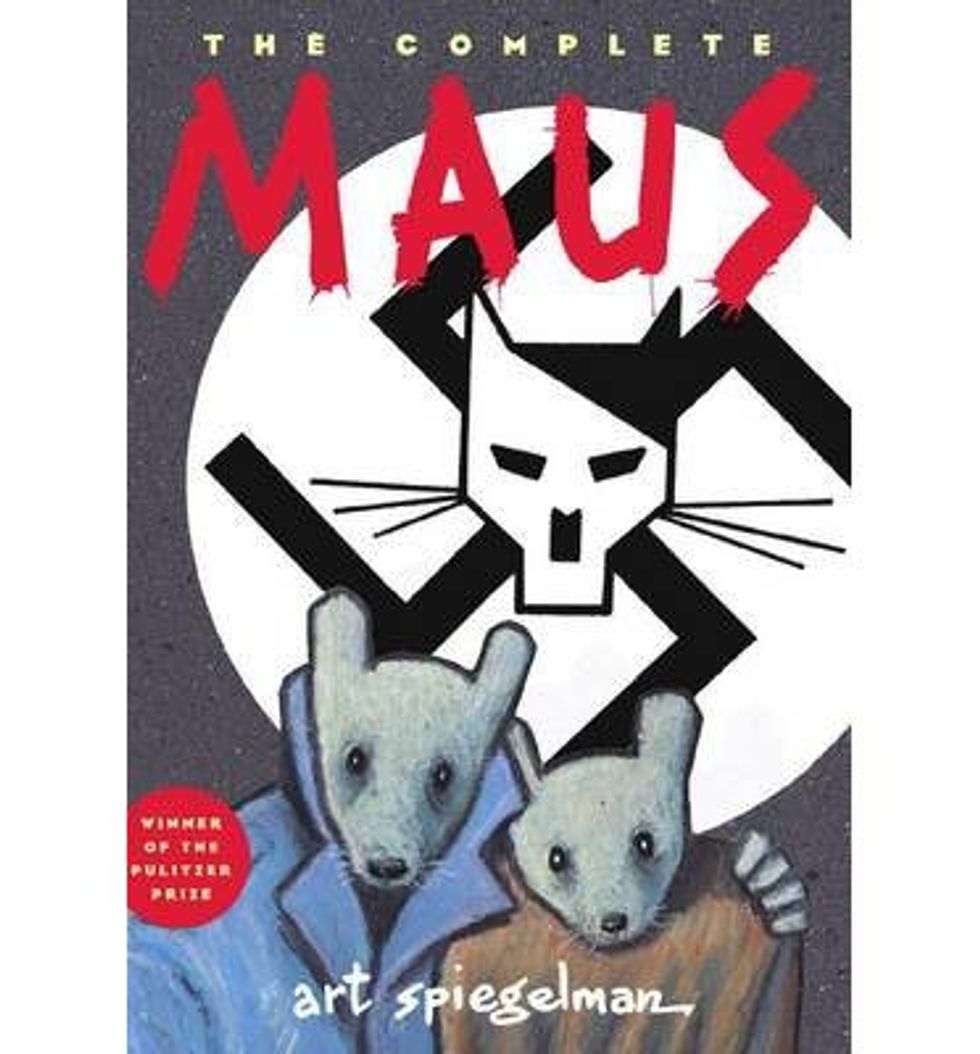
Art Spiegelman's "Maus" is one of the most unconventional yet amazing story about the holocaust, where Nazi's are portrayed by cats, Jews are portrayed by mice and poles into pigs, is a story everyone should read. It was the first comic book to win the Pulitzer, and changed the way comics- Although "Watchmen" would later contribute into this movement- are portrayed by the American population. Maus helped proved that comics can be more than just Superheros, but a serious medium that can elevate stories and imaginations.
“Maus” is not a graphic novel but rather a memoir and history. It tells the story of Mr. Spiegelman’s father in Poland before World War II, in Auschwitz during the war and as an old coot in Rego Park, Queens, after the war stopped. Part of Mr. Spiegelman’s accomplishment in “Maus” is that he turned it into a second-generation Holocaust survivor’s account, too. That is, he managed to turn himself into a character in the book and threaded in his own sensibility.
The style is simple yet it works well. The story not only helps tell about the holocaust, it also helps you see the holocaust. Mr. Spiegelman tells the story dispassionately and honestly without any winks to comics-literate readers. Nor is he trying to tell a "worthy" story, but simply documenting his father's wartime experiences and depicting how he elicited this information. The present-day sequences give us an unsentimental portrait of this survivor of the death camp. Mr. Spiegelman doesn't glamorise his father as some kind of hero, as Vladek comes across as irritating, manipulative, exasperating, and even bigoted at times.
Given that the book is about a sensitive subject, especially the holocaust, you would think there wouldn't be any humor. Yet surprisingly the book has its moments of humor, often being sarcastic and situational. Which certainly does help lighten the mood during some of the stories more serious and thrilling scenes.
While the story is considered a masterpiece and best-seller today, you might be surprised to know that the story had a hard time getting published. The story was originally turned down by many publishers. Probably because the idea of a comic book about the holocaust seemed inconceivable to anyone. Many editors commented that the backlash from the public would be severe, while other editors feared the story might not sell at all. Eventually, Pantheon Books would published the story. "Maus" would go on to become a best seller, surprising even Mr. Spiegelman himself.
Regardless, "Maus" is a story that comes one in a generation. The story helped legitimized the comic book genre, while also showcasing the different approaches when crafting a story. I would recommend picking up the twenty-fifth anniversary edition as the book collects both volume one and two, and also comes in a cool hard cover edition. So if your bored and want to read something new yet provoking, why not try reading the first masterpiece in comic book history.