
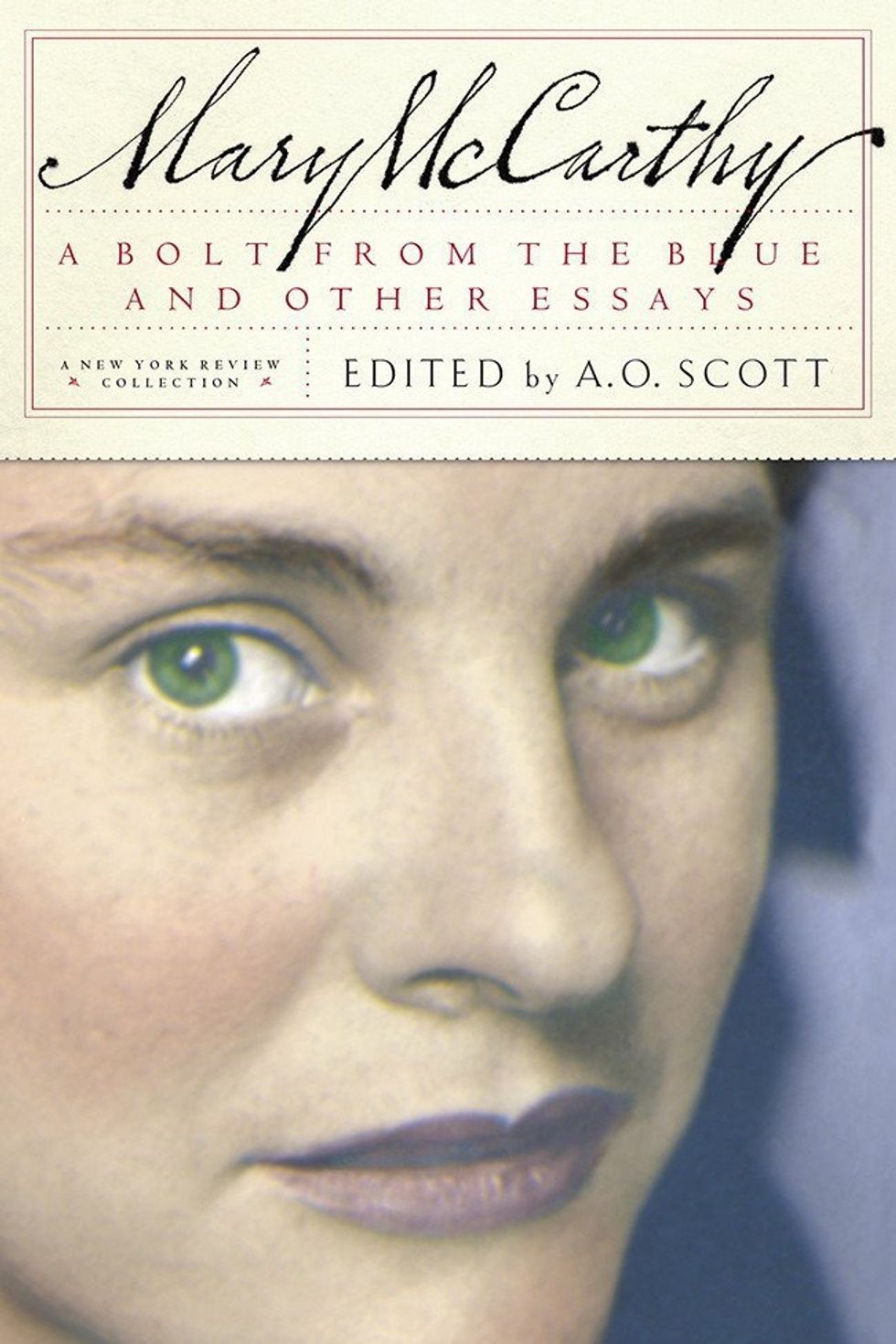
Although Mary McCarthy is not a very well-known author, many of her books and essays tend to dive into the theories behind why authors construct their works as they do. In her essay, “The Fact in Fiction”, McCarthy explains her views why the novel isn’t a novel anymore. However, before we can really dive into what McCarthy believes a novel is, readers have to understand what the word “novel” means. According to Merriam-Webster, a novel is “new and not resembling something formerly known or used,” or an “original or striking especially in conception or style." I believe the latter definition is what McCarthy is trying to get readers to understand. Those definitions, however, are not what McCarthy wanted readers to understand. She wanted us to understand that she believes that a “novel” is “a prose book of certain thickness that tells a story of real life”.
In her essay “The Fact in Fiction,” McCarthy points to Jane Austin, Dickens, Balzac and a few others whom, among others, as some of the greatest “novelists” to exist. She says this because she believes that they, “as different as they are from a formal point of view, they have one thing in common: a deep love of fact…” McCarthy, throughout this essay, she mentions again and again, that a “novel” is FACT and nothing is going to change that. What is this fact that she is talking about? Is it “The sky is blue?” or is it something along the lines of “animals can talk?” According to McCarthy it is 100% “The sky is blue.” She firmly believed that to be a real “novel” it has to “obey the laws of nature,” meaning animals can’t talk and men have to act human. She also mentions that there can absolutely be no supernatural acts: people can’t fly, turn into something else, come back to life, etc. This part, I will admit, is a bit confusing, I mean to say if no supernatural entities can exists in a novel, then why does she say that Dickens is a great “novelist”?
People can say his use of the supernatural is because it was a different period in time, but she didn’t believe that. She believes that Dickens use of ghosts in his novels was just a shortcoming, and maybe it is, or maybe it is isn’t. The truth is McCarthy believed that novel without fact isn’t a novel. Which now, more than ever, is failing her. McCarthy solely believes that more and more novels are just becoming books, just a story, no fact what so ever. Throughout this essay, she seems to believe that novels are becoming less personal, more factual, and more about social issues. However, it is kind of hard to understand what she means by this, simply because novels have always had facts in them. Also because social issues are constantly evolving, and to have an understanding of her intent, we must also have a good understanding of the historical context in which the original work was created. McCarthy says that a novel is only a “novel” because it has no element of the supernatural in it, it is just fact. But how can novels, in modern time, evolve and become more factual and not still be a novel? How can novels be less personal when she counts Jane Austin as a great novelist? Austin is known as one of the greatest romance writers of all time, yet how can one be a romance writer if one doesn’t put personal information in? Is the latter because Austin didn’t put herself into the story? While her belief of what the “novel” is can be understood, it’s a little perplexing.
Maybe her belief of what a novel should be can be better understood in a review she wrote about Joan Didion’s book “Democracy” in her review of the book, McCarthy tends to be on the harsher side picking at and pulling apart the simplest sentences that don’t seem to fit her mode of what a novel looks like. At one point she pointed out that Didion’s book “is deeply enigmatic,” which in simple terms, “Something that is hard to understand." McCarthy mentions this is because, “I have noted the cinematic quality of Joan Didion's work and the relation of the present construction to puzzles, specifically of the jigsaw kind.” Through McCarthy’s analysis, one could see Didion’s book as like trying…book is like trying to do a jigsaw puzzle, I personally start with the borders because then I have set a frame. That frame is a place holder for me, if the length of the puzzle runs the length of a kitchen table, then I know it is that wide. It’s the same with the width, no matter how big or small that width is, I know every other piece is going to fit inside of it. I believe that this is just one thing McCarthy is trying to get readers to understand about Didion’s novel: figure out what the borders are and then work to piece together the inside.
The other thing I believe McCarthy is saying that a novel should be complex, it shouldn’t be easy to understand how a book goes. It shouldn’t be predictable. I say this because in her review of Didion’s novel she mentions that it, “feels like the working out of a jigsaw puzzle that is slowly being put together with a continual shuffling and re-examination of pieces still on the edges or heaped in the middle of the design.” As I mention above, I work on the edge pieces first because I believe that they are easier. On smaller puzzles it’s easier to work on the middle, however, a novel isn’t a smaller puzzle. It’s this huge complex puzzle that needs time and energy to work out how each piece fits. You have to take one piece at a time, look at the design and then try to find were it fits. It may not fit the first thing you try it with, but that’s the fun it working on a puzzle, finding where it does fit.
McCarthy’s essay “The Fact in Fiction” is a very good essay on understand the “whatness” of a novel. Is it the fact that makes a novel a “novel”? Or is it something else? I don’t agree with McCarthy on this concept. I agree that a great novel is only filled with facts, I think what make them great is the complexity of them. For example, Lord of the Rings is a classic novel, J.R. Tolkien created this complex story, a puzzle. Nothing is as it seems and you have to keep guessing until the very end. I also don’t believe that the novel is becoming less personal. I have read countless stories that hit so close to home. Lastly, don’t agree that social issues aren’t facts. Depression, gay pride, the presidential election, etc. those are facts. No, they aren’t the facts that McCarthy believed in, but they are facts. The one thing that I do agree with her on is when she said that Didion’s novel was like a puzzle, and that is what makes it a novel. A novel is a puzzle, it has complex twists and turns and it doesn’t matter what forms they come in, as long as people enjoy it.