

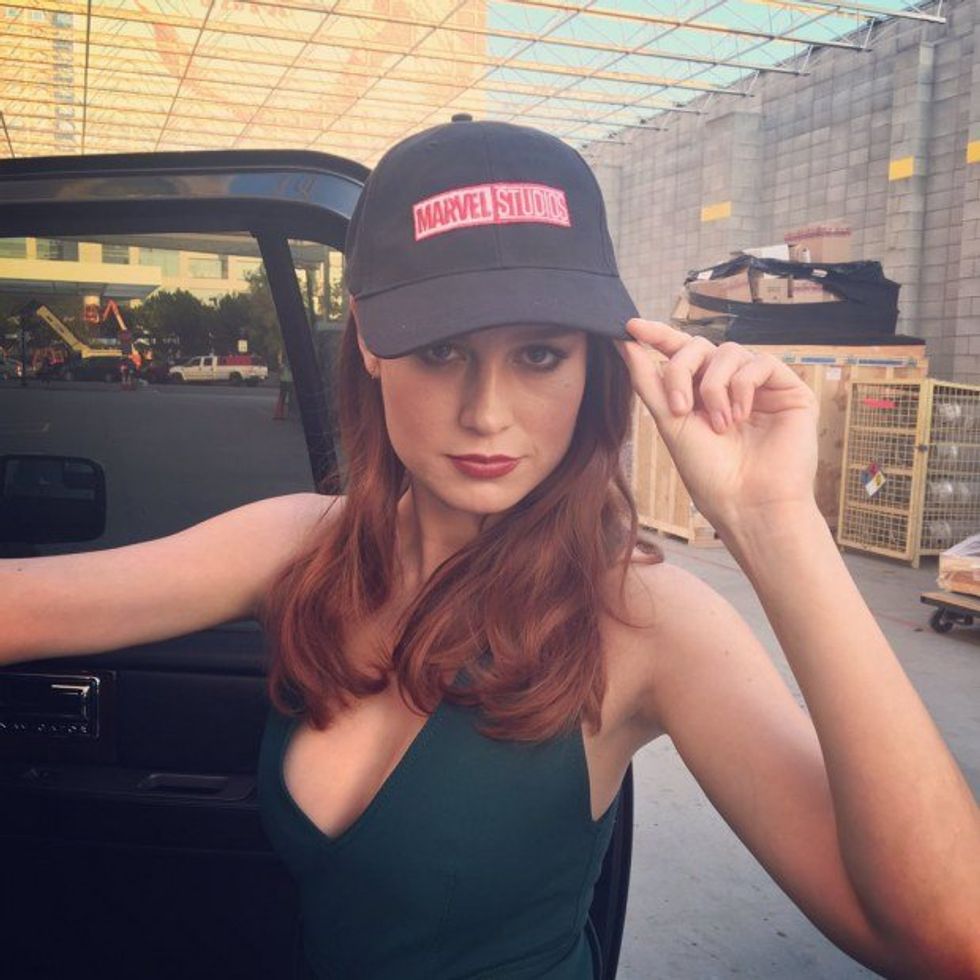
One of the biggest pieces of news to come out of last week's San Diego Comic Con was the long awaited casting announcement of Captain Marvel. Brie Larson, it was finally revealed, will take flight as Colonel Carol Danvers in Spring 2019. The film will be Marvel's twenty-first installment in their cinematic universe, and their first (and currently only) movie to have a female lead. As tends to be the case with an iconic role, reactions to the casting have been a mixed bag. But there's a little bit more to this mild controversy than your run of the mill bitter fans complaining that Harry Potter is supposed to have green eyes or that Han Solo is supposed to be taller.
See, the thing about comic books, or at least those comics books focusing on caped vigilantes, is that they last for decades-- many of them have been around since before World War II. And because their books run so long, superheroes rarely age that much. They have a nebulous existence that makes them float in and out of whatever time period the story needs. It's weird and wonderful and all part of the magic of comic books. But characters still have a general age range they fit into; they aren't twelve one minute and sixty-three the next (unless it's a time travel story, which is a different matter entirely). Peter Parker is always the down-on-his-luck youngster, Alfred is always the ancient but fatherly family butler, and Carol? Well, Carol Danvers is always the tenacious forty-something who chases after her dreams.
One of the quickest ways for readers to tell this is her status as a colonel. It takes at the very least twenty-two years of service and three years as a lieutenant colonel in order to be promoted to colonel. Even for someone like Carol, who joined the army as soon as she turned eighteen, there is absolutely no way she could get a promotion to colonel while being under forty. But it's also pretty clearly evident from her attitude, way of speech, and general mentor role to younger heroes. It's as much a part of her character as the iconic lightning bolt across her chest.
So why is she being played by a twenty-six year old actress?
Marvel's shown in the past that they aren't afraid to have older superheroes. Chadwick Boseman and Paul Rudd, two of Marvel's most recent leading men, entered the movie universe at ages thirty-nine and forty-six, respectively. Robert Downey Jr. is still going strong as Tony Stark at age fifty-one. James "Rhodey" Rhodes, Carol's fellow colonel (and on-again/off-again boyfriend), is played fifty-one year-old Don Cheadle. So why doesn't Carol get the same treatment?
The answer, as per usual, seems to be... it's a gender thing.
The fact is Marvel has always gone for women in their twenties and thirties to be their leading ladies, even when they're opposite men significantly older than them. Just look at the recent Marvel movie romances that paired Scarlett Johansson (30) with Mark Ruffalo (47) and Evangeline Lily (35) with Paul Rudd (46). Even Gwyneth Paltrow, who plays the girlfriend of middle-aged Tony Stark, hasn't been seen in a Marvel movie since 2012, when she was in her late thirties. Older women in this universe are invisible. Practically non-existent.
I say practically because there are a few exceptions. Aunt May of Spider-Man fame recently had a brief cameo in the third Captain America movie, where she was played by Marisa Tomei, who turned 51 last December. Her role in the film was small, but a running gag was still made out of her "hot aunt" status. This seemed to have been meant as aside to the audience; a conspiratorial wink about that fact that this Aunt May is prime Mrs. Robinson material instead of the stern elderly matriarch seen in the comic books. But film adaptations have been progressively aging down Aunt May. Rosemary Harris was 74 when the original 2002 Spider-Man film appeared, and Sally Field was 65 when the 2012 The Amazing Spider-Man reboot premiered. Perhaps it was only natural that the 2016 May Parker would barely be 50. Now I'll grant you that it's probably a bit more common for a teenager to have an aunt who's in her early fifties rather than her early eighties, but it's also a bit more common for people bitten by spiders to develop rashes instead of superpowers. Why choose to focus on the woman's age so it's more "realistic" and not tweaking any of the more outlandish story aspects? Was that really the most distracting thing about the story? That Peter's mother figure wasn't young enough to be a "hot aunt"?
Fairing slightly better are Laura Barton and Margaret Lang, wives of heroes Hawkeye and Ant-Man and the mothers of their children, who both have minor roles in movies their male partners appear in, despite the fact that they were both 40 at the time. Laura is the doting pregnant housewife and mother of his two children who Hawkeye spends the movie trying to make it home to. Her character comes pretty much out of nowhere, shocking even the other Avengers, as Hawkeye apparently decided it was better to keep her secret. Even though no mention of her has ever been made previously, viewers are meant to believe she has kept him fighting all this time. Margaret, on the other hand, spends the movie determined to keep their daughter away from her ex-husband because of his criminal past, against the wishes of both father and daughter. She's more of a plot device to keep Ant-Man away from his daughter than an actual fleshed out character, and there's never any hint of romance between she and her former partner. The two pretty neatly fit into a "good mother, bad mother" dichotomy, and their whole characters revolve, albeit in different ways, around their super spouse.
And aside from that? Thor's mother Frigga dies tragically so he can be sent on a dangerous revenge quest (she was also 16 years younger than the actor playing Thor's father, by the way). Hayley Atwell is occasionally aged up with make-up and CGI to play an elderly Peggy Carter, so Captain America can sadly mourn the fact that his time-jump robbed them of their chance to be together. And that's it. 13 box office smash-hits, one movie universe, and a small handful of women over 40, all of whom are mothers or wives of the male heroes.
So, yes, given their history, it may not be surprising that Marvel went with a much younger Carol Danvers than we're used to. But boy is it disappointing. This would have been a chance for Marvel to not only have a female superhero leading her own movie, but to have it be a woman over forty. To begin to change the way they've showed older women all throughout their film. To show that being a hero doesn't have an expiration date. To prove women can have adventures at any point in their life. But it seems that, even in a world of glowing fists, ice monsters, mind control, talking trees, robot dictators, anthropomorphic ducks, and people dressed every color of spandex imaginable... a woman being super AND older is still too out there for Marvel.

















