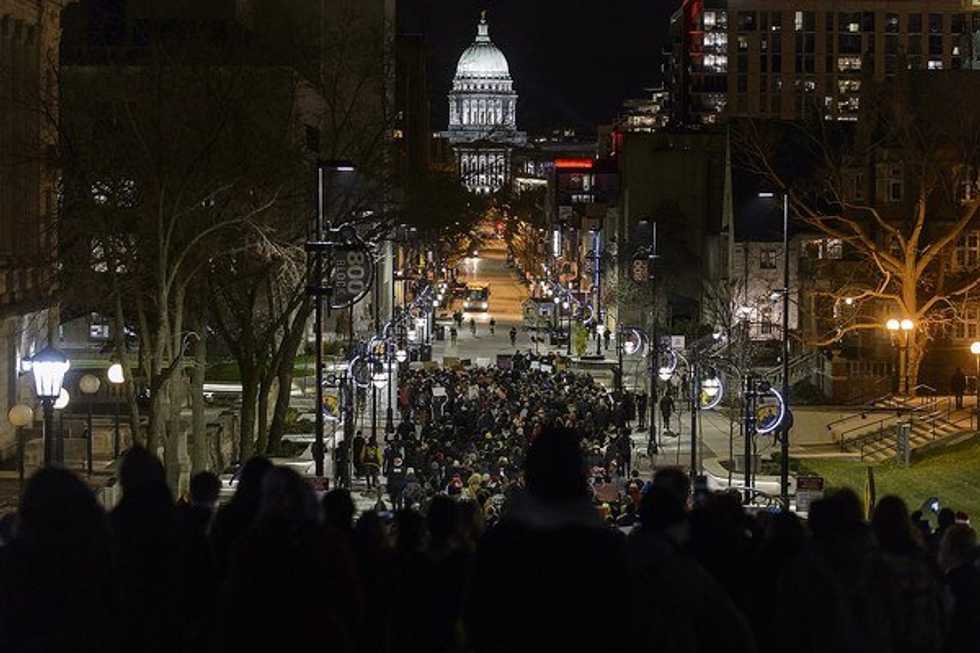
The Capitol shines bright against the dark, November sky to be seen by the city of Madison. Gleaming bright at the center of State Street, the Capitol mirrors Bascom Hill to shine light on the 1.4 mile path between them. The University of Wisconsin-Madison students gathered by the hundreds to unite, Thursday, Nov. 12, to march from Bascom Hill to the state Capitol building to demonstrate their solidarity with the students of color at the University of Missouri.
The march was a way for the students at UW-Madison to show their support for the lives of the students of color at Mizzou, and to fight for racial equality after the recent acts of racial tension and injustice that have impacted the students at Mizzou. Students at Mizzou were very upset with the way their president handled a series of racial incidents that occurred on campus this fall, which further incited many protests. The march took place around 8:15 p.m., beginning with a few student who made speeches and set ground rules for the march, to ensure a safe and peaceful course of action. Student activism has always thrived at Madison, and the ability to unite students of all ages and backgrounds around a single cause is a powerful statement. Petar Cirjakovic, a freshman at UW-Madison, participated in the march and was able to reflect on his experience and how the march impacted his views.
Why did you decide to participate in the march?
“I wanted to participate in the march to show solidarity with the black community of students at Mizzou. I feel like people think that racism is dead in society and attention needs to be brought to the fact that it is certainly not.”
How did you feel when marching with a large group of students who shared the same views as yourself?
“Marching certainly felt empowering. It makes you feel like something you are a part of can actually affect change and action.”
Did participating in the march allow you to learn more about the racial cause that you were supporting?
“Yes, I learned a lot more about the cause by participating. I learned that it is more of a national movement than I thought. The movement is trying to get more racial equality for all schools and students, not just Mizzou.”
How do you think actions, such as the march, will affect the future progress of the racial equality movement?
“Acts like this are going to help raise awareness for sure. A lot of people think that racism is dead, but when you have big groups of people saying that is not true, dissenters have to listen.”
What do you think is the most powerful aspect of student lead movements and unification?
“Student lead movements show that the youth is on board with the equality movement. Youth support is great because it shows that society as a whole is moving in that direction.”
What was the most memorable part of your participation in the march?
“I don’t think you could call any one moment more memorable. Overall, though, I would say that the passion of the protesters was the most remarkable thing to experience.”
How do you think Madison, both as a community and a university, can improve to reach more racial equality?
“I think Madison can improve by addressing racism when it happens with more conviction than in the past, both with the students and the administration. There have been some anecdotes about racist events that were handled poorly in the past and should be handled better in the future.”
Student activism is a strong way to prove to society that college students have a powerful voice and set of beliefs that will be eagerly acted upon, no matter which school they attend. Bringing together such a large and diverse group of people to draw attention to the racial equality cause demonstrates that change is desired and in progress.