

This is going to be one of the most pathetic sentences I have ever written and all New Englanders may need to sit down, but here it is. I went nine weeks of my summer only having one iced coffee from Dunks. Fortunately, I was not in a comma, nor unable to drink, nor in a life altering scenario that hindered my dunkins consumption, no, I spent nine weeks of my summer out in the glorious state of Utah.
What the heck was I doing out there? A lot, but primarily, I was there on a research grant sponsored by the National Science Foundation and Utah State University studying education through the field of engineering. Although I am technically not allowed to disclose my exact research findings until the paper is published, I am fortunate enough to (finally) share in clear detail what I studied and how it applies to every student’s life, including you.
The premise of my research was highly qualitative, which is just an annoying way of saying I analyzed and coded hundreds of survey questions using inductive interpretation. Qualitative research, unlike quantitative research, does not need to be reproducible because each study and project needs to be unique such that every research project is distinctive.
My subject of research? Self-Regulated Learning. Much like it sounds, self-regulated learning is a process in which a learner systematically directs their thoughts, feelings, and actions towards attaining a desired goal (Flavell & Mille, 1998). Essentially, how some acts or behaves in order to get something they want. Every single person in their life has exhibited some form of self-regulated learning.
Let me play it out for you; you have an exam in your stupid gen ed class that you know is going to be wicked hard. The night before, you whip out all your notes and the lecture slides and you tell yourself that you are going to study for an hour, take a break, and then study for another hour. While you are studying, you are flipping through your notes and asking yourself what each vocab word means and seeing if you can predict how your professor will ask you to define each word on the exam. Sound familiar? If yes, then you are a skilled self-regulated learner. Even if only a few of these tendencies sound like you, you still exhibit the skills of a self-regulated learner.
A large portion of self-regulated learning is motivation. Motivation can be influenced by hundreds of factors, but primarily theorists, teachers, and research students categorizes motivational influence into intrinsic and extrinsic values. If you study for an exam because you want to learn the material and hold conversations around the content, you are being intrinsically motivated. If you study for an exam because you want a good grade in a class, you are being extrinsically motivated. No type of motivation is better than the other, but different types of motivation explain personal behavior.
The focus of my research was to study a population of students and figure out how motivation and self-regulated learning influenced their learning of a certain content. To do this, I analyzed and coded surveys and transcripts and looked for key words and phrases that indicated motivation or self-regulated learning. Depending on what the student said, I was able to identify what the student learned, how they were motivated to learn it, and how they mentally interpreted new knowledge.
This type of research may sound stupid and pointless to many people, but I promise you, there is an incredible amount of worth to understanding how students learn. As a student teacher, I look to my formative assessments to indicate the level of knowledge my students have. With an understanding in motivation and self-regulated learning I can easily understand why a student answered a question poorly while a different student answered it in great detail. How? Student motivated intrinsically typically write more than those who are motivated extrinsically. With this information, a teacher can completely modify their lessons to include more relevant information to suffice a student who is only extrinsically motivated. I bet you never realized that your teachers even did that.
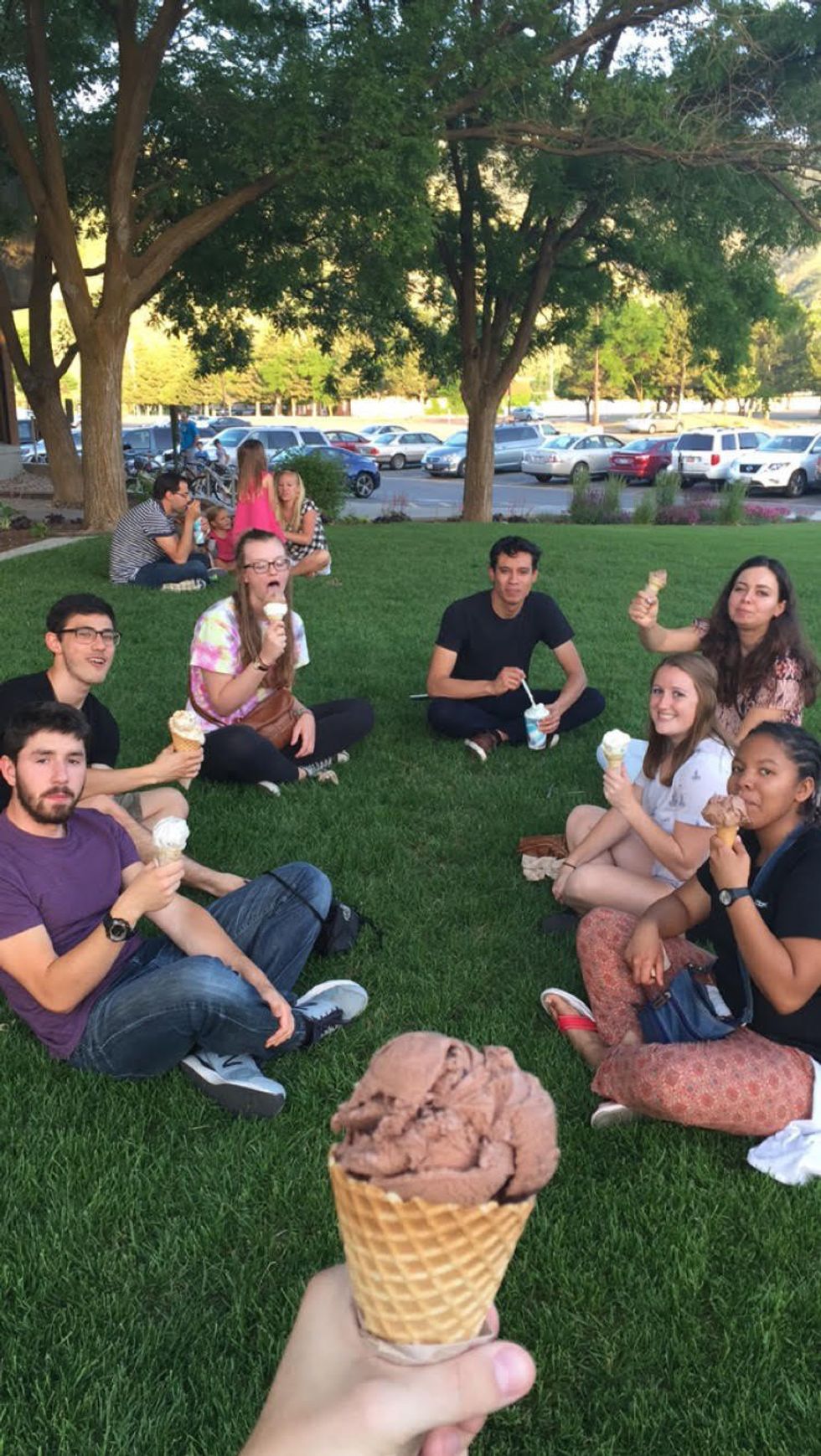
My research grant was by far one of the best things I have done with my life. Not only did I completely change the way I get to think about my career, but I also was able to work and collaborate with undergraduate engineers from six different states. The seven people I was fortunate enough to work with and the many other students and faculty members I was blessed to meet in my nine weeks in Utah, completely changed my life. I have no interest in sharing cliché words of advice, but I will say this; you have a chance to go on a new adventure with people you have never met before, go do it.