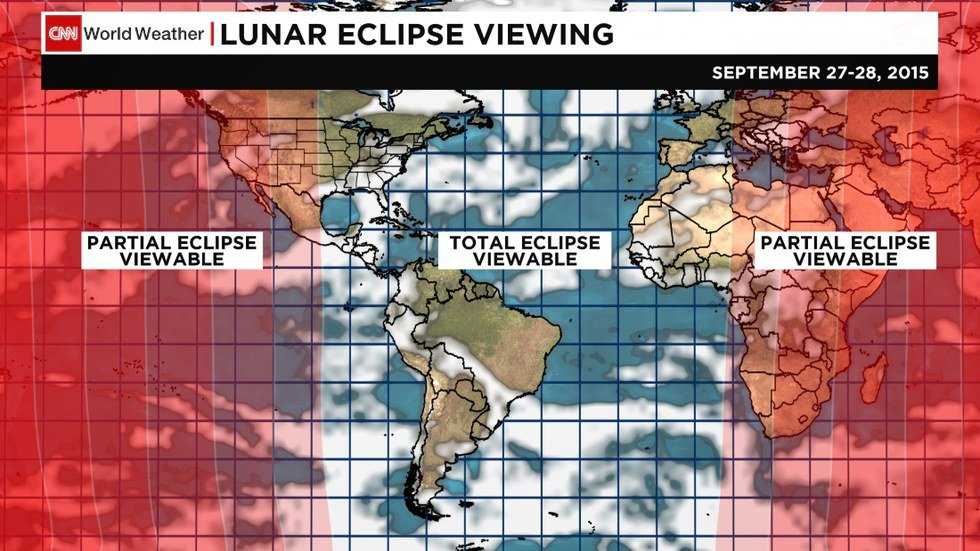
Stargazers, night owls and astronomy enthusiasts alike rejoice, because this past weekend, for the first time in over 30 years, a lunar eclipse and a supermoon have coincided at the same time. According to NASA and CNN, the United States and much of the Western Hemisphere were able to see a night sky featuring a big, bright, reddish glowing moon that was encapsulated in a total lunar eclipse late Sunday night into early Monday. A supermoon, which comes about once a year, happens when the moon is closest to the Earth within its orbit. This supermoon appeared 14 percent larger and 30 percent brighter in the sky this past Sunday evening before it was overshadowed by an engulfing lunar eclipse, which was visible for over an hour.
According to Jareen Imam of CNN, "this eclipse is the fourth and final in the so-called 'blood moons,' a phrase that has become popular to describe the four lunar eclipses we have seen in 2014 and 2015. Scientifically this is known as a lunar tetrad." This rare cosmic event, a supermoon eclipse, is predicted to not occur again until the year 2033.
According to NASA, "since the orbit of the moon is not a perfect circle, there are times when the moon is closer to our planet. This is known as perigee. Sunday's supermoon will technically be a perigee full moon, the closest full moon of the year."
"There's no physical difference in the moon," Noah Petro, a scientist for the Lunar Reconnaissance Orbiter at NASA's Goddard Space Flight Center in Greenbelt, Maryland, told Fox. "It just appears slightly bigger in the sky. It's not dramatic, but it does look larger."
So were you able to catch the super moon eclipse? In case you missed it, the total lunar eclipse lasted about one hour and 12 minutes, and was the most visible in North and South America, as well as Europe and parts of West Asia and the eastern Pacific regions, according to NASA. However, stargazers and eclipse enthusiasts were able to camp out for the partial eclipse which began around 8 p.m. EST. The eclipse reached its full peak around 10 p.m., giving the supermoon a deep reddish tint as the Earth's shadow dimmed across the moon. This breathtaking effect lasted until about midnight.
Unlike a solar eclipse, which needs to be viewed with special protective eye gear, the total lunar supermoon eclipse was easily seen with the naked eye.