

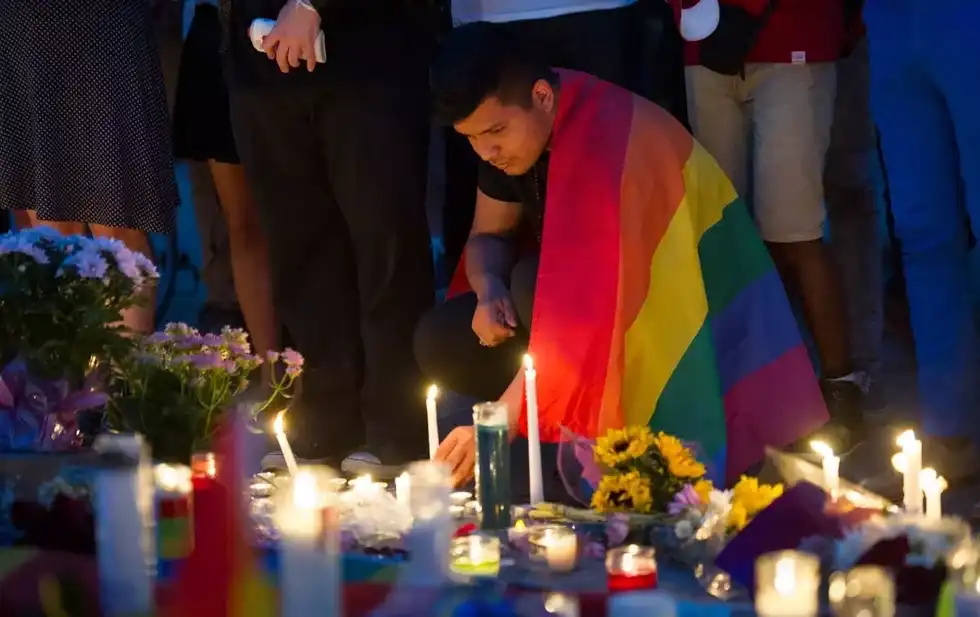
It’s been a week since I saw the headline “50 Killed in Orlando Gay Club” and thought - or hoped, rather - that it was a joke. It wasn’t.
It would be easy for me to say that I don’t have words to express the deep-seated sadness and anger within me in regards to the shooting in Orlando, but let’s face it, I’m a writer at heart and I definitely have a few words.
I could write an article in which I diverge my thoughts on gun control. I could write about how terrorism has affected America, how xenophobia lives on or how religion isn’t to blame for one person’s evil actions. I could write about the discrimination and hate that the LGBTQ+ community continues to face on a daily basis. I could, but I won’t. Maybe someday I will write about these things, but today I am more interested in discussing not just one of these individual topics, but rather their crossroads. Today, I am interested in looking at how these different strands crashed into each other at an intersection without a crossing guard to guide them safely across. Many articles boil the massacre in Orlando down to solely an issue about gun control. It’s more than just gun control. Many other articles bring the focus to discrimination against the LGBTQ+ community. It’s more than just that. It’s more than solitary issue. It’s the intersection of many.
Yes, the shooting in Orlando was ultimately a hate crime against the LGBTQ+ community. A man was apparently so angered by two men’s affection that he decided to open fire and kill and injure almost 100 people. It’s disgusting, horrifying, unsettling and angering, among many other emotions. To deny the fact that members of the LGBTQ+ are still seen as second-class citizens would be to trivialize their reality and dismiss the struggles they face. I think this is important to recognize, but my purpose today is not to highlight the horrors which frequently permeate this community.
Yes, the shooting brings up the ever-present issue of how America should deal with gun violence. The facts are that America’s gun-to-person ratio is higher than any other country. Some people think we should continue to allow citizens to buy guns relatively freely, and some believe that we should enforce restrictions. Should everyone has access to guns, or only a select few? A polarizing argument, I think there is validity to both sides. Do actions need to be taken, solutions found, and laws made? Definitely. But, again, such is not why I am writing this today.
And, yes, this shooting brings to the surface the xenophobia which becomes more and more prevalent in mainstream culture. With each mass shooting by a person of color, many people jump to the conclusion that one person’s actions are representative of everyone who may share their nationality or religion. You cannot use one person’s mistake to judge an entire group of people. You cannot use one person’s sin as an excuse to hate anyone remotely similar to them. This is an awful and illogical way of thinking, and I would hope that we are careful in how we treat those around us. As important as this issue is, and as much as it needs to be addressed, such is not my point in writing today.
My purpose today is to say that, regardless of the details in these individual issues, I think that all of these strands are united by one common rhetoric - hate. Hate is what has dug this hole, and created these craters. Hate is what has shaken the nation and cut holes in too many families. Fighting hate with hate is as useful as pouring water on a drowning child or using gasoline to extinguish flames. It will do nothing except further hinder the children and add fuel to the fire which already burns too bright. As Martin Luther King, Jr. said, “Darkness cannot drive out darkness-- only light can do that. Hate cannot drive out hate-- only love can do that.”
It’s also important to remember, however, that you can’t save a drowning child by watching her drown, and you can’t put out a fire by watching it burn. I cannot claim to have answers, but I can say that complacency is not one. Speak up when people spew words with bad intentions. Watch your own mouth and actions towards the people you may not accept as good. Micah 6:8 tells us that we are “to act justly and to love mercy and to walk humbly with your God.” This is easier said than done, for if it were easy to do all the time, God wouldn’t have to ask us to do so. But, regardless of how much effort it requires, it is essential that we put forth our best efforts to achieve justice, mercy and humility in response to such horrific events. Now is not the time to condemn or separate. Now is the time to go out and show grace to people who you might not otherwise think about. For, if you cannot live in grace in the worst of times, how graceful can you truly be?