


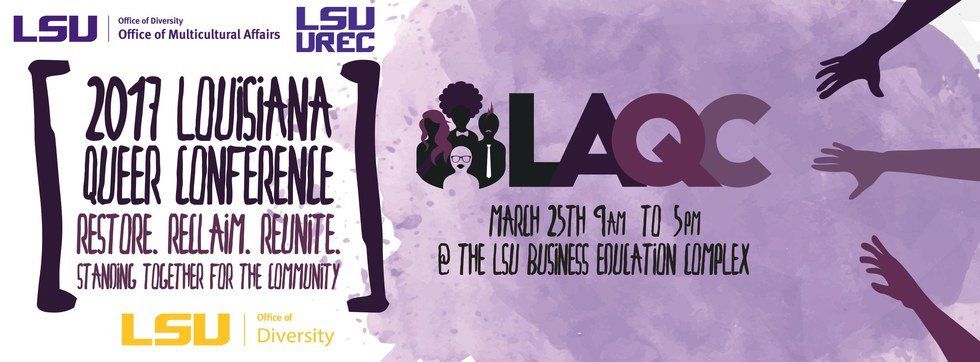
For those of you who don't know, something really special happens at LSU in the spring: an entirely student-led conference, the largest of its kind in the South, just for LGBTQ students (and their allies).
In 2017, the Louisiana Queer Conference was held on Saturday, March 25th, in the Business Education Complex just on the outskirts of LSU's main campus. From 9 AM to 5 PM, there were community panels, where members of the LGBTQ community in south Louisiana and beyond were asked about their activism efforts, and the ways their groups change and adapt with the political climate; there were student panels, where leaders of student organizations at universities across the state talked about their recruitment efforts, and how they deal with the respective administrations at their schools; there were also three workshop sessions, with three workshops to choose from in each; and finally, a keynote address. This year, the keynote speaker was Michael Sam, LGBTQ advocate and the first openly gay NFL star.
At this point, you might be wondering why I chose to write about this. It seems pretty straightforward, right? But the reason I wanted to write about LAQC this week is to try and get across how unbelievably important this is for LGBTQ youth to be able to gather and communicate about their shared experiences, not just to each other, but to straight, cisgender people as well. The thing is, people who have never been marginalized find it difficult to understand what it feels like to look out into the world and not see yourself looking back. It's not their fault, exactly; it's just human nature. But the story I heard told most often Saturday is a sad one: members of this community feel alone, they feel isolated, they feel unwanted by a world that for the most part rejects them. Events like LAQC are chances for people like that to come to a place where everyone has experience with the things they're feeling, and for people on the outside looking in to try harder to understand.
Apart from that, it's a chance for people within the community to better understand each other. One of the workshops I attended was titled All Black Lives Matter, and it was mostly comprised of discussion surrounding the intersectionality of being black while also being not-straight or not-cisgender. I was one of a handful of white people in the room, listening to the experiences of our black peers, and for me, personally, it was a really wonderful learning experience, and a chance to see something more clearly from someone else's point of view.
In summary, the reason I wanted to talk about LAQC this week is that if this article, and subsequently the existence of this conference, can reach at least one person who needs to hear it, I'll have done my job: you are not alone.

















