"The Jungle Book" is back! When I was a little monkey, I watched this movie all the time. I would sing "The Bare Necessities" and wanted a Baloo of my own. I was afraid of Kaa and sometimes thought Bagheera would protect me throughout the night. As I grew older, it left the top of my to-watch list, and although it never left my memory, went away from the foreground of my life. But now it's back!
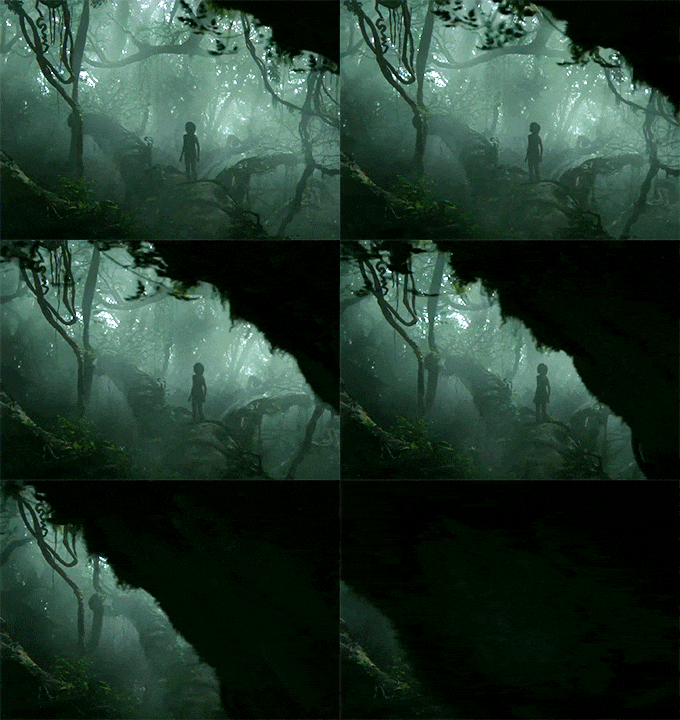
In the new live-action version of Disney’s classic animated film, "The Jungle Book" follows the same classic story. Mowgli, played by Neel Sethi, is a man-cub who was raised by wolves. But Mowgli finds he is no longer welcome in the jungle when the fearsome tiger Shere Khan, who bears the scars of man, promises to eliminate what he sees as a threat. Urged to abandon the only home he’s ever known, Mowgli embarks on a captivating journey of self-discovery, guided by panther turned stern mentor Bagheera, and the free-spirited bear Baloo. Along the way, Mowgli encounters jungle creatures who don’t exactly have his best interests at heart, including Kaa, a python whose seductive voice and gaze hypnotizes the man-cub, and the smooth-talking King Louie, who tries to coerce Mowgli into giving up the secret to the elusive and deadly red flower: fire.
The director, Jon Favreau, was interviewed by IGN and explained the differences between the classic and new live-action.
IGN: What specifically did you want to capture from the original Kipling tales?
Jon: From the Kipling I wanted to have them inform the tone and the life-or-death stakes of the story. I liked the mythic quality. I liked the sense of order and the culture of the jungle with things like ‘The Law of the Jungle’ and the water truce and the peace rock. That’s all from the original Kipling and we found a way to incorporate it, especially through the character of Bagheera, who often as narrator will quote chapter and verse from the passages of the Kipling stories, which I felt was a nice way to make the two worlds come together and also gave us a sense of cultural history that could be drawn upon as back story and to give dimension to this world. Whereas in the 1967 film it all felt like a kid’s musical and there were emotional scenes, but they were mostly emotional because of the quality of the character animation as opposed to the depth of the story.
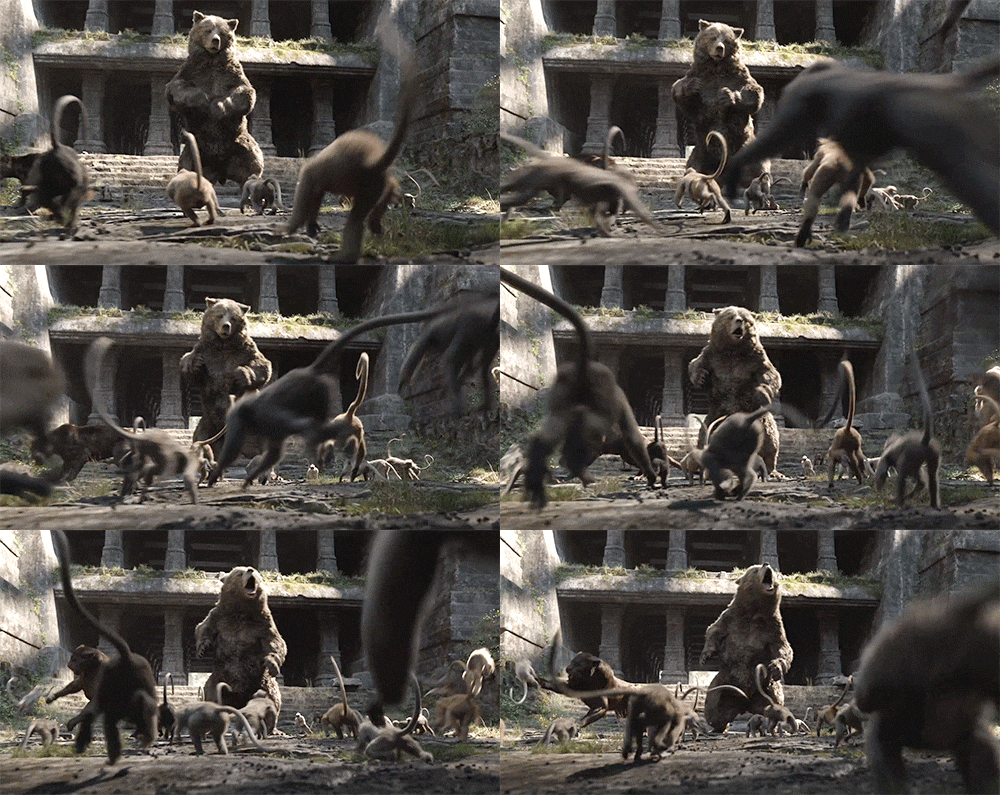
So I felt that we could deepen the story a bit. Use this to see how far we could push the photo-realism in the wake of films like 'Life of Pi' and 'Planet of the Apes' and see if we could actually get talking animals to be convincing, because that was the big thing that scared me—if the talking animals are distracting, the whole movie was going to be burdened by it.
*Spoiler Alert for anyone who has not seen the first "Jungle Book" yet, reader's beware!*
IGN: You’ve also altered the ending quite drastically, with Mowgli staying with his jungle pals rather than following the girl into the man-village. What prompted that change?
Jon: One was to leave room if we wanted to do more stories because I felt that the way the original one ends is a little bit unsatisfying in that it’s alluding to something but you kind of want to learn more and it doesn’t leave you necessarily with a happy feeling. I think the idea that Mowgli rejects the jungle is not the theme that I wanted—I wanted to show that you can be a human being and still be a part of the circle of life; you could either be destructive towards nature or you could be a steward of nature. And without being too much more specific decisions are made by Mowgli that establish that he has respect for the world around him and an appreciation for it and learns to be part of it without ever pretending to be part of the animal kingdom.
I think that if we could learn to live in harmony with nature there’s probably a good lesson for now, and if we don’t, it’s going to be a sad place because things are going to look a lot different in the next 100 years. And also ultimately I didn’t like the old ending when I was younger. It was a bummer to me. He left his friends because he was hypnotized by the song of this young girl?
But it also leaves us a lot of room if we want to move forward and do more chapters. There’s a lot of back-and-forth between Mowgli and the man-village in the Kipling – some of it gets pretty dark. But I think that at least giving us a clue as to what to explore it’s a good compass.
In this new live version, "The Jungle Book" blends photorealistic animals and environments in order to captivate audiences. The Jungle Book opened this past Friday, April 15, 2016.

I’ll be back soon—I’ve gotta go see this!