I got the notification just before my Introduction to Poetry class. I felt the buzz in the breast pocket of my jacket, while I was slumped against the wall, waiting for the previous class to finish, and I scooped my cell out, glancing at the red text of the automatic news app. It said simply ‘shots heard outside Houses of Parliament’, and to be honest, at that point I thought little of it. Certainly, it was odd – Britain has much stricter gun laws than America on account of the Dunblane School Massacre in 1996 – but it didn’t say ‘people shot outside Houses of Parliament’, yet. Or the worse ‘people killed outside Houses of Parliament’. Much like when I first heard that a Member of Parliament had been attacked prior to the referendum on Britain’s position within the European Union last year, I assumed that those involved would be alright. Unfortunately, much like the outcome of that attack – the brutal murder of politician, wife, and mother of two, Jo Cox – this would also be a tragedy.
Though an official investigation is still ongoing, the facts of the terror attacks in London this Wednesday as we know them so far are:
- Fifty-two year old, British-born Khalid Masood first drove a car into pedestrians on Westminster Bridge, injuring forty individuals and killing two; forty-three year old British national Aysha Frade, and fifty-four-year-old American tourist Kurt Cochran. An unidentified seventy five-year-old man has also since died as a result of sustained injuries. At least one more individual remains in critical condition. It is currently being speculated that Khalid Masood may have been born ‘Adrian Elms’ before changing his name following a conversion to Islam.
- Masood then attempted to gain entry to the Houses of Parliament, armed with two knives. He stabbed an unarmed police officer since identified as forty-eight-year-old PC Keith Palmer, before being shot by armed police. Conservative Member of Parliament Tobias Ellwood attempted to resuscitate PC Palmer, who had fifteen years of experience on the force, but the stabbing proved to be fatal.
- Masood is believed to have been a ‘lone wolf’ attacker, but six addresses across Britain have been searched, and eight individuals have been arrested on suspicion of preparation of terroristic acts. British Prime Minister Theresa May, who was evacuated from Parliament immediately after the attack, has since confirmed that Masood had been previously investigated by MI5 in relation to the extremist activity. Workers at the hotel Masood had stayed in the previous night described him as having been in jovial spirits.
- Terror group Daesh have claimed responsibility for the attack, but this is currently unverified.
Understandably, people worldwide have been shaken by the attack – which has been compared to the 2013 murder of off-duty British Fusilier Lee Rigby – and leaders globally have spoken out to both offer condolences and condemn the attack, (I considered commenting here on the divisive way that the son of one particular world leader spoke on the attack, but honestly it’s not even worth our time to pay attention to such a malicious individual). The last major terror attack to occur in Britain was the 7/7 bombings, which killed fifty-six people, and injured over eight hundred.
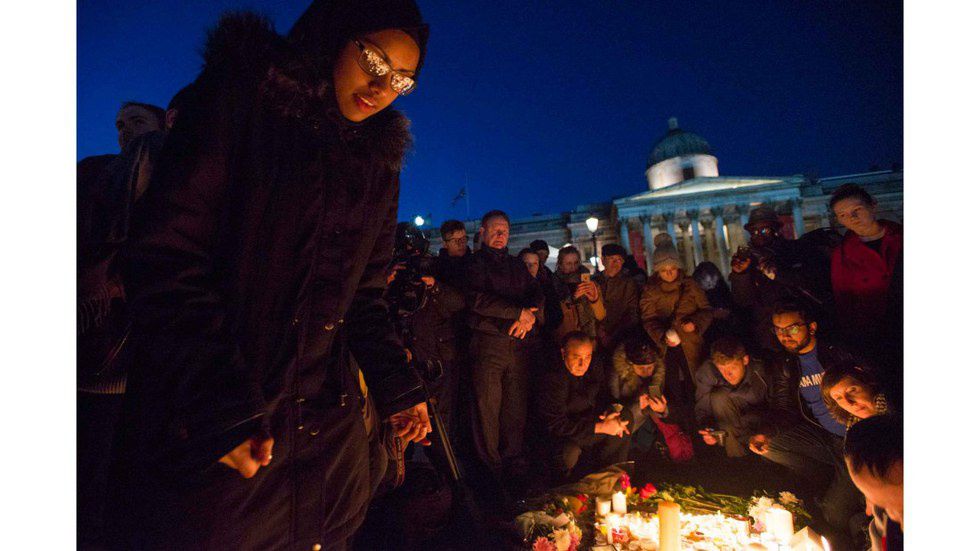
But, it’s Britain, and though my homeland certainly has problems – and I’ll be one of the very first to point these out – the strength that we show in response to such atrocities, and such tragedy, makes me so immensely proud to be British. In the face of terror, and hatred, and disaster, we do not tremble, and we do not submit. We ‘keep calm and carry on’, and we show those who seek to destroy, and kill, and terrorise, that their actions will not alter us; as London mayor Sadiq Khan phrased it the night after the attacks, at a vigil attended by thousands, ‘Londoners will never be cowed by terrorism’.
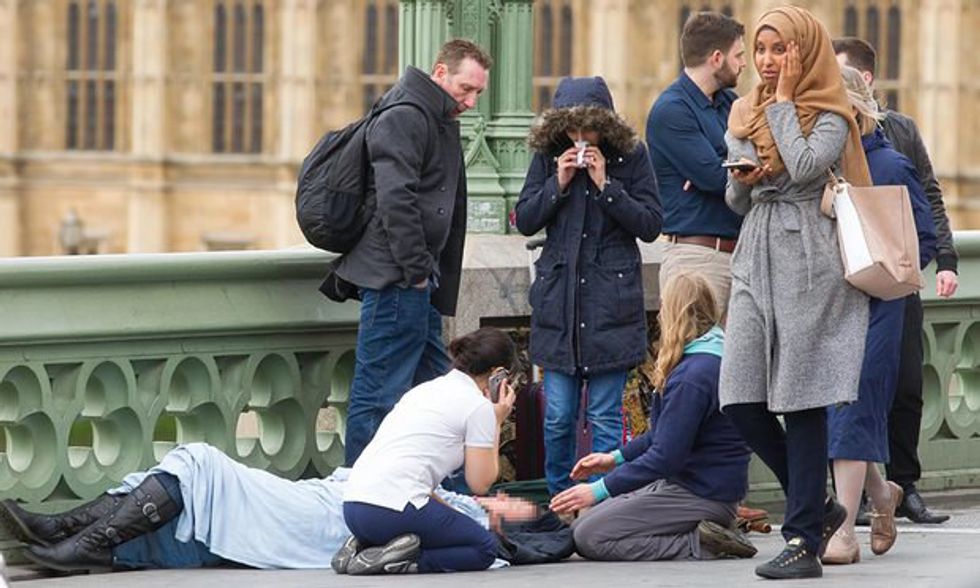
What I am not proud of, however, is the immediate Islamophobic backlash to the attack. It should have been evident that this would happen, when in the immediate aftermath of the killings, former leader of the ‘English Defense League’ (a group of notable and publically racist individuals who I would perhaps dubiously refer to as a ‘political party’), Tommy Robinson, turned up onto the scene. From here on, xenophobic and anti-Muslim comments have been written in many social media post made on the attacks, with the most common example being the highly-circulated image of a hijab-clad woman walking past an individual injured in the attack. In the image, the woman appears to be looking at her phone, and this has been used to argue that she is unconcerned with the situation unfolding around her. Interestingly, the second image taken of the woman, where she is visibly distressed, has not been as widely circulated. Nor, for that matter, have any of the numerous images taken that day of white individuals looking at their phones. The woman in question has actually spoken out about the situation since then, and the horror she has felt at seeing her image so exploited to support xenophobic ideology.
There has been a vocal backlash against Britain’s Muslim community, with some individuals suggesting that Muslims themselves should be doing more to ‘speak out’ against atrocities committed by the likes of Daesh, and lone Islamic radicals. But, not only are Muslims already doing this, with the head of the Muslim Council of Britain, Harun Khan, stating that ‘there is no justification for this act whatsoever’, and his ‘condolences, thoughts, and prayers go to the families of the victims’, but they shouldn’t have to. Individuals such as Khalid Masood are no more representative of the majority of Muslims than I am, and unless we as a society are going to start demanding apologies from all fifty two-year-old white men also, (since, after all, this describes the terrorist who murdered Jo Cox), we have no right to demand apologies from Muslims for events they are completely detached from.
What makes Britain great, and what we should cling to, at all costs, is the phenomenal diversity of our cities; the mishmash of different cultures, people, and beliefs. This is what terrorists seek to take from us – unity – and we should not give into that demand easily. As Harun Khan noted in his statement for the MCOB, ‘the best response to this outrage is to make sure we come together in solidarity and not allow the terrorists to divide us.’
Solidarity, not emnity. Love, not hate. Hope, not fear.