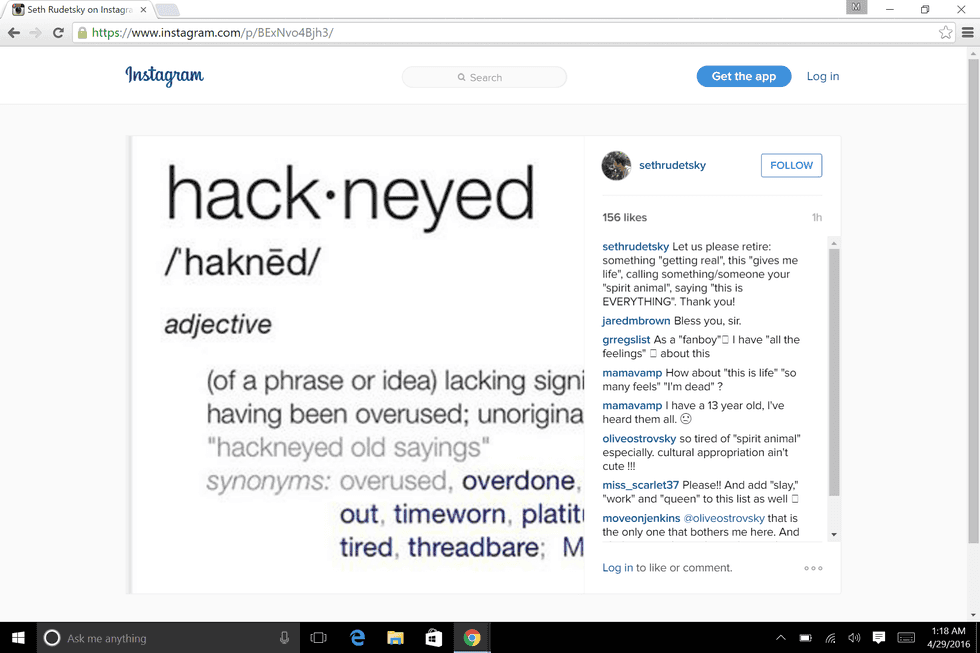
Recently, I saw an Instagram post from radio talk show host and current Broadway star Seth Rudetsky that contained a screenshot of the definition of the word "hackneyed."
According to Merriam-Webster, the definition of "hackneyed" is as follows: "not interesting, funny, etc., because of being used too often: not fresh or original."
Seth's response?
"Let us please retire: something 'getting real', this 'gives me life', calling something/someone your 'spirit animal', saying 'this is everything.' Thank you!"
I mean, the guy's not wrong. In 2014, the words "selfie" and "tweep" were added to the dictionary. When we give someone a compliment on their outfit, we call it "on fleek," or "fierce."
Honestly, what's wrong with saying "You look nice today?"
I understand the development of language. We've come a long way since ancient Latin or the Old English of colonial times. In fact, Oscar Wilde, author of the play "The Importance of Being Earnest" and the novel "The Picture of Dorian Gray," is credited with coming up with the word "dude," as being a combination of the words "attitude" and "duds."
But really, the English language is beautiful.
Here's an example: we've all had feelings we couldn't describe. Perhaps it was how at peace we were during a rainstorm or the love for the sight of the moon at night. Or maybe it was a deep disappointment in something happening after planning for it for months, or years, even.
Guess what? English has words for those.
Feeling like Jay Gatsby in the sense that you feel like you actually, can repeat the past? Then perhaps you're dealing with "klexos," or the art of dwelling in the past. Or maybe you feel drained from your daily personal internal wars—that's called "altschmerz," or weariness with the same issues you've always dealt with.
I found these incredible words from a BuzzFeed article. I'm telling you guys, if you ever check this website out, you'll find words that you never knew existed. And you never know, there might be a word that you connect to on a personal level. Me, I know I connect very deeply with a lot of these words.
Which is why it absolutely breaks my heart to see words—if they should even be called such things—like "bae" or "dope" being used ad nauseam. I get it. People would have heart attacks at the use of an advanced vernacular. But then again, it's even more distressing to realize that some words aren't part of society's vocabulary.
I was in a voice room at my school's main building on a Saturday afternoon, and my friend happened to be walking past. He saw me and came in, and we talked and caught up. I told him about how afraid I was of a teacher I had, and he asked me why I felt like that.
"Well," I said, "I'm afraid to incur his wrath."
"Hang on," he said, "You're too smart for me. What did you just say?"
A little miffed, I said, "I'm afraid to piss him off."
Maybe it's just me, but I love words. I took Latin for three years in high school and was a spelling bee champion in my county.
The next time you feel something you can't describe or you want to compliment someone, here's my advice: break out of the norm of using shortened, hackneyed slang terms. Use words no one has heard before.
In the words of Professor Trelawney of the "Harry Potter" series: "Broaden your minds."