

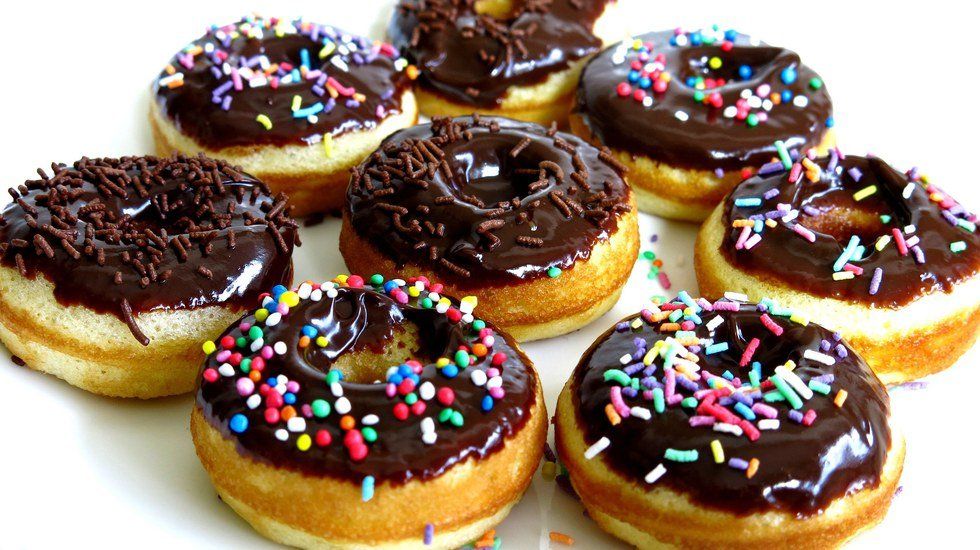
In elementary school, the annual Fall Party, a day filled with halloween-themed games and void of classes, was a much awaited event for any small child. During my second grade year, I was sitting in my chair, disappointed that the exciting day had almost drawn to a close, when one last game was brought out. The grand finale, the ultimate test of seven-year-old greatness was a powdered sugar donut hole eating contest.
The stakes were unbelievably high. My teacher was watching. My classmates were watching. My mom was watching. Our school's vice principal had even paid a visit.
I had to prove myself.
Safety was not an option. I had to win. So, shoving the entire donut hole in my child sized mouth, eating as quickly as possible, I triumphed over my classmates in my incredible feat.
Yeah, I'm totally kidding.
Almost immediately, I started gagging and crying because, for some strange reason, I did not comprehend how much powder would actually envelop the powdered sugar donut hole. My mom dragged me out into the hallway, where I spit out what was left of the sugary snack into a trashcan, swallowed water from the fountain, and was strongly encouraged to stop freaking out.
Today, I am known as a slow eater by pretty much anyone who has ever eaten a meal with me. Although I joke that my habits originated from this "traumatic" childhood experience, I was most likely biologically predestined to consume my food at a sluggish rate. Being a slow eater has come with several quirks, moments of hilarity, and tireless endeavors.
If you are a slow eater like me, you have most likely also found the following to be recurring struggles:
1. Always having to ask for a box at restaurants. You don't want to put your family and friends through the stress of waiting around for you to finish your food. But of course, you want to continue enjoying the food, so you save it for later.
2. Receiving "the look" to check eating progress. "The look" is unmistakeable. You begin eating your food, take a few bites, talk to your friends, and inevitably lose track of time. Your friends glance down at your plate, assessing your progress. Their eyes squint, and you can see the gears grinding in their head as they search for a sarcastic comment to make.
3. Being the target for food challenges. People figure out your eating habits rather quickly, and once they do, they put you to the test to discover your true limitations. These challenges range from "I bet you can't eat a pancake in one bite" to "I bet (insert name here) can finish his whole plate of food before you finish the last few bites of your sandwich."
4. Stressing about scheduling meals in between classes. For you, 40 minutes is far too little time to eat the amount of food that you truly desire.
5. Wanting to consume large amounts of food, but not having enough time. "Eating your feelings" is much less effective when the act of doing so takes over two hours.
Despite the struggles, my eating speed (or lack thereof) has led me to realize that I have some pretty amazing friends who are willing to stick by my side ten, fifteen, or thirty minutes after they've finished their meal.
Thank you to everyone from the bottom of my heart for putting up with me and my slowly vanishing food.