
If I were to label myself as anything I would call myself a storyteller. No, not in the sense that I am a liar, but rather that I live, breathe and crave stories. Be it in video games, movies, TV shows or books, you can practically get me to do anything for a good story. It is this defining fact that led me to me majoring in English in the first place. I am fascinated by the stories other people create in their mind and love to see how they bring it to life either on a page or a screen. I long to one day publish my own set of stories and watch people, such as myself, gobble them up. For now, I will just have to settle for giving you all a glimpse of all the things we storytellers go through.
1. Getting that one idea

Nothing is better than getting inspired and having that one idea in your head that just makes your finger itch for a pen or pencil so you can start writing. It is honestly one of the biggest thrills you can feel. Everything just slides into place as you begin to develop this character or story line and how the pieces fit together. Soon your character’s motives begin to make sense as you figure out what happened to them in the past or what will happen to them in the future that makes them explode into action.
Tip! Write these ideas down in as much detail as you can because you can forget them later on! Maybe carry around a small notebook in your bag or have a notes application on your phone.
2.Trying to figure out how to put that idea in the right words
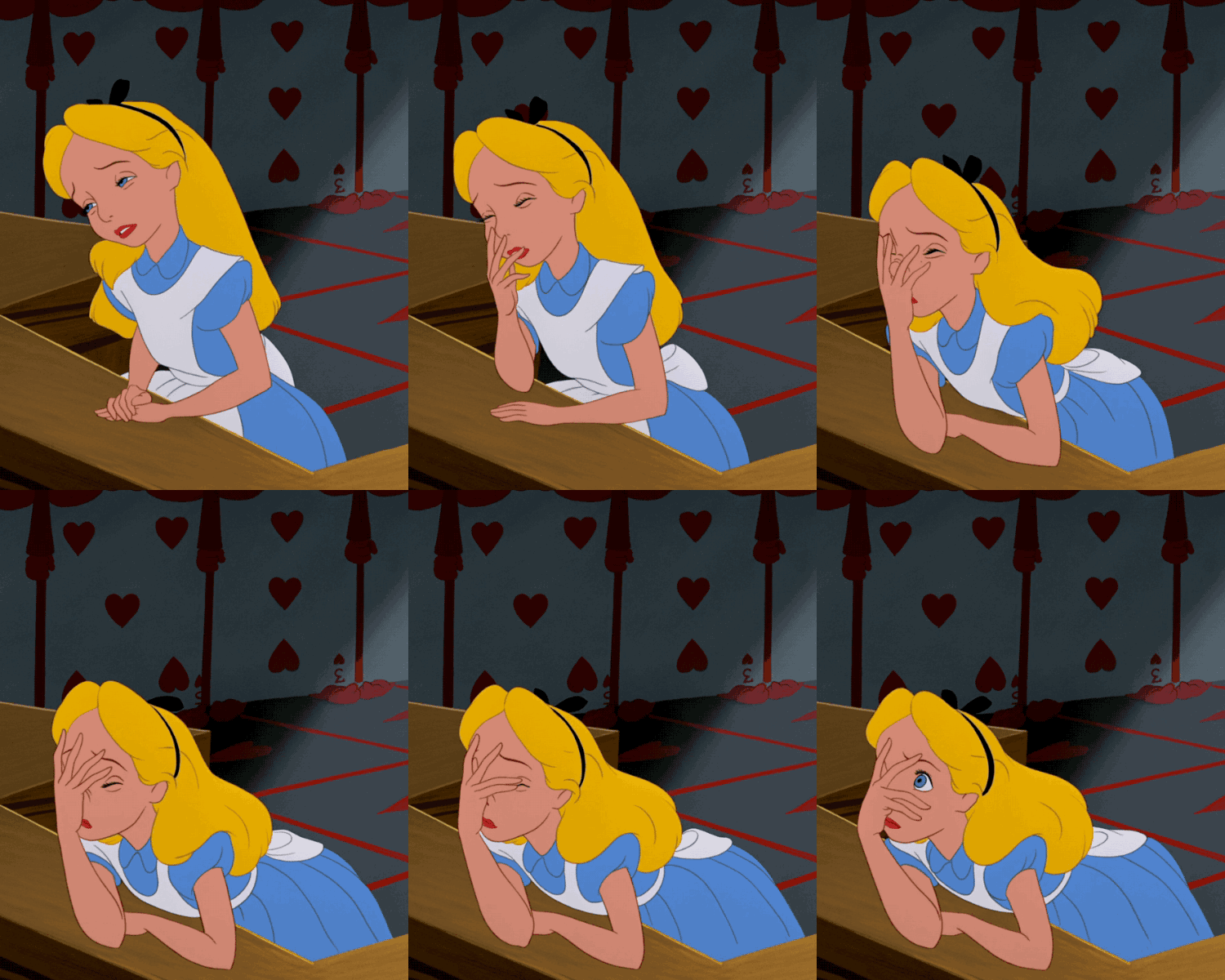
Just as you’ve gotten that great idea, you’re left trying to put it into words. The brain is a funny thing; it thinks great in forms of pictures and jumbled words, but it does not always translate perfectly onto a page for everyone else to understand. I cannot tell you the amount of times I have tried to explain something to my friend about a story and often found I lacked the words to express my previous thoughts (which always flowed so perfectly moments before you opened your mouth). This feeling is maddening. You can picture it in your mind vividly and alive, the words on the tip of your tongue, but never able to fully express or write down the masterpiece stuck in your head.
Tip! If you ever encounter this (and trust me you will), try either verbally talking through it by yourself (or with a friend if you feel a bit crazy) or writing through the “bad” version of it. By just trying to get the words out, more often than not, the right words will find themselves spilling out almost seamlessly.
3. Hitting that sweet-spot

The only other feeling that rivals getting that one idea, is hitting that writing streak where the words are flowing so smoothly and rapidly that you could not stop if you wanted to. This is the zone every writer gets in after that initial rocky period when you’re trying to find the “right” words. Your fingers fly across the keyboard, the sound of the keys clicking of the keys as you see your masterpiece explode on the page and time moving faster than you could imagine it. When you hit that sweet-spot, you’re in the zone and everything feels right in the world and that your life if put together and really the only problem you are faced with is trying to hold off on your other needs so you can keep writing.
Tip! Keep a water bottle and small snacks near-by so you do not have to get up from the computer or desk. The less interruptions you have, the better.
4. Trying to keep that streak

Remember how I said that sweet-spot is the best thing ever? Well you want to do everything in your power to keep that streak going because let me tell you, when it stops, it’s the worst. Nothing sucks more than being in the zone and suddenly being ripped away from it and all the words just slam to a halt and derail faster than a train turning a bend too fast. It’s an absolute disaster. What is the real kicker is that when you lose it, it’s gone and you’re stuck trying to find those “right” words all over again.
Tip! Try writing in a secluded location, maybe a nook in your school’s library, or a balcony that no one ever goes to. The less distractions around you, the better.
5. Coming back to a story (especially if you left yourself notes)

You can’t write an entire story in one day (well at least not a very long story in one day) and eventually you are going to have to walk away from the computer or notebook (if you prefer a more traditional form) and come back to it another day. This is both good and bad. Good because you come back with fresh new ideas and a new perspective to your story that allows character to grow more and giving you the ability to see any mistakes plot-wise or grammatically. It’s bad because if you leave yourself notes (as I often do in the margins of my journal) you lose yourself quicker than if you were in a mirror maze (those things are hard okay?). More often than not it is because your notes are abbreviated in such a way that it made sense when you were in the thick of the plot, but now coming in fresh has thrown you off entirely. Now you have an entirely different puzzle to solve and it will take up more of your time than you think.
Tip! Reread. Trust me, you will do yourself a huge favor if you just reread from the first full paragraph of what you have previously written because it will give you some bearing when trying to figure out where to go from there. Also, if you are going to leave yourself notes, try not to abbreviate and be as detailed as you can so it makes sense later.
All in all, writing is hard. Writing is long hours sitting
at a desk or pacing around your room trying to find which words that describe
the one character or explain this one idea that your mind has created out of
nothing. You find yourself tearing out your hair or stuck in a chair for hours
on end because you simply lost track of the time. Yet, despite all this, you
would do it again and again because that is who you are... a storyteller.