
Seven days ago, my family and I wove through Seattle traffic on our way to a port. As we crossed the threshold of a tall metal gate I caught a glimpse of my home for the next week. The size of three Portland city blocks and docked alongside three neighbors of equal or greater stature, the cruise ship sent pangs of anxiety through my body.
I know what you’re thinking. “A cruise ship? What a privilege! What is she complaining about?”
Keep reading, I will explain.
We parked the car and boarded a shuttle. I trained my eyes on a seat in the back and stepped over fellow passengers’ feet, still not believing that I was getting on the boat. My brain vessels tightened up as I tried to figure out a kind way to break the news to my family. Meanwhile, the shuttle bus driver, a jovial fellow, told us: “It’s not the real world on there.”
An unexpected tear welled up in my eye. Trapped inside my tear was a tiny replica cruise ship, and it fell out of my eye and down my cheek.
What was really inside that tear? Submission of self control, in a couple of ways. First, I was going to be physically trapped inside a (admittedly, huge) capsule, afloat at sea. Second, I was going to be immersed in a lifestyle that I did not want and with which I did not agree. I saw the ship as an emblem of consumer culture and the creator of massive amounts of waste. The ship creates 50 tons of waste every week, plus uses hundreds of thousands of gallons of water. There is a casino onboard as well as a number of jewelery stores and four all-you-can-eat meals served each day.
Further, many of the towns the ship visits are former Native Alaskan villages — Juneau, Sitka, Ketchikan — that have changed since boats full of white people approached their shores a couple centuries ago. Sitka has been inhabited by the Tlingit (pronounced “Klinkit”) Kiks.ádi clan for over 10,000 years. They lived off of the land and were self-sufficient. Since Russians arrived in the area in 1799, and violently seized control in 1804, the way of life has changed.
As a white passenger aboard a cruise ship in 2016, I think about how this narrative continues today. Cruise culture may be the antithesis of the original Tlingit way of life. Further, the impact colonialism has had on Native American language, religion, land-relations, and culture across the U.S. complicates the ethics of tourism. How have we earned the right to “see” these cultures? I wonder how the Tlingits view the cruise ship industry. Is it positive, bringing jobs and money into the economy? Or negative, detracting from their culture?
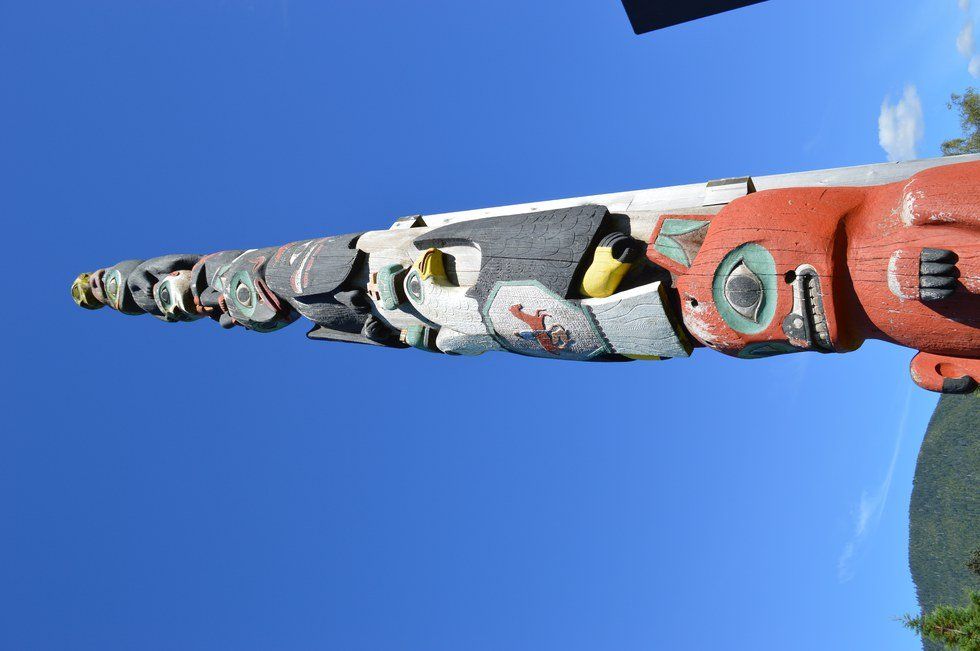
A totem pole in downtown Sitka tells a little bit of this story. The totem was commissioned by the Forest Service in the 1940s and, for many, represents a painful past. It features Baranof, who led the Russian conquest of Sitka and the Tlingits in 1804. The totem’s original intent seems to have been to honor Sitka’s history. However, when local totem carvers were unable to carve the totem, the job was shipped to the nearby town of Wrangell, where, to the dismay of the Tlingit of Sitka, carvers took creative liberty in featuring Baranov nude and bald. After that, the totem became a “shame” pole.
Seventy years later, when the pole was in need of rehabilitation, the Tlingits had mixed views on this controversial landmark. Some saw the totem as a “ridicule pole,” others as a testament that while the Russians are gone now*, the Tlingits are still “here.” The Tlingits agreed to support the reconstruction of the pole, and reclaim it as a pole of healing. One Tlingit elder from the Kaagwaantaan clan said, “Choose your direction based on how you choose to interpret history. It could be a positive direction or it could be a negative direction. I choose to be positive.”**
What strikes me about this story is that, for the most part, the Tlingits seem to accept the changes that have transpired in their culture in the last two centuries without judgment or resentment. Meanwhile, I, a former cruise ship passenger, have been seething with judgment. Their acceptance has inspired me to see a positive side to what I call “cruise culture:” cruises draw tourists into the towns they visit and thus stimulate their economies. Each cruise ship is home and work for hundreds of crew members and staff. And for most passengers, a cruise is a needed vacation and rest. To be fair, the ship’s programming reaches beyond gambling and shopping to education on the environment and people in the areas visited, and some crew members are passionate about spreading awareness.
While I have learned a lesson about acceptance, and can see the pros of cruises, there are also cons, and these should not be accepted. Cruise passengers and crew members have a responsibility to understand how “cruising” affects the environment and culture of the places cruised to and through. We have a responsibility to raise awareness and protect the cultures we have exploited in the past so that we do not continue to exploit them today.
*Complex, because while this is a real viewpoint, the Russians aren’t gone. Russian churches are sprinkled throughout Sitka, their dead lie in a hilly, forested, and well-flowered cemetery, and many businesses in town have “Baranof” in their name.
**Quote and some perspectives on pole from kcaw.org, “Controversial totem pole returns to Sitka square” by Ed Ronco and “Downtown totem pole headed for makeover” by Melissa Marconi Wentzel. KCAW is a community radio station operated by Raven Radio Foundation, Inc. of Sitka, Alaska.