
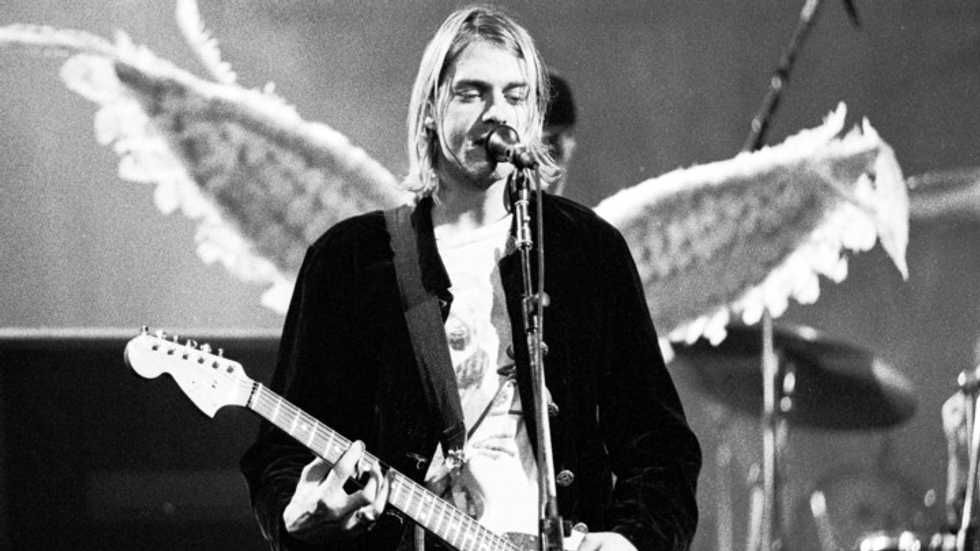
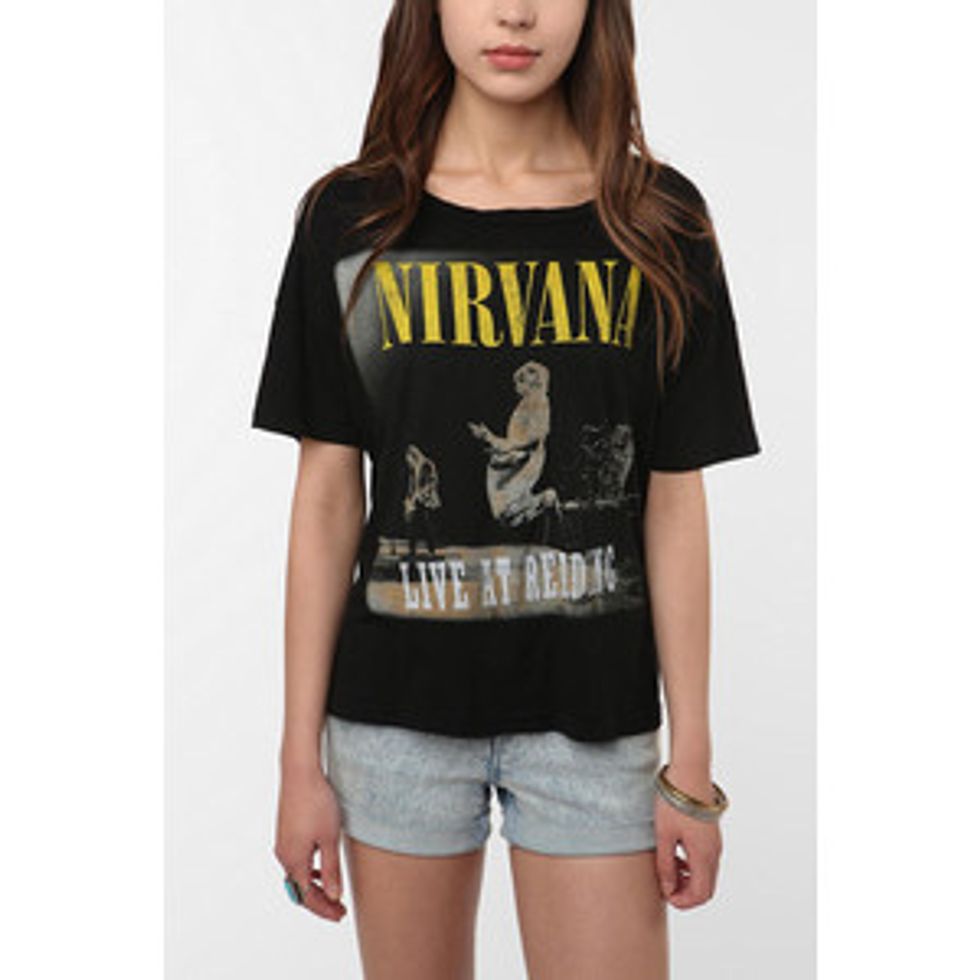
When I would walk through the halls of my high school, I often found myself dumbstruck by the number of girls walking to class in Nirvana t-shirts. Whether it be the typical yellow band logo, the "Live at Reading" visual or simply a picture of Kurt Cobain’s face, it was a common trend for teenage girls to sport Nirvana apparel.
In the hopes of having a conversation about her favorite Nirvana records, I once approached a girl I knew with when she was wearing a "Nevermind" shirt. However, when I excitedly asked her if she was into Nirvana, she responded with a disappointing, “What? Oh, the shirt! No, I just thought the design was cool.”
I don’t blame her. Like many other band’s graphic design work, Nirvana graphic tees are “cool.” Also, this girl was just one of the millions of modern-day teenagers who sport Nirvana without knowing much about the band.
Popular clothing stores, such as Urban Outfitters and Forever 21, peddle Kurt Cobain and Nirvana merchandise like it's water in the desert. Additionally, these stores’ sales stretch well beyond clothing. The instant you walk into an Urban Outfitters, you are pelted with Nirvana vinyl, books about Kurt and more.
What attracted trendy corporations such as Urban Outfitters to select Nirvana as an entity they wanted to capitalize on? Well, they’re smart, and they know their audience.
With the recent release of the documentaries "Montage of Heck" and "Soaked in Bleach," it’s safe to say that interest in Kurt Cobain remains at a high. It's challenging to state explicitly why such a huge part of the modern-day generation is so infatuated with Cobain in a way that goes well beyond just his music. Approach any 21st-century teenage Nirvana fan, and they will likely go into excruciating detail about Kurt’s heroin use, his controversial relationship with Courtney Love and, most of all, his suicide.
It seems like it’s the hip thing to quote Kurt’s “I’d rather be hated for who I am than loved for who I’m not” on artsy photographs on Instagram. It’s trendy to misattribute Neil Young’s “It’s better to burn out than fade away” to Kurt (because of his suicide note) on a Facebook status. It doesn’t matter what Kurt actually said, when he said it or how he said it. It is the simple notion that accrediting these proclamations to Cobain adds to his mystique.
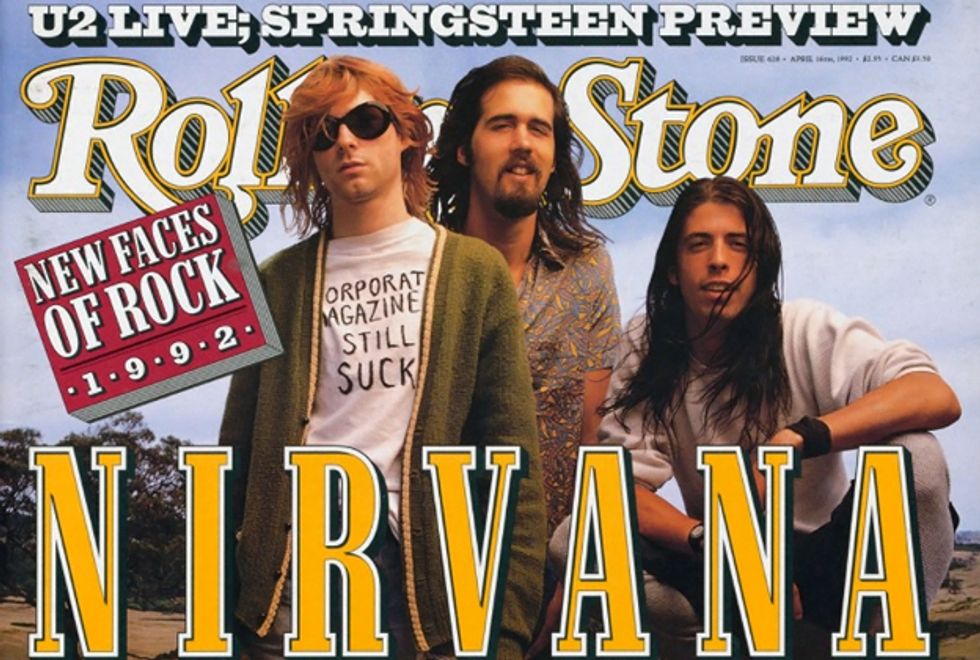
Everything about Kurt Cobain screams nonconformity and brings “coolness” to those who wouldn’t typically be considered “cool." Before him, what artist would even think to wear a t-shirt that said, “corporate magazines still suck," on the cover of Rolling Stone? That’s f*cking awesome!
However, the entire paradox of his existence was that his career was a middle finger to Corporate America, but Nirvana was still the band that brought grunge music to the front lines of mainstream popular music. He would ride around in his pre-Nevermind Volvo; Courtney would buy a Lexus and he would force her to return it. That contradiction is what teenagers love so much about Kurt.
Then, there is the harsh imagery in his lyrics. With lines like, “I wish I could eat your cancer when you turn black,” and songs about being an isolated societal reject living under a bridge, just listening to Nirvana makes you feel a part of something greater than yourself. Personally, when I listen to Kurt’s lyrics spoken through piercing screams, Krist’s bass riffs and Dave’s drum rolls, I take solace in the fact that there’s this subculture of people who understand me. People who go through the same things I do.
On April 5, 1994, at the peak of his career, Kurt committed suicide at age 27. This placed him in the infamous “27 club” amongst other rock icons such as Jim Morrison, Janis Joplin and Jimi Hendrix. That’s another massive component to add to his badass image. Establishing Kurt alongside these wildly famous, rebellious figures of the past made him the modern-day equivalent of all the things they represented. Beyond that, every aspect of Kurt’s death was a spectacle. The heroin. The bullet to the head. The suicide note. The conspiracy theory. God, do teenagers love a good conspiracy theory.
Would Kurt still be the significant, rather-godly figure he is today to millions of teenagers worldwide if he didn’t die when he did and how he did? I’m not sure. But because of his suicide, Kurt will be an ageless deity for eternity. Imagine if, in the middle of the 1970s, Mick Jagger committed suicide. Would we hold a completely different image of him? Probably. But instead, we get to see a 71-year-old Jagger still touring across the globe and at Super Bowl halftime shows. Try to picture a 48-year-old Kurt Cobain — I know I can't.
Even after his suicide, Nirvana released two albums that reached number one, "MTV Unplugged in New York" in 1994 and "From the Muddy Banks of the Wishkah" in 1996. Even in death, Kurt Cobain’s influence was able to sell records, ranking him as an artist with sixth most posthumous record sales.
In today’s culture, where pop artists and DJs reign over the popular music industry, it's cool for teenagers to have an idol who lived to challenge what society accepted as OK. In terms of looks, he is everything that conventional good looks is not. He’s scrawny. His hair is long and ragged. His clothes are too big. But teenage girls not only think of him as attractive in spite of those reasons, but they fall in love with him because of them.