A couple weeks ago, my Writers Craft class—a course dedicated to observing and criticizing the writing style of authors at The College at Brockport—was discussing the works written by Barry Lopez. As I listened, I had an appalling realization: What even is the point in preaching to act upon environmental concerns if no one cares?
A few of my fellow classmates presented on the essayist, fiction writer, philosopher and modern naturalist, providing the class with a quick biography and an overview of his writing topics of choice. Everyone in the room was quick to label him as a nature writer, as was I. Soon after, our discussion narrowed in on the mulling over the following: the beauty of nature.
The conversation, however, failed to contemplate the impending issue of climate change, sticking only to a Thoreau-vian wonder. Sure, it was brought up, but people pushed it off to the side as a conversation to return to later if there was extra time.
But there is no extra time when it comes to climate.
Instead, students wanted to point out how carefully detail-orientated Lopez was while transcribing the landscape or setting of his essays in "About This Life." Every time someone so much as mentioned the words “trees,” “land” or “animals,” I couldn’t help myself refrain from physically cringing. Hearing others talk about nature writing suddenly became upsetting, turning my own environmental sentiments off. As a personal research topic of mine, the superficiality of the discussion took me aback. Disappointedly, I kept my mouth shut, too overcome with embarrassment to speak up. We were only able to brush of the surface of what Lopez means when he writes about the community: engaging with the natural world in order to establish a community inclusive of both the human and non-human as equals.
Listening to my peers in the humanities close read Lopez, someone who is well-known as a nature writer, forced myself to internally reflect on my own career goals in science communication.
I’ve been down this road previously as an undergraduate. I began my education as an environmental science major, but I found the intensity of the environmentalist identity at my initial school, however, overpowering. The sciences too difficult for the public to grab a hold on, the material was not my calling.
Finding a balance between scientific nomenclature, narrative and detail is a hard thing to do, as I am learning.
At the same time, though, what’s the point in writing about the environment if people aren’t going to care? Even after a class of over 30 people delved into Lopez’s work, hardly any of them wanted to talk about how he represented wilderness. Instead, people were more focused on his renditions of culture, of people.
Which, I can’t necessarily say is a bad thing, but it really does seem that, more often then not, people don’t want to talk about how our everyday lives—something as simple as not recycling a plastic water bottle or leaving the sink running the entire time you brush your teeth—is negatively impacting the integrity of the Earth.
When you hear the word “environment,” I’m guessing a swirling concoction of sentiments occur in reaction.
Immediately, people think of landfills, endangered animals or Yosemite National Park. Most do not, however, think about their local water system, a farm or building. They do not think about their car, the emissions it releases or the oil it requires, the number of lives the United States has poured into the Middle East to secure their own supply of dirty energy.
We are so painfully oblivious to what goes on in the States, from the chemicals in our food to the Coca Cola brothers allegedly owning just about everything to the restricted amount of tuna you shouldn’t eat per week because of the dangerous mercury levels.
Did any of these conversations pop up during the three hours as we took a closer look into Lopez’s essays? Of course not, even though the thinking points, the simulating paragraphs were there.
And what does that say about us?
Even as I continue to explore the influence nature writers have on their audiences, I can’t help but to question their actual accomplishments. Legislation may have been implemented, but socially and culturally we are the same as we have always been.
If anything has changed, it’s the fact that “green” has become more of a marketing strategy than ever before, a point of difference for products, allowing a provider to sell at a premium price for a supposedly premium product.
“Organic” chicken or lettuce, anyone? They’re double the regular price.
You see companies and businesses releasing more Corporate Social Responsibility reports than ever before. Why? Because the more they show themselves as being a good thing for society, if they plant more trees than the other company, then maybe you’ll purchase from them more.
In 1949, Aldo Leopold first proposed the idea of a land ethic in his essay collection "A Sand County Almanac." Lopez’s ideas were presented in much the same way Leopold did—similar rhetorical strategies were utilized in order to gain interest from the reader. Following Leopold have come plenty of biologists turned writers—Garett Hardin, E.O. Wilson, Rachel Carson—all of which have preached a “real-world view” or a holistic perception when viewing the natural world.
Still, we have failed time and time again to realize we are no more important than the soils, waters and animals, that we are a part of the ecosystem.
Some may be scoffing at this idea, maybe even ready to play the Charles Darwin card as a counterargument, noting through natural selection we have earned the right genetically to be the dominant species, the apex predator.
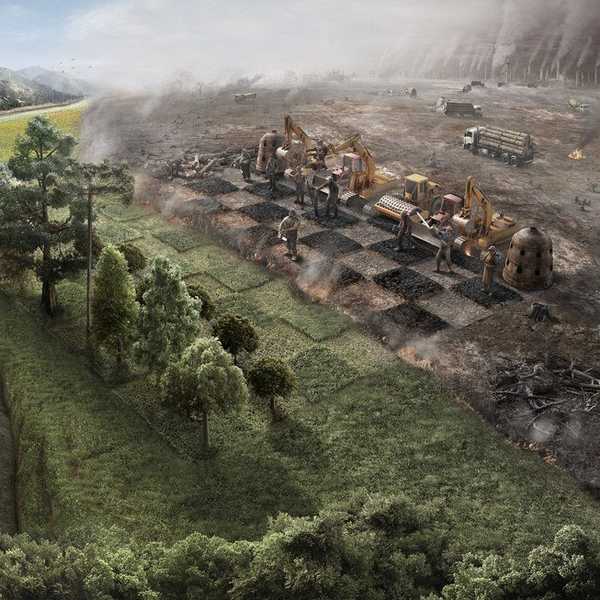
But what other species do you know has specifically altered entire ecosystems, has been the reason for the eradication of thousands of species?
None.
We lose dozens of creatures every single day. Currently, “51 percent of known reptiles, 52 percent of known insects and 73 percent of known flowering plants are in danger along with many mammals, birds and amphibians,” according to the World Conservation Union. The Center for Biological Diversity notes: “99 percent of currently threatened species are at risk from human activities, primarily those driving habitat loss, introduction of exotic species and global warming.”
You want to talk about genocides? Think about the mass die-offs of the biotic community responsible from anthropogenic activity. The fact that amphibians—yes, frogs—are dying out when they surpassed the dinosaurs through their own mass extinction should be a red flag in and of itself.
Mankind remains a separate entity from the rest of the world because our culture and mindsets, our education, even, fashions us to think as such.
When are we going to realize, as Conservation International puts it nicely, that Nature doesn’t need us? That we need nature?
But herein lies the problem: Not enough of us think that way, think we need nature. We’re perfectly content with a manicured garden, a weed-free patio or a concrete environment. There is no internal need or hunger in most to surround themselves in wilderness.
I feel defeated, recently, as more and more of the truth looms its wicked head—there are droughts, natural disasters, there are bees disappearing. There are so many things going wrong that I fear they’re going to consume the good, the things society is constantly trying to do to combat climate.
The Paris Treaty, right? Isn’t that a good thing?
Until real action occurs, until real goals are met, it’s not—the language that appears in the treaty is vague, ultimately most likely to enable everyone to sign it, but how countries will now go about an implementation process is unclear.
And among all this negativity, I’ve realized it’s hard not to give up. The fate of the world is in our hands—so what are we going to do?
Climate change threatens everyone—no matter your ethnicity, class, sexuality or location, without a world in which to inhabit, these issues can’t be addressed.
And every day I struggle with the fact that no on realizes this important fact—it makes me want to give up, I want to throw in the towel and shout, why does it matter?
But it does.
If I don’t say anything just like I didn’t say anything during class, no one else’s thoughts are going to start running in that direction.
How do we get people interested in nature? How do we get people engaged in talking about climate, about changing lifestyles, about changing our day-to-day activities whether that be where we live or what we eat? How do we make conscious decisions to pick chemical-free options?
Simply: How do we get people to care?
Is it through writing? Through scientific fact? Through legislation? Through force?
By mid-century, we will have lost 30-50 percent of all species inhabiting the planet.
Whatever it is, we need to figure it out and fast, because time is running out. If we don’t start making changes now, we’re simply going to be too late.