
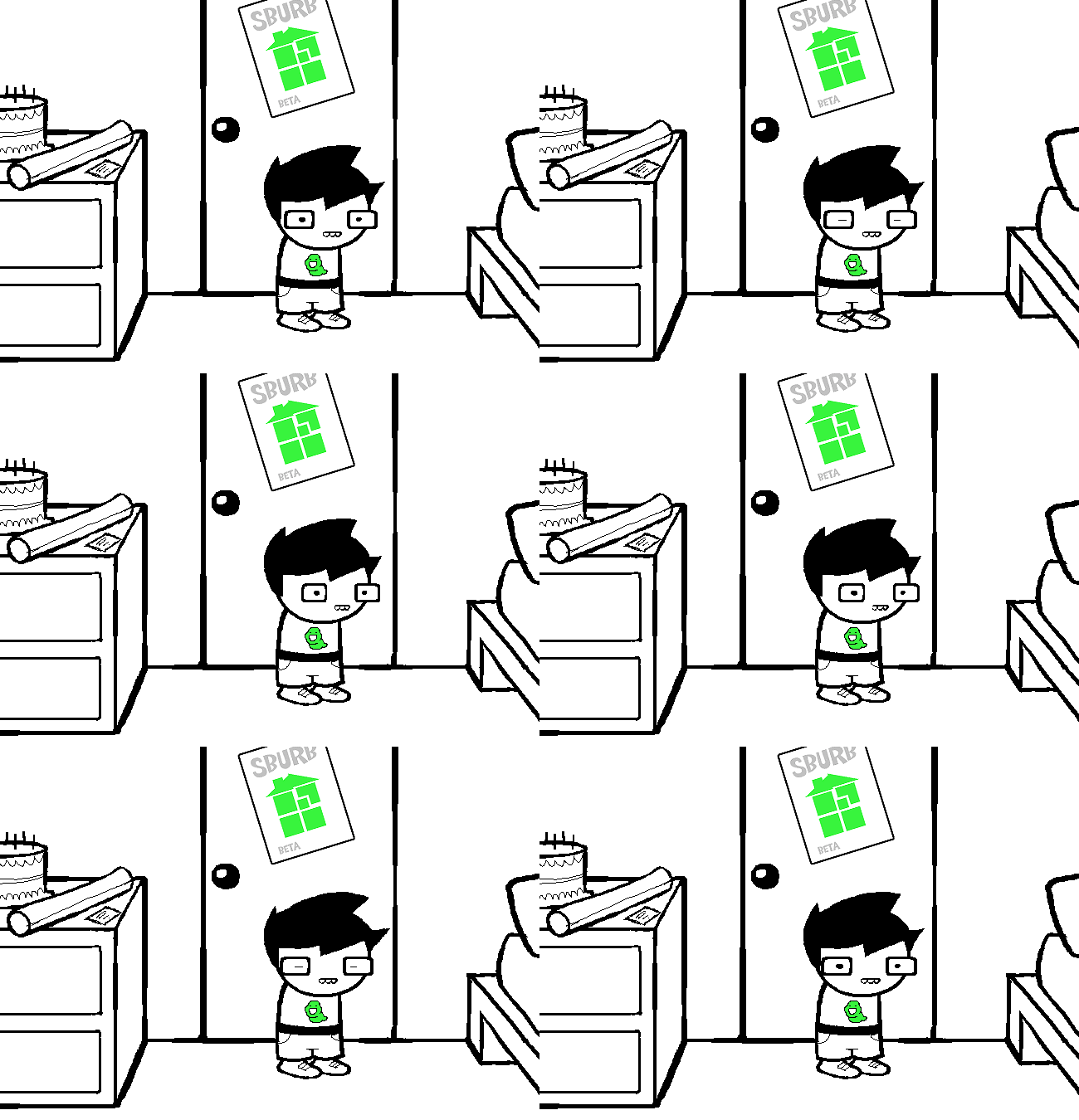
"So let me tell you about 'Homestuck.'"
From April 13, 2009, to now, that sentence has inspired confusion, embarrassment on so many levels, and (especially now) a sense of nostalgia. So, what is the fuss about "Homestuck?" Why are people still talking about it in 2016? What's the big deal? Well, besides being a seven-year-long webcomic, "Homestuck" is a convoluted story that involves a lot of bad jokes, bad language, conspiracy theories about numbers like 413 and 612, and heartbreak.
Webcomics are a pretty common thing now. They're like normal comics but on the web. Most webcomics will either have their own site or be part of a larger site that will host them there. Sometimes there are text bubbles. Sometimes there are panels on a single page. A lot of these decisions are left up to the creator. They can range from pixelated art to art that looks like paintings. Ava's Demon is a beautiful webcomic, but because of the art style, each page takes some time to create.
When Andrew Hussie began the webcomic in 2009, it was a simpler time. The webcomic was originally based on text-based adventure games such as Zork, and many other video games. Zork was published in 1979, and instead of any graphics, the game describes the scene to the player and the player tries to guess about what they can really interact with in this game. In that same spirit, "Homestuck" began with silly commands with running commentary found below the panel:
Enter name.
John: Quickly retrieve arms from drawer.
(This command is a gag that has been in other webcomics of Andrew Hussie's, which are found on mspaintadventures.com. In fact, self-references are quite common throughout all of his work.)
John: Squawk like an imbecile and shit on your desk.
Early on, many of the strangest twists and turns in the story are thanks to early readers. There was once a point in time where the fandom was integral in keeping the story of the comic going. Of course, Hussie was going to do what he wanted; but this set a precedent for how important the fandom is later on in the comic (even earning personifications that became major characters). There is a second set of characters (a race of grey-skinned aliens that have horns that are colored like candy corn) that come in. Almost all the names chosen and used were suggestions from readers at the time.
Much of the music used throughout the webcomic was also fan-created.
Wait. Did I say music? Didn't I say this was a comic? Well, it is. And then it isn't. There were one or two interactive pages, and then there was...
[S] John: Play haunting piano refrain.
This one page set a precedent for crucial moments in the webcomic to come. [S] pages became exciting things, sometimes even heartbreaking at times. Some of the most crucial points of the story are shown through animation rather than pages. The best example is [S] Cascade. The 13-minute flash animation with accompanying soundtrack was the longest animation in "Homestuck" (recently beat by [S] Collide which clocked it at 18 minutes).
It broke the boundaries of the typical page (literally moving the comic panel) and it showed just how far Andrew Hussie could bend the medium he was working in. I'll link you to [S] Cascade, but regardless if you are intending to take a stab at reading "Homestuck," then I would highly suggest not watching it. It's rather confusing if you don't know what's happened in the previous five Acts. Beyond just pages of pure animation, there have been many interactive portions of the webcomic, allowing readers to explore select areas and discover all sorts of Easter eggs and learn about characters.
The structure of "Homestuck" began as a rather typical thing. There was an Act that covered a certain plot arc and then it ended on a crucial moment, usually involving an [S] page and curtains of some kind showing the end of the act. But even this structure began to mutate as it went on. Act 1, Act 2, Act 3, Intermission, and Act 4 were technically Part 1 of "Homestuck," housed on a Disc One. Did I mention that the video game motif wasn't just limited to the way the plot was shown? No, these characters are involved in a life-or-death video game. Part 2 consisted of Act 5 Act 1, Act 5 Act 2, and Intermission 2. Splitting an act into further acts? That's a little odd. But it only gets more fun after [s] Cascade which was the end of Part 2.
Part 3 is ongoing, but so far has consisted of Act 6 Act 1, Act 6 Intermission 1, Act 6 Act 2, Act 6 Intermission 2, Act 6 Act 3, Act 6 Intermission 3, Act 6 Act 4, Act 6 Intermission 4, Act 6 Act 5 Act 1, Act 6 Act 5 Act 2, Act 6 Act 5 Act 1 X2.
And after Act 6, Intermission 5 with all 6 of its Intermissions, came Act 6 Act 6 which had alternating Acts (Act 6 Act 6 Act 1) and Intermissions (Act 6 Act 6 Intermission 1) and Finally ended on Act 6 Act 6 Act 6.
And if that confused you, then there's a good reason. I had to look up a reference to make sure that I was including every single little part.
There is a final Act, Act 7, which is set to be released in its entirety on April 13, 2016.
While I can't say everything I would love to articulate about this webcomic without spoiling major parts of it, this webcomic has done things I can't imagine I could pull off in a novel.
From fans creating arts and music for animations and pages to multiple universes intertwining together to breaking the fourth wall in such a way that the fourth wall becomes part of the plot to a fandom that has survived through a lot, "Homestuck" is quite a story. It's one that can continue to exist even when it's over. It's one that fans will be "stuck" on for a long time to come because of the possibilities presented by the plot.
Let me tell you about "Homestuck," one of the biggest creative influences in my life so far. But I wouldn't suggest you read the thing unless you have a ton of time. According to a page that has been keeping track of a lot of data about "Homestuck" and mspaintadventures.com (the website that the webcomic exists on), "Homestuck" has about 8,096 pages and 817,575 words (about 113,314 of which have been transcribed from [S] pages and various panels).