
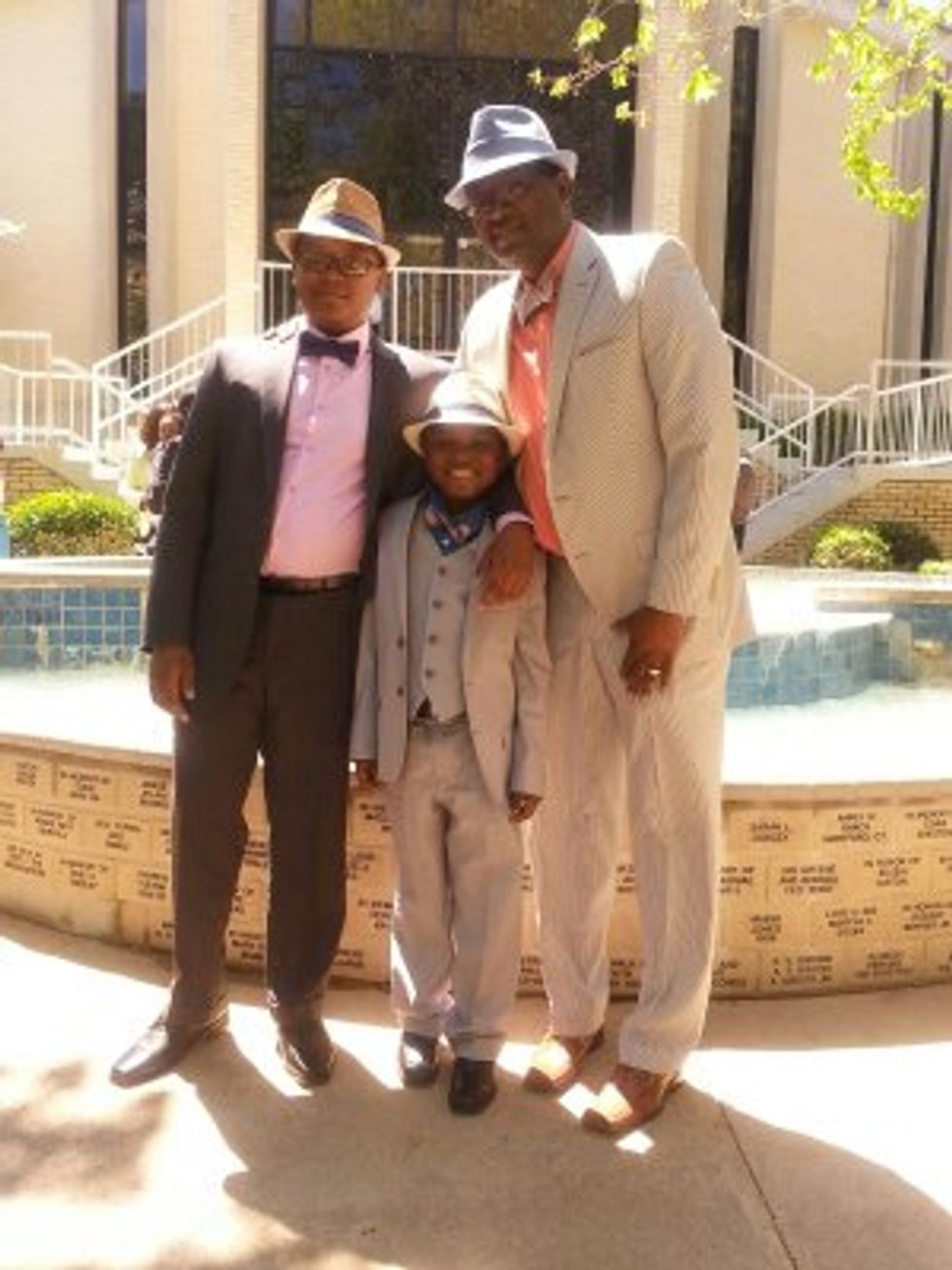
Easter 2014
Derek Sr., Derek Jr., and Elijah stood in front of the church’s water fountain after the Easter service, grinning and posing for me to take their picture. My mom and I had already taken ours, but my brothers felt as if their matching hats were being left out of the picture.
Then, two years ago, I simply captured this on my dad’s phone. I never wondered, until now, why the church members stood there in awe of my dad and my brothers and were actually taking pictures of them for themselves. As my brothers goofed around, bragging about whose hat looked better, church members marveled at the very sight of a black father and his two sons.
We attended an Easter service lead by the head pastor, who is an older African-American woman, who established the church on her own over 40 years ago. She holds her tongue for no one and dresses flamboyantly and elegantly at the same time. Standing six feet tall, she preaches to her congregation, which is majority older black women, dressed alike in their Sunday’s best, with the glow of both youth and wisdom. Being surrounded by so many strong, independent black women, I knew exactly what the answer is to Beyonce’s question of who run the world.
Yet, the society we live in constantly reminds us of the percentage of unmarried African-American women, and black women having children out of wedlock…
…and the marginalized image of a single African-American mother on welfare…
…and the mockery of black women on reality shows, black comedy movies and shows, and social media…
…and the high school dropout rate of black boys…
…and the number of African-American men incarcerated…
…and the growing number of black-on-black crime…
…and the exploitation and injustice of young black men killed by police brutality.
No matter how accomplished the women of the church were, no matter how many times Oprah Winfrey and Shonda Rhimes could say they would not let marriage overshadow their success, no matter how many doctorate degrees my mother would receive in a lifetime…
Society has equated “success” with the presence of a man, and society has made sure to tear down the image of a man in the African-American community.
This very thought was the photo I captured that Easter.
Do not get me wrong, my dad never restricts my mom from what she wants and aspires to do, and my brothers respect me for the very fact that I am the eldest child in the family. Yet, even though my mom and I were not in this picture, this was an image the members witnessed, that the males of my family were the namesake of the family, under society’s standards.
And this image, the very presence of my father and my brothers, were the supposed, assumed solution to the black community's “problems.” That is the restoration of patriarchy in the community due to the emasculation of black males by various factors.
But this image of masculinized hope, this image of only my dad and my brothers, I honestly feared, would greatly disregard the presence and efforts of the women of the family, the women of the black community, the women of society.
The article is the second of the series "Lessons from My Brothers." More of this series will be posted in the upcoming weeks. Read part one here .

















