
"Les Misérables," a story written by Victor Hugo that lives on not only through his page-bound books, but by one of the most iconic and spectacular musicals in the world. Throughout the entire show, Hugo's original themes of survival, redemption, hope, despair and love shines throughout the stage and on to the audience members. It is a theatrical triumph and an absolute must-see for those who love theater. As I have recently seen it, my mind keeps racing at the thought of certain scenes and songs while fighting off the impulse to burst out singing "One Day More" in broad daylight, so I decided to share my thoughts here about this slight obsession.
As I go forward, I should probably warn you that I am going to talk about certain plot points of the story and might give out important information that you might not know yet, so if you don't want anything spoiled on this musical and prefer that you see it yourself, I suggest that you read no further. If not, I hope that you enjoy my analysis and experience with "Les Misérables."
The biggest thing I realized when I watched the show onstage was that the themes and messages of "Les Mis" were stronger and much more impactful, compared to the film production. Through the stage adaption, I saw the similarities with all of the characters in the show, like, at some point, they were impoverished, or led a fine life before falling into a lower status, or likewise, how different yet similar their lives were, and how every single character is a survivor.
Think about it -- Fanzine survives solely for the well-being of her only child, selling her locket, her hair and eventually herself, just to keep her daughter alive, all the while not knowing that the Thénardiers had been lying to her the whole time about her daughter being sick all the while ripping her off, I might add, Cosette being a servant for who knows how long to the Thénardiers, Marius being the only one of his friends to survive the barricade. Even Javert admits that he was born in a jail cell and had to rise up to become a man of the law. But the biggest survivor of them all is Jean Valjean.
Here is a man who had a hard life in the beginning, being imprisoned for 20 years, but finds the grace of God, breaks his parole so that he can become a changed man and spends the rest of his life raising the daughter of a woman he had let down, so that he can redeem himself to her, all the while trying to not get caught by the police inspector that has sworn to bring him to justice (Javert, he stole a loaf of bread -- his crime wasn't that bad!). But surprisingly, throughout this musical, with Valjean and Javert, the show sets up the main difference between the two.
When Valjean was faced with the first act of kindness in years, by a complete stranger, he is humbled so much that he changes his ways and continually proves throughout the entire show that he will stay true to his word to the Lord. Javert on the other hand, when he shows a change of heart in sparing Valjean, a man that he has hunted for his entire life, he breaks down, questioning himself and his purpose, which then leads to his suicide. This proves that Jean Valjean was a stronger person than Javert, despite their statuses and it was shown by their actions, Valjean putting others' well-beings over his, while Javert stayed ignorant for the most of the musical, until he saw what the price of justice cost. Valjean stayed humble and helped those in need in any way he could until the very end.
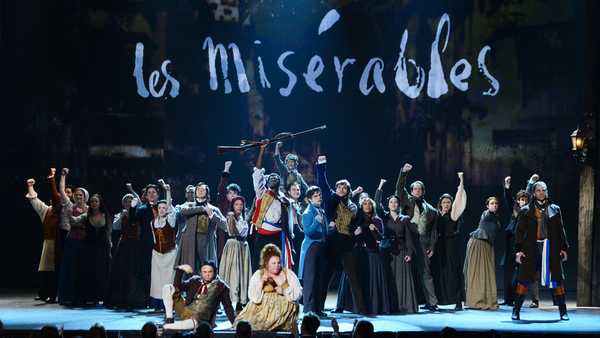
To cast the character and theme analysis out of the way, the show was spectacular to watch, not only because of the actors, but the set design, special effects and lighting. The opening scene shows the prisoners rowing a ship, and I was just overcome with emotion just to see not a complete model of a ship, but an illusion that leaves the audience members to their imaginations. In the final battle scene at the barricade, after all the members are killed, white stage lights shone on every single one of them to signify that their deaths were not in vain and they made passage to Heaven. As for the special effects, the backdrop gave off the illusion that the actors on stage would be moving forward, making their way through a sewer, and falling into a murky death into a body of water.
By the end of the musical, I, along with the audience, applauded the cast as they took their final bows. Our applause became louder as the main actors came up, but when the actor playing Valjean came center stage, everyone was on their feet. I read in the program that it was his Broadway debut, and he simply blew me away with his performance. Then he did something that made me break down into tears. He looked up toward the balcony, raised his hands together as in prayer, kissed his fingers and raised them up to the ceiling.
That is why I love musical theater -- it is a community of people that perform and create, on stage or backstage, and they don't do it because of money -- they do it because they love it and they want to share that love to other people. Actor Terrence Mann, who happened to play Javert in the original Broadway production, once said that "Movies will make you famous, television will make you rich, but theater will make you good." That is a statement that couldn't be more true. As the actors looked into the audience, smiles spread on their faces as they bowed down together for the last time that night and spread off backstage, leaving Jean Valjean in the center of the stage. He looked so happy and humble as he gave his final bow, and I knew, just like any other performer, that feeling of pure joy after giving a performance, and I felt the same exhilaration as he did. And I thank him, the cast, and crew of Imperial Theatre New York, for a wonderful performance.