
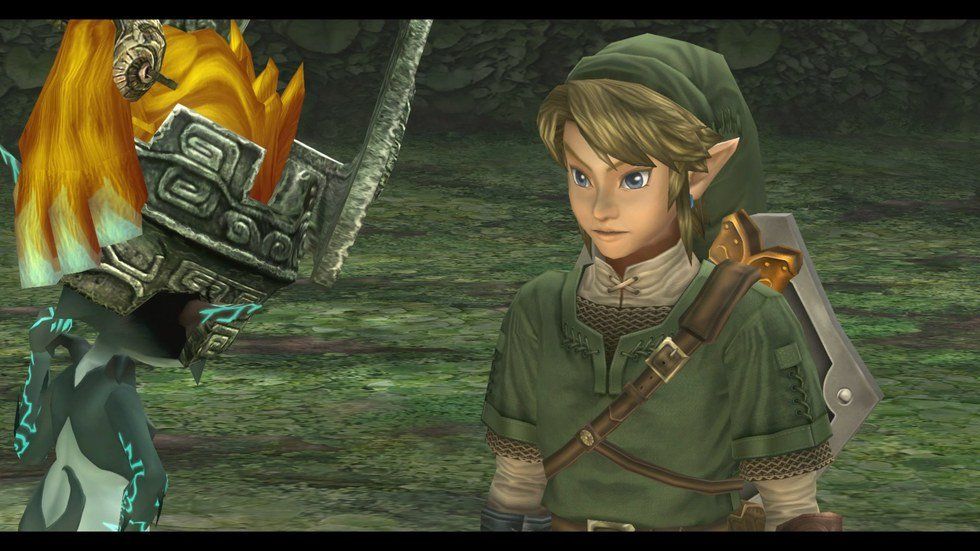
This March, the WiiU received an oddly-timed remaster of a game that nobody asked for: The Legend of Zelda: Twilight Princess HD. OK, well nobody except for everybody who watched that beautiful demo of the tarantula battle in 2011. Yeah, I was scraping the shit off my pants seeing the intricately designed marble temple reflected in the floor as Link’s fairy flies around him, casting a shadow in real time.
Ah, but that 'tis the life of a Zelda fan: Nintendo releases some outlandish video of Link dashing around a single room, looking slightly cooler and slightly darker than the last time we saw him, then the game we get is far more … Not. And then people everywhere groan: “When are we going to get our ‘realistic’ Zelda game?”
Zelda: Twilight Princess is a byproduct of this fan backlash; the Gamecube was revealed at E3 shortly after everybody’s favorite Zelda game, Ocarina of Time. At E3, fans were pleased to see Link return as a no-nonsense badass. Upon receiving positive feedback on the show, Nintendo did what it does best and did everything nobody particularly wanted. Zelda: The Wind Waker came a-shining with enough primary colors and bloom to blind a room full of nerdy journalists. Nintendo’s email was overflowing: half optometrist bills, the rest insecure fans crying about the lack of testosterone in the latest Zelda game. Ever since, the game has received many awards, but even when Twilight Princess hit the drawing board, people were still complaining. Nintendo’s answer was, “Screw it, just make Ocarina of Time again and throw olive oil on the screen.” Thus, Twilight Princess was born.
Since the release, critics haven’t shut up about the shortcomings of Twilight Princess, and the majority of people put it far from their favorite in the series, in part due to its similarity to Ocarina.
It’s time to give Twilight Princess another shot. Now, more than ever, this remaster (I refuse to call it a remake this time, Nintendo!) may have what it takes to shoot the game to stardom. I can give several reasons.
1. The last time I and many others played this game, one of the most important buttons in a Zelda game, the attack button, was replaced with flicking the controller. While I personally loved the motion implementation in Skyward Sword, this game, originally made for the Gamecube, did not need to make pressing the “A” button so complicated on Wii.
2. The game now looks the way you thought it was supposed to look. Yep, your contacts are fine. The problem is, playing Gamecube and Wii on any HD television makes games look like a blurry mess. In addition to HD, the WiiU game will have visual improvements that match the original artist’s vision closer than any other. (High-quality textures, revamped character models, etc.)
3. The Wolf Link amiibo unlocks a new dungeon that challenges you to wolf-only trials, and it can be used at any time, presenting a different temple every time. It’s a neat little idea that was going to be in the original game (minus amiibo) but couldn’t be added before release.
4. The Zelda-series amiibo make the game truly adjustable; scanning any version on Link will refill your arrows, Zelda/Shiek will refill your hearts, and Ganondorf’s amiibo makes you take double damage, essentially acting as your “Hero Mode.” Finally, people complaining about the game being too easy/hard can shut their pieholes.
Zelda games are not for everybody and, moreover, not every Zelda game is for every fan. What I’m saying is, some of you still won’t care about this game the second time around, but it’s really worth taking a less critical look at one of my favorite Zelda games of all time.