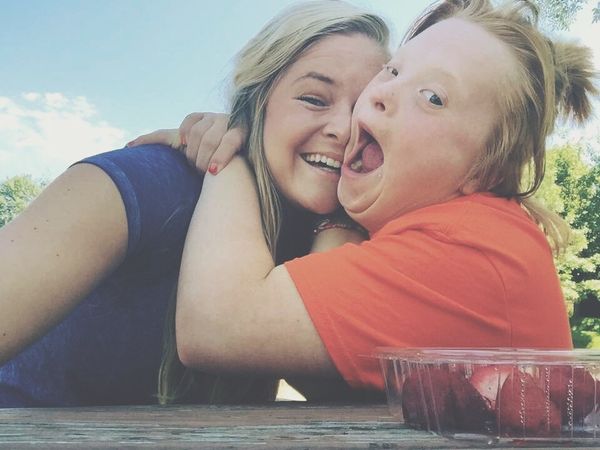


My younger sister, Brigid Satre, is the most resilient person I know. Throughout her life, she has been different from the rest. More caring, more creative, and more hilarious than the rest. These things make her different, and I could not/ would not ever want her to change a single detail about herself. One of these differences lies in the way she perceives the world around her, and it goes by the name of "visual processing disorder." Our parents found out at a young age that this was one of her qualities, and as a result of this knew that she would have to work harder than others to be "academically successful" in a traditional sense. The diagnoses predicted that she would not be able to follow the path that kids are supposed to follow in school.
So, she made her own. Through her tenacity, bravery, and overall positive outlook on the world she not only achieved success in her basic schooling, but advanced to higher learning and currently holds a spot on the dean's list at the University of North Dakota. To say I am proud of her is like saying the universe is large. She is the my motivation, and the reason I need to be a great person: so I can deserve to have a sister like her. Anyways, she recently felt the urge to write an open letter to the world about disabilities, in an attempt to make them more understandable. After convincing her to let me read it I begged her to let me publish it. She said I could, to spread awareness, and so other people who are experiencing this unique situation could know they're not alone. Ladies and gentlemen, what you are about to read was written by my amazingly talented sister, Brigid Satre:
"One thing that I admire the most in people is when they can make fun of themselves. It’s hard to talk about learning disabilities personally for me because growing up I was diagnosed with visual processing disorder. I actually didn’t know the name of my disability until I was in class listening to one of the presentations and it sounded like what I had. I called my mother immediately after class to ask if that was what I was diagnosed with, and she confirmed what I suspected. I always felt that people looked at disabilities in a negative way there for I viewed myself in a negative way. When I had to attend special classes for reading and writing I was ashamed and did not tell any of my peers. Living with a learning disability as a child had its pluses and minuses. I look back and laugh because while other kids were learning the alphabet I was cutting out pictures of the next American girl doll I wanted. I remember kids making fun of the fact that I talk slower than normal or fellow peers editing my assignments riddled with spelling errors. This thing that I held locked up in my heart I finally set free by talking about it, and you’ll soon find out that inherently means that I joke about it as well.
To get straight to the point the media can sway anyone’s opinion on a topic. For a while when I was younger the cool thing to do was watch South Park. South Park was a modern clever and fun show that always left me laughing. The problem was I feel like a lot of the shows targeted to young adults represent disabilities in a negative way. It’s always nice to be able to make fun of yourself and not take yourself seriously, but when you start to make fun of someone else’s imperfections it can cross some boundaries.
The popular word back in my middle school days was retard. Most kids used this term in a negative connotation. Most kids were awkward and uncomfortable with themselves so they would joke about other kids’ differences. Jokes should not be taken seriously, but everyone knows it is not a fun feeling when you are the butt of the joke. I wanted to look at comedians and see their perspectives on this topic.
Comedians often push boundaries and say things that deep down you want to say but usually can’t. I watched Josh Blue’s stand up and Jim Jeffries comedy special. Both men are drastically different but talked about disabilities. Josh has cerebral palsy and wins audiences over with his self-deprecating humor and Jim is the type of guy who gets laughs from witty below the belt humor. I am one who can 100% percent laugh at a mistake I make or a thing that I can call a flaw and it was nice to see that Josh’s standup was talking about disabilities and that they don’t define you or hinder your happiness. He pretty much is stating “yeah, I have a disability and before you can make fun of me for it I can do it myself, and the jokes will be 10 times better than yours too.” While when Jim Jefferies talked about learning disabilities, he compared infrastructures of different societies. (Just to forewarn you Jim Jefferies does swear quite a bit and I will keep things a bit clean by inserting beeps in replacement to swear words)
He states: “If you have a classroom (with) American little children and Johnny isn’t keeping up with the other kids, what you do? Come on Johnny you can catch up. We believe in you. What do you think they do in China when Mae Pang isn’t towing the line? Get out of the way you dumb (beep), don’t talk to the smart kids, you’re weighing them down… But your child isn’t stupid. Not your child, your child has a ‘learning difficulty’ that’s the definition of stupid. If you have difficulty learning; that’s what stupid is.”
Harsh words to take in. I know I painted this comedian in some sense to be a villain because many people agree with this view that a learning disability automatically means you are “stupid” or “dumb”, I personally disagree. I think that because I literally view/learn things differently it doesn’t mean I’m “textbook stupid.” I have been fighting my whole life to prove to myself and others that I am smart/normal. I don’t need help and that I can do this.
The idea that I can take away from Jim Jefferies stand up is his point that “I’d take a nice idiot over a smart (beep) any day of the week.”. Overall when I tell people I have some tough times learning I don’t find that they react in a negative way or sometimes the way I view myself. More and more people in American society do cheer on “little Johnny” with the learning disability because we value people who work hard and do struggle. No adventure or epic had a character go from point A to point B without struggles and hardships. I want to go through this journey of life laughing at my mistakes and facing my issues, that doesn’t mean that I’ll need to laugh at others while I do it, and neither should you."
Good work Brigid. Love ya.