"If you must blink, do it now. Pay careful attention to everything you see no matter how unusual it may seem. If you look away, even for an instant, then our hero will surely perish." -- Kubo and the Two Strings.
I'm going to try and write about the things this movie made me think about. But, if you haven't seen the movie yet and are concerned what you might gather from reading this, here's a spoiler warning.
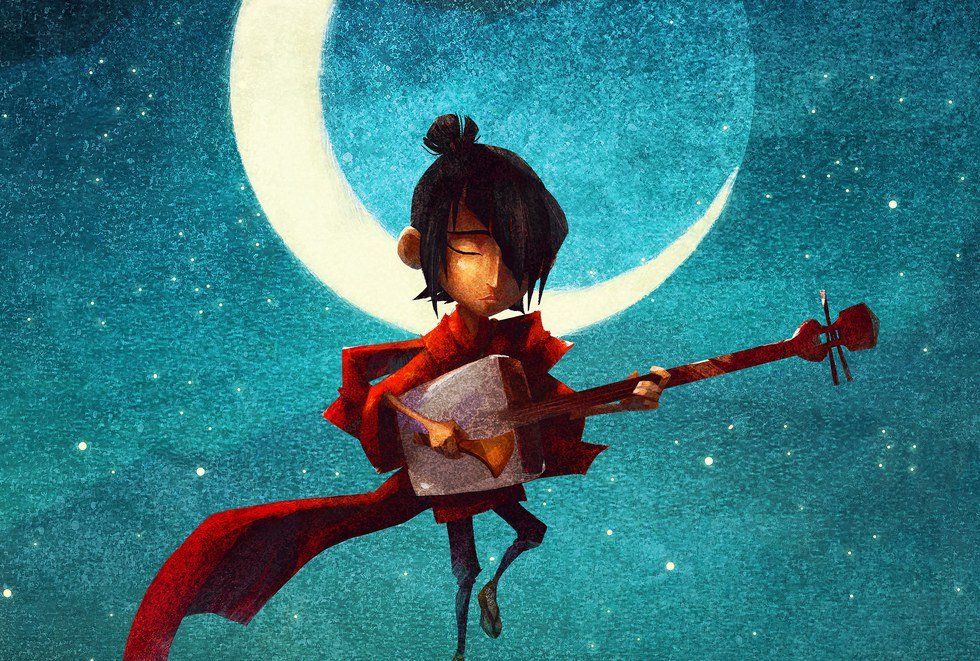
The movie opens with a voice-over from the main character, Kubo, a boy who spends his days telling stories in the village with magic origami and music from his shamisen, a Japanese three-stringed instrument. Day in and day out, he weaves tales of heroic figures battling the dark forces, enthralling the villagers and leaving them eager for more. However, he always returns home before the sun sets, heeding his ailing mother’s warnings that the Moon King will come after him to steal his eye. One day, Kubo stays out too late and is found by the Moon King and his two daughters. Thrust into danger, Kubo is forced to embark on a quest to locate the three parts of a magical armor that will protect him from the Moon King.
Kubo is, at the core, a storyteller. And that's really cool.
His greatest gift is his magical shamisen, which he uses to animate the stories that he tells the villagers. In the end, after spending the majority of the film seeking the magical armor, he removes the armor in his last stand against the Moon King, takes up the magical shamisen, and strings it with hair from his mother and the bowstring of his father, symbols of their love for him. When he strums it against the Moon King, who has been pursuing him to rid him of his sight, and by extension, his humanity and empathy, the latter is reduced to an elderly man who has lost his memory. The Moon King wakes up in the rubble of the village he has destroyed, while scared villagers peek out of their hiding places.
Kubo and the villagers take in the old man in as one of their own and fill in the gaps in his memory with new stories about how he was a really generous and helpful man, who acted selflessly and cared for people’s needs. The former Moon King readily accepts his new identity and purpose and joins the rest of the village. At this point in the movie, I was seriously torn between two reactions.
The first: This ending doesn’t serve justice for all the evil this man has wreaked upon his world.
The second: This is a startlingly bold message in a time where justice is increasingly warped and twisted, a time where no one can seem to agree on what the right thing to do is.
Here’s what I appreciated: Instead of using physical force or completely magical means, Kubo disarms the threat by rewriting the Moon King’s internal narrative. Why is this important? Up until his defeat, the Moon King has been living under the belief that to physically see the world -- to be proximate and to feel empathy for its inhabitants – only brings weakness, pain, and chaos. This internal monologue gets written over with new stories about living in harmony with villagers and taking care of their needs. Kubo the Storyteller, not Kubo the Warrior, saves the day.
Stories have a way of presenting truth elegantly and artfully without always using facts, that when done well, the end result proves profound and worth more than the sum of its parts. They can change people, alter their perceptions, cross boundaries and barriers, and bring different people closer together. That is their power.
Today, storytelling is more important than ever. We are increasingly saturated with headlines, seeing the same links pop up on our social media homepages with the same messages. Those are important. They keep us aware and grounded on the plane of what's-actually-going-on-with-the-world. But stories can humanize, draw out the invisible lines and ties that bind everything in this world to each other, and help us reshape the internal narratives that drive us forward. This, ultimately, allows us to make the greatest change that we want to see.