


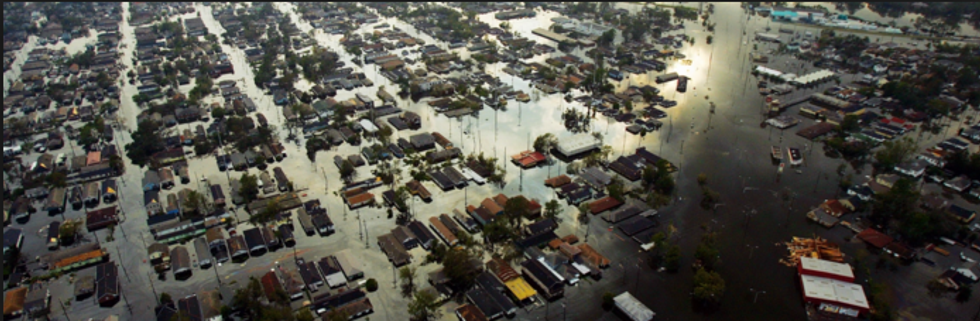
As many of you know by now, Beyoncé released a music video over the weekend. Because I see the publication of artistic work as an invitation for review, I will proceed to voice my opinions concerning her use of what I saw at first as a problematic employment of history. Due to my limited understanding of music, I will refrain from uninformed scatterings regarding that realm; instead, I will focus on analysis of the video on a purely visual and ideological level.
Beyoncé's video upset me. Coming from New Orleans, it stunned me that someone could exploit my pain, the pain I share with so many others, to comment on her perception of contemporary judgments. Hurricane Katrina is part of a collective trauma that New Orleans had to face and battles with to this day. The streets are still blemished by shells of homes left in ruins, and people lose their wits when those all-too-familiar cloud formations show up anywhere near our sweet little boot-shaped state. So to see Beyoncé, a woman with so much support from all kinds of interest groups yet no cords that I could see connecting her to New Orleans (ahem, Houstonian), splay herself on a submerged police car and sing about her roots, seemed extraordinarily out of place for me.
Why should it? It was at times inexplicable, that souring of my gut when friends lauded the video for the umpteenth time. It was like hairline fractures in the stones of my foundation, the way they could appraise her video with such high regard. So, as I often do when I find myself perplexed and with no apparent solution, I walked around my room, stood up, sat down, opened books I didn't intend to read. It was on the shutting of such a book that I understood the praise my dear ones were giving the video. Although I'm sure theirs was probably not a conscious assessment, their interest revealed to me that good art should challenge the borders of our comfort areas. What bothered me most about her presentation of Katrina imagery was that it seemed so ineffectual. What I now see, however, is the perplexing observation that her video didn't treat Katrina with any of the tenderness and sensitivity with which it has been handled since its landfall in my city.
The best artists search for inspiration outside of their own heads: who would Hemingway be without his matador muses? It was not so much her evocation of these images that conjured too bleak of memories for me than the lack of softness with which she presented them. But why should they be bleak? Katrina showed just as much the capability of our citizens' resilience and light spirits as the corruption of our government systems, the storm should hold just as much cause for jubilation as for lament. At this juncture I can say that she had every right to echo her anger towards stereotyping and racism in America with the symbolism of Hurricane Katrina. Despite the driftwood shards of a trauma that will never quite go away, we do not have the right to authorize or forbid such displays of inspiration. In such a censored world, the face of literature would atrophy into nothingness.
















