
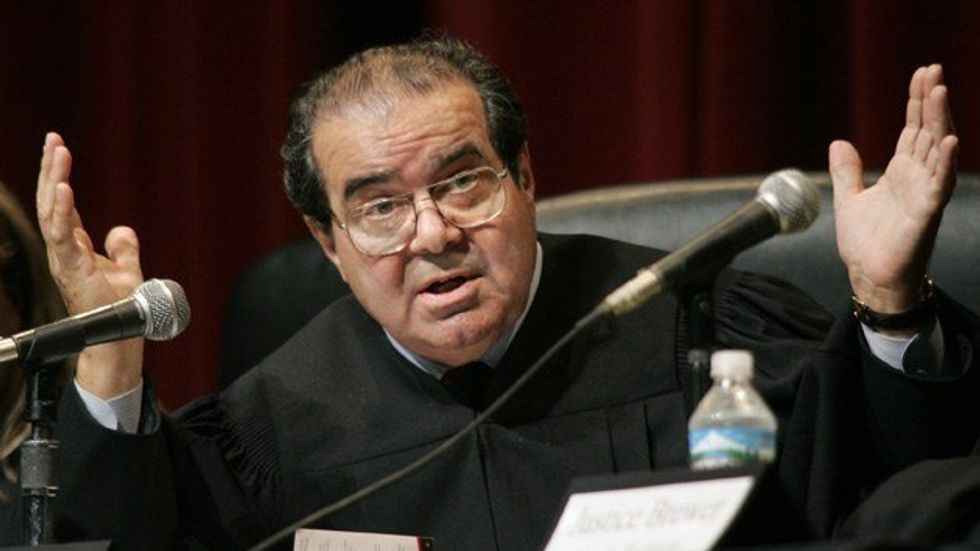
Antonin Scalia, a 30-year Justice on the Supreme Court, was known for his scathing dissents on the federal bench. His opinions were the representation of conservative thought and there is no doubt that his opinions and dissents characterized and continues to inspire much of the conservative movement in this country.
Scalia was known for many things: A literal interpretation of the Constitution and a strict originalist view of American law. He was also known for his wit, his cheeky sense of humor, his no-nonsense attitude and his unusual yet remarkably beautiful friendship with this polar opposite: Justice Ruth Bader Ginsburg.
Two weeks ago, the Justice passed away while in a resort in Texas and has left many to mourn the death of one of the countries leading intellectual voices in law.
His death has created an inconvenience, particularly with the Republican Party. Only hours after his death, Senate Majority Leader Mitch McConnell announced that he would do everything in his power to stall the nomination of a new Supreme Court Justice as a replacement for Scalia.
According to the Majority Leader, "The American people should have a voice in the selection of their next Supreme Court Justice. Therefore, this vacancy should not be filled until we have a new president."
This statement comes as a historic backlash to the way politics have always worked. According to the Constitution, the president is given the authority in these kinds of situations to nominate someone to the bench. That nomination would then go to the Senate for a vote, and the Senate will decide, after several confirmation hearings, whether the nominee is fit to serve as Justice.
But this time, the GOP leadership in the Senate has blatantly admitted to plans of deliberately obstructing the process claiming that the selection of a Justice hold off until a new president is elected. Giving the "American people... a voice" is nothing but an attempt to preserve the already fragile political power balance in the Court.
Previous to Scalia's death, the Court had five conservative judges and four liberal judges. With the death of a conservative voice on the Court, that gives the president the opportunity to fill the vacancy with a more like-minded judge, dramatically shifting the ideological balance of the court from primarily "conservative" to "liberal."
It's not surprising that the Senate leadership would do this. They are clinging to a hope that the next president would be a Republican and that the new administration will appoint a conservative judge similar to Scalia. This would obviously not happen with the current president who would more likely nominate a more liberal judge.
The tactics of the Senate leadership are obviously of an obstructionist nature to avoid a Justice that does not line up to GOP values. To use the American people as a scapegoat is also humiliating. The American people do have a voice and they continue to have a voice in the selection of Justices when they elected the president in 2012. If they felt the president was unfit to select a Justice in the case of death, they would not have elected him to begin with.
Deliberately obstructing the process is an embarrassment and the use of Scalia's death for political games puts the Justice's life work in vain.