
Imagine: you enter a restaurant, movie theater, or any other public place, and you are judged immediately. People stare in fleeting glances, go out of their way to avoid coming in contact with you, and whisper about you secretly to each other. They mumble degrading comments under their breath as you simply try to go about your day.
Such is the everyday life of a person who is labeled by society as “different”.
It’s the 21st century. We sent a man to the moon nearly five decades ago, our smartphones can talk back to us, and we have built weapons capable of destroying an entire nation. Yet, as far as we’ve come technologically, humanity has failed to learn the art of compassion and acceptance.
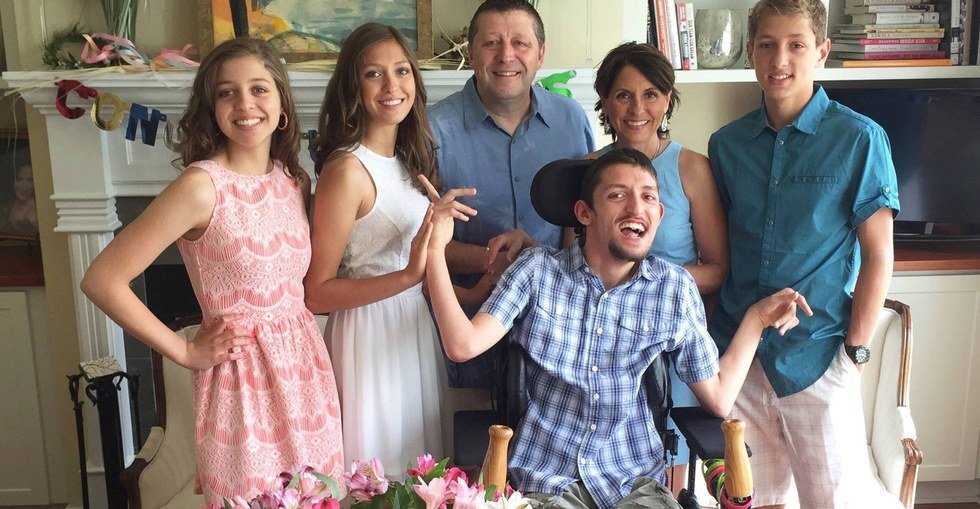
My older brother, Nicholas, was born with quadriplegic cerebral palsy. Cerebral palsy prevents Nick from controlling his arms and legs, rendering him wheelchair-bound for his entire life. He cannot walk or talk on his own. It stems from a malfunction in the brain and is not contagious or transferable from person to person.
Growing up, I never saw Nick as different from other people. He was special because he was my older brother, not because he was unable to control his arms and legs. My siblings and I talked to Nick like a ‘regular’ person. Being the oldest in the house, we knew he was the boss.
Nick is extremely intelligent and communicates via his eyes and “yes-or-no” questions. He looks to the right to answer “yes”, left to answer “no”, up to the ceiling to answer, “I don’t know”, and down at his feet if he needs you to repeat the question again. Nick is fully cognitive, completes all his own homework assignments, and can hold a conversation quite well.
He even uses a special computer, controlled by his eye movements, to talk and create full sentences. I had my first conversation with Nick the night before I left for my freshman year of college. For the first time in 18 years, my older brother told me goodbye, that he’d miss me, and that he loves me. That transcends all physical boundaries.
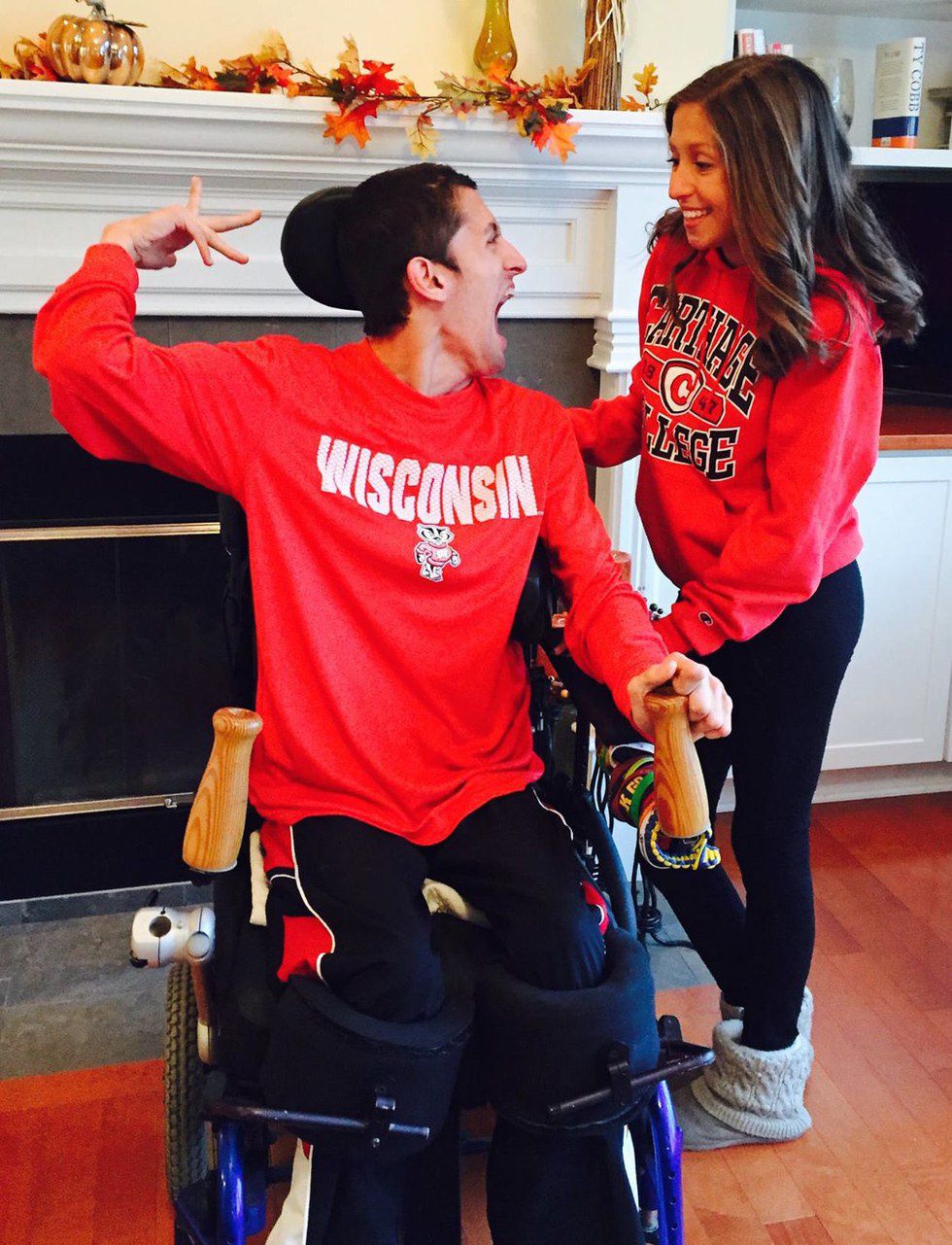
Nick’s disability hasn’t stopped him from living his life to the fullest. He’s modeled for magazines, flown in hot air balloons, plays baseball, and even competes in marathons (with the help of other athletes). He’s helped change medical practices for individuals with special needs. And still, Nick is one of the most kind-hearted, generous, and positive people I have ever meet. He is, without question, my role model. Needless to say, Nick’s disability isn’t an obstacle for him. Yes, it’s a part of his life. But it doesn’t define him.
And that’s how it should be. The way someone was born shouldn’t define who they are. But some can’t look past that. To them, all they see in Nick is a man who can’t walk or talk like them. Nick has endured those glances of repulsion, the condescending tones of voice, and the pure disgust from people who haven’t taken the time to sit down and get to know him.
I’ve met people who are worried that cerebral palsy is contagious, and they don’t want to touch or be around Nick because they’re afraid they’ll “end up like him”. They simply judge him based on what they first see, and determine that he isn’t worth their time. Somehow, those people are better than Nick. Society has labeled him as inferior, a burden.
When it comes down to it, what are we, really? Flesh, blood, and bone. We all, more or less, come from the same place, and end up in the same place. We share so many similarities, both physically and within personalities. So are someone’s skin tone, religious beliefs, or ability to walk or speak really justifiable means to judge someone? Should the way that someone was born affect how they’re treated by society? Who’s to say that two people’s differences in personality aren’t justifiable means to discriminate, but certain factors out of their control are?
Obviously, this issue isn’t limited to those with disabilities. It applies to races, religions, sexuality, illness, and even genders. But, as a culture, we haven’t fully come to terms with the concept of acceptance. We simply tolerate.
The Merriam-Webster definition of the word “tolerate” is “to put up with,” and definition of “accept” is “to give admittance or approval to,” as in the context of a group. Do you see the difference? One describes just bearing with the fact that another person is different, and the other describes welcoming another’s differences. Simply put, tolerance just isn’t good enough anymore. It’s time we learn to embrace other people’s needs, remember that we all have feelings, and start treating others as they are: human.
I’m going to ask you to try and put yourself into Nick’s shoes for a moment. Imagine getting up every day, knowing that the world has condemned you as inferior, feeling like no one is on your side to help you achieve your goals and dreams. It’s a frightening thought, isn’t it?
People come up to me often and say, “I don’t know how you do it. Isn’t a struggle to deal with him and his differences sometimes?” Obviously, these individuals have only good intentions in mind (at least, I like to think so). But the answer is, quite simply, no. No, it is not difficult for me to know an individual who maybe has a more difficult time conveying his ideas and thoughts. No, it is not hard to treat him like a human being, with the respect he deserves. No, it is not hard for me to love someone unconditionally, even though he may not be exactly like me.
And so, I encourage you to take the time to get to know someone with a disability, who struggles with their sexuality, or who are from another race or religion. In a room full of people who stare or shake their heads, be the one who offers compassion, kindness, and a helping hand. Perhaps in embracing another’s differences, you’ll find you both have a lot in common.
After all, when it comes down to it, we’re all human. It’s time we start treating each other like it.