

Physics is broken into two general classifications depending on the content or the problem. Classical physics is the first group and it includes any of the discoveries made before the twentieth century. Some of the major discoveries of in this group include Newton’s laws, Maxwell’s equations (Which help form the foundations of classical electrodynamics, optics, and circuits), and the laws of thermodynamics. The second group is modern physics, which includes any discoveries that are based on the two pillars of modern physics, relativity and quantum mechanics.
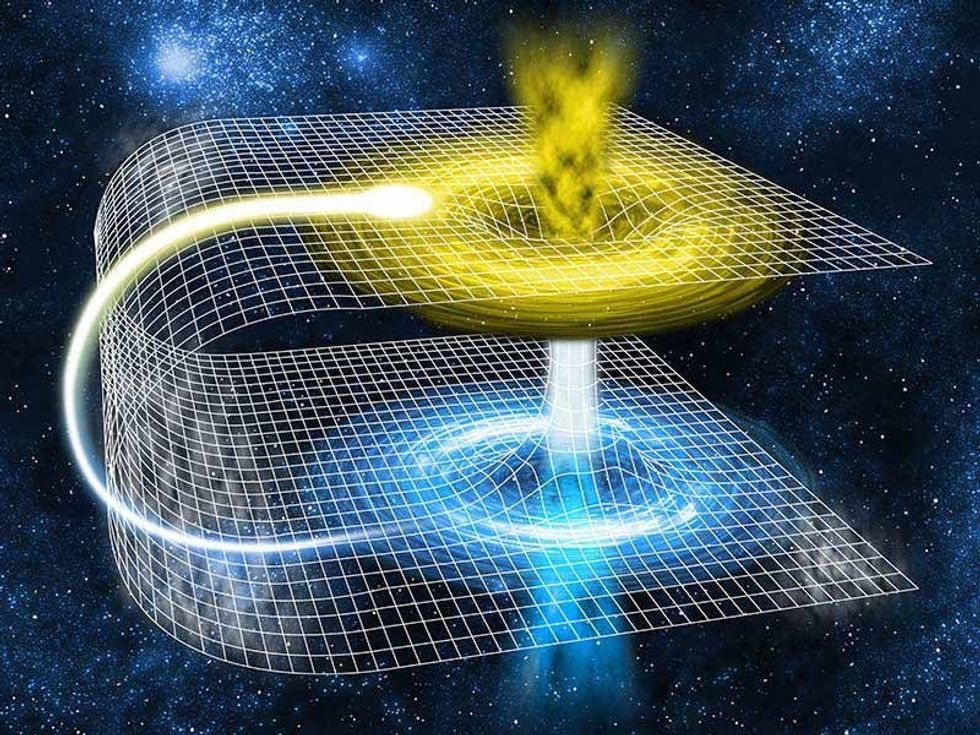
Relativity is a two part theory proposed by Albert Einstein. The first part, special theory of relativity, was published in 1905. Special relativity is a vast theory that explains much about the universe and how it works. It is based on two ideas that are contrary to classical mechanics. The first is that the laws of physics are the same for all observers in inertial frames. The second is that the speed of light in a vacuum is constant. Based on these two principle concepts Einstein was able to tell the world that time is relative, energy and mass equivalent, the cosmic speed limit is the speed of light and that the effects of gravity are not instant, but travel at the speed of light. Special relativity also constructs what is known as spacetime. Spacetime is the theory that three-dimensional space and time are combined into a single four-dimensional continuum. Spacetime is the basis of the second part, the general theory of relativity. General relativity is Einstein’s theory of gravity. Einstein explains gravity by saying that objects with mass cause dilations in spacetime. Think of spacetime as the blanket on a mattress imagine placing a bowling ball in the middle. The bowling ball will push down on the blanket and mattress the dilate it. Now if you were to place another ball such as a ping pong ball close enough and it will start to fall towards the bowling ball. This is how gravity works according to general relativity.
Quantum mechanics is a bit different from a theory, because while Max Planck is accredited with its discovery there were many others that contributed to this breakthrough. In simple terms, quantum mechanics describes the laws of physics in the sub-atomic world. What this means is that at a sub-atomic level things happen differently and how they happen is described by the equations of quantum mechanics. What they describe is the interaction between matter with other matter and matter with energy.
A problem arose when these theories were being applied together. It turns out while numerous experiments have supported both theories, there has yet to be a highly successful theory that works experimentally with both relativity and quantum mechanics. This problem is what physicists are still working on today.
These theories have led to some of the most important theories in the century. This includes the standard model of particle physics, black hole theories, dark matter, and string theory. They have led the study of physics to continue while causing difficulties. Most importantly they have been a basis for some of the most important and complex theories to ever arise in physics.
http://blog.stephenwolfram.com/2015/12/what-is-spa...
https://en.wikipedia.org/wiki/Theory_of_relativity...