I come from a moderate middle-class family, but my father always wanted me to go to private schools because they would present me with more and better opportunities. Since preschool, I attended private schools, all the way up to high school. Coming from a moderate middle-class family in Zimbabwe and being in a classroom with children who would always get the latest gadgets and toys was not easy, but each time I complained to my father about how so-and-so went to South Africa and bought the new PlayStation or sneakers with wheels, he would remind me that the only reason I was in that class was so that one day I could afford to buy the latest [blank] for myself without thinking twice about it.
He would say, “Tino, I don’t have any cows, land, or property to give you when I die. The only thing I can give you is a chance at a better education.” Then he would chuckle and say, “Plus, I went to fight the colonial war for two reasons: One, so my children could go to the schools they told us we could not go, and, two, so that we could take back our land.”
So in moments of school fees debt and thread-bare school shirts, I would think of my father’s words. In 2013 when I received an opportunity to go study at a private prep school in South Africa, ranked the best Pan African prep school on the continent, I thought of my father’s words. His sacrifice was paying off; I was getting better education and tremendously better opportunities. In 2015, when I received my college acceptance letter admitting me to Wesleyan University, I thought of his words again. Despite not having much, my father was going to have his son attend a top-tier college in America because of the choice he had made to invest in my education - but most importantly because he could.
If my father and I lived in America, then he would not have been able to send me to good schools even if he was willing to sacrifice all the money a single middle-class parent makes. Why? Because of institutional racism.
Institutional racism hinders African Americans and minority ethnic and racial groups to obtain not only good education, but health care, housing, and, above all, employment. Now, not all African Americans or minority racial groups in America are unemployed or working class, but the majority are. And even those who are middle- or upper- class still face the corollaries of living under this system of organized oppression. Given that I am not an American citizen, my American history may not be as expansive as, say, a Supreme Court judge, but I do know one or two things. America ratified its Constitution in June 1788. Within this document were three clauses under Article 1 which stated that:
- The Migration or Importation of such Persons as any of the States now existing shall think proper to admit, shall not be prohibited by the Congress prior to the Year one thousand eight hundred and eight, but a Tax or duty may be imposed on such Importation, not exceeding ten dollars for each Person.
- Representatives and direct Taxes shall be apportioned among the several States which may be included within this Union, according to their respective Numbers, which shall be determined by adding to the whole Number of free Persons, including those bound to Service for a Term of Years, and excluding Indians not taxed, three-fifths of all other persons.
- No Person held to Service or Labour in one State, under the Laws thereof, escaping into another, shall in Consequence of any Law or Regulation therein, be discharged from such Service or Labour, but shall be delivered up on Claim of the Party to whom such Service or Labour may be due.
These three clauses regarded African Americans as disposable, exchangeable property who could not be considered whole or complete because they were inferior to the white man. It is imperative to take note of this historical moment because it is within this historical moment of slavery and exploitation that institutional racism is born. It is within this moment that segregation is systematically endorsed by the highest power in the land: the Constitution.
Slavery was then abolished in America in 1865 after 77 years and the 13th Amendment, 14th Amendment and the 15th Amendment were ratified. However, abolishing slavery did not mark the end of segregation. America then moved into the Jim Crow and lynching era, which came to an end with the civil rights movement and the passage of the Voting Rights Act in 1965. Before this civil rights moment, African Americans were not allowed to own houses or get a mortgage, attend good schools, attend university; they were basically not allowed to build wealth or have any access to any resources or tools that would allow them to do so. So whilst America was experiencing an economic boom and the white middle-class was growing due to home ownership -- in the suburbs -- African Americans were being redlined and forced to live in the inner city and just be cheap labour.
Fast forward to today, and are things any different? Upon arriving in the United States I had some white Americans tell me that we are now living in a post-racial society where the president is black. Some even said that race is a personal issue, and some have even said that black people can be racist too.
Not only is it the white Americans who told me this that think like this, it is anyone who fails to see the systematic consequences that come with being black in America. It is anyone who fails to recognize that there are policies that exist or existed whose sole purpose is to and was to stagnate the African American and minority groups in America. For example, in terms of education in America, you can only go to the school within your zone and not outside it. This is because in America people pay taxes to fund the resources of the schools in their zones.
This may sound completely reasonable until you consider that because of the discriminatory housing policy, working-class African Americans (who are the majority) live in ghettos or dilapidated areas where the schools cannot afford the resources they need because the working class tax payers fees is really not that much. So this means that if you are a child born to an African American or any other minority group your chances of attending a school where they see more drop outs than graduates are higher than the child who is born white community. Why? Because many years ago white people who controlled policy making in the country (and still do) decided that dark skin was tantamount to inconsequential.
The reason why there is more violence in African American and minority communities is not entirely because people of color are inherently violent; it is largely due to the systematic constraints that these people are experiencing. If you cannot go to a good school because it is not in your zone, and if you cannot find a job because the employer will not hire you in fear that you will make the customers suspicious, and all you see on TV are people like yourself being constantly portrayed as violent thugs, then at some point you begin to internalize this view because it is all you see and all you are allowed to be. As the Nigerian author Ngozi Chimamanda Adichie says, “If you show a people as one thing, as only one thing, over and over again, that is what they become.” Now, by no means am I trying to dismiss individual agency and choice and put all the blame on “the system,” but my concern is that the system is limiting the individual’s agency and that this is despotic.
What is even worse than the system being oppressive is that it tries, and most often succeeds, in blinding us from its existence and its effects. It does so by forming a society which grows up believing in the power of individualism in capitalism and the opportunities it offers to us all despite creed. By fostering an environment which celebrates mantras such as “raising all boats” and “pulling yourself up by the bootstraps” the system successfully commits the erasure of the African American plight. The erasure of being robbed of generational wealth, culture, and values. How can all boats be raised when others are still swimming to the boats? How can one pull themselves up by the bootstraps when they cannot even buy the boots? We live in a society that teaches us the horrific history of slavery but then expects us to not hold the present accountable for the past.
"We live in a society that teaches us the horrific history of slavery but then expects us to not hold the present accountable for the past."
It is a society that says you can choose to live your life right, work hard and succeed. This individualistic lens is a philosophy rooted in neo-liberalism. It is a philosophy that blames the individual if they fail to look after themselves. In a neo-liberal state, like America, the state sheds itself of its responsibility to the citizen and transfers it to the private sector. In America, the private sector is run by the top 1% who are white wealthy families who have been accumulating wealth for the last 400 years. These families have a direct impact and influence when policy is being made and their main goal is to represent their own needs.
This is what institutional racism is; it is a system that oppresses people but blames them for their failure to succeed. It is ignoring the consequences of not having been able to earn remuneration, accumulate wealth and buy property for at least a hundred years. It is negating all the social and economic consequences of the racial policies ever implemented in America. The problem with people who say that racial laws have all been struck down hence racism no longer exists is that they fail to realize that just because a law has been struck down, does not mean the culture engendered by that law has also disappeared. They mistake correction for reparation. They are not the same. The Supreme Court ruled the federal use of covenants unconstitutional but this did not stop realtors from selling good houses in safe neighbourhoods to white people only. The Supreme Court ruled that slavery was unconstitutional but this (even after Affirmative Action) has not stopped white men being the most hired population in America.
Institutional racism is about a longstanding power dynamic that exists between white people and everyone else. This is not saying that every white American is constantly waking up and devising policies that will aide himself and his peers - no. But the foundations of this ‘great society’ were built on segregation and hence the institutions put into place those many years ago that is the Executive branch, the Judiciary, and Congress were also built to model this oppressive structure.
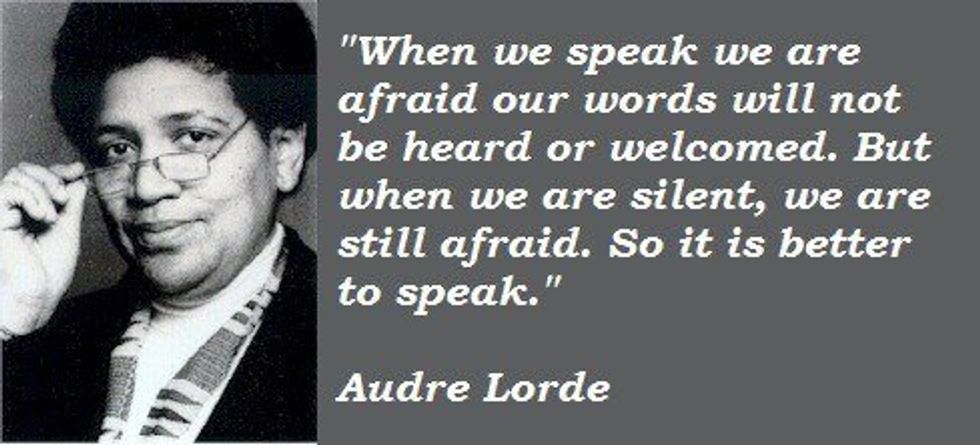
Hence, I do not blame Barack Obama for not doing as much as he could have done to advance the black agenda because, in America, people do not run institutions; institutions run people. One man cannot change a system that has had over two hundred years to set and augment. One man cannot perform a complete system overhaul in eight years, so if any radical positive change is to be actualized soon, people must realize that what Audrey Lorde said was true: “The master’s tools will never dismantle the master’s house.” It will take a complete societal awareness of the limitations placed upon others, not because of their own doing but only because of their identity, to see the day where a single parent in America who comes from a minority racial group and is of modest income be able to simply choose to work hard to afford their child a better life, without having to circumvent systematic policy hurdles as well.
So to you, reader, who did not understand what “institutional racism” is: I hope now you do. If you do not, that is okay. The multiple shootings of black bodies with no justification or cause other than assumption should serve as good enough of a physical illustration of this mythical system I speak about.