Beauty comes in all shapes and sizes. Or, beauty comes in all shapes and sizes?
That, in two sentences, captures the social issue of who gets to feel beautiful. The media tells us beauty looks like a Victoria's Secret model and Scarlett Johansson, or maybe more appropriately the unattainable forms of Photoshop. Despite promotions such as the Dove Real Beauty campaign, the window of beauty ideals remains way too small, metaphorically and literally, because, the greater majority of times, issues of beauty are also issues of weight. Photographer Yossi Loloi created the Full Beauty Project to challenge that.
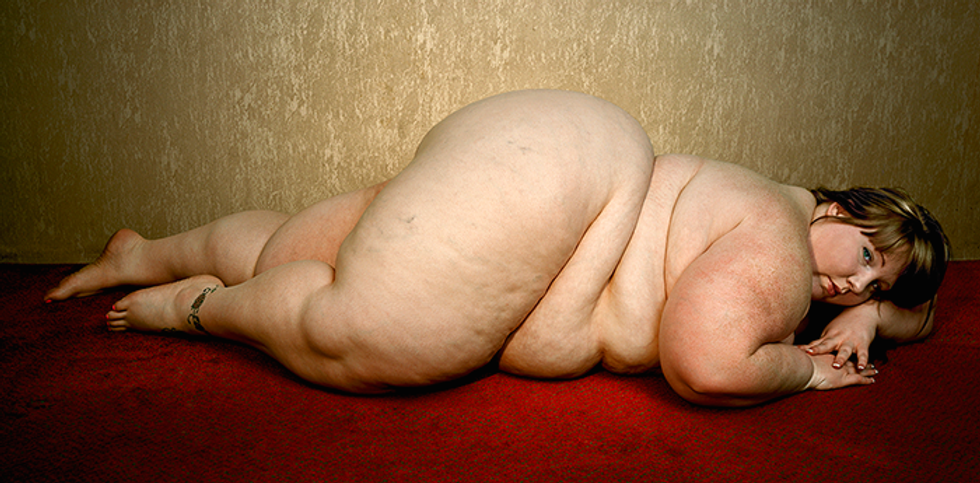
A renowned photographer, Yossi Loloi became famous for this provocative project in 2013 as it began exhibiting around the world. The Full Beauty project took shape over several years, beginning in 2006, and features the nude forms of women from the ages of twenty-three to fifty and weighing anywhere from 350 to 600 pounds. Loloi met most of the women who posed for Full Beauty fighting size discrimination at fat acceptance events. Loloi, himself, says the project focuses on women’s “fullness and femininity, as a form of protest against discrimination set by media and today’s society.”
The collection has been met with an array of reviews and reactions ranging from positive to negative and everything uncomfortable and uncertain in-between. In a review of the collection, Meghan Young writes, “the Full Beauty Project photo series is chock full of shocking images.” But, let’s be frank, it certainly can’t be the nudity that makes these images “shocking”. The year of 2015 having bared witness to Magic Mike XXL, countless more nude Kardashian selfies, and television programs such as Naked And Afraid, Dating Naked, and Naked Castaway. It seems safe to say society’s sensitivity to nudity has come and gone . Meaning, the shock value of the collection solely revolves around the weight of its photographic subjects. Yet, that’s almost equally ridiculous considering that over a third of Americans are obese, the average American woman is a size fourteen, and, in 2014, more women reported wearing a size sixteen than those wearing a zero, two, and four combined.
Those who praise the collection, including myself, often focus on its ability to manipulate the perspectives of the audience; calling us out as victims of mainstream media, brainwashed by the current beauty ideal, and challenging us to see a greater spectrum of society as beautiful. When studying the collection it’s hard to ignore the associations of Loloi’s subjects to prior beauty ideals (that’s right beauty ideals have evolved).
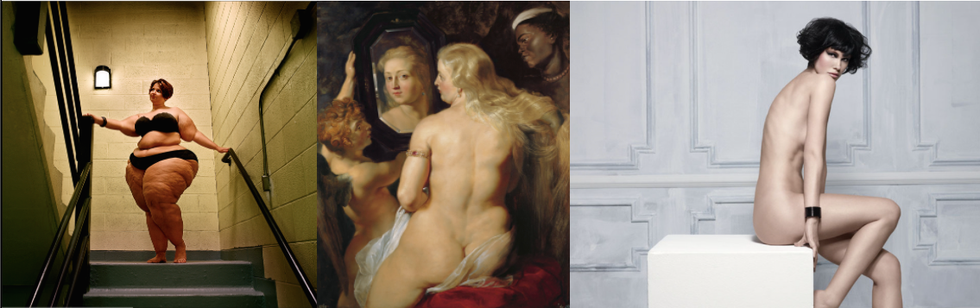
It's easy to see that the female proportions in Loloi’s work mirror that of Rubens’s “Venus In Front Of The Mirror” much more than that of the photograph of model Brenda Arens which you might find in any current fashion magazine. The Full Beauty Project calls upon the form of women of Renaissance Italy: rounded bodies with full hips and large breasts. Whereas the photograph of Brenda Arens calls upon the thin and withdrawn look of the 1990s and 2000s. This noticeable connection to the past reminds the audience that beauty is not a fixed ideal; it varies from between time and between the eyes of the beholders.
Those who criticize the Full Beauty Project claim the collection exploits the obese and glorifies a dangerous medical condition. Yet in a beauty ideal vortex of mostly rail-thin women on the verge of anorexia, another dangerous medical condition, it seems oxymoronic to widely include one while shaming the other. Still many say that viewing the Full Beauty Project as artwork and, therefore, the women photographed as beautiful perpetuates that obesity is okay instead of the threat to health it is. These critiques largely argue that more awareness needs to be spread as to the health risks of obesity. As an obese woman, I would like to say that I don’t believe anyone that’s reached a certain level of fat does not understand the health risks involved. But, much like screaming at a woman with an eating disorder to “eat a hamburger” isn’t helpful; hating on larger women (and men) does not motivate weight loss; studies prove it actually leads to more weight gain.
In response to his critics Yossi Loloi says, “the more people accuse me of promoting fat, the more I understand that there is more work to be done to remind people that we are beautiful because we are different.” The Full Beauty Project is "not only the acknowledgment of 'fat' as subversive beauty," Loloi said. "It's the realization that simply anyone can be beautiful."
So let’s say beauty comes in all shapes and sizes. Period. No question mark.