Our own great historian, W.E.B. DuBois tells us, "Always Africa is giving us something new. On its black bosom arose one of the earliest, if not the earliest, of self-protecting civilizations, and grew so mightily that it still furnishes superlatives to thinking and speaking men. Out of its darker and more remote forest vastness came, if we may credit many recent scientists, the first welding of iron, and we know that agriculture and trade flourished there when Europe was a wilderness."
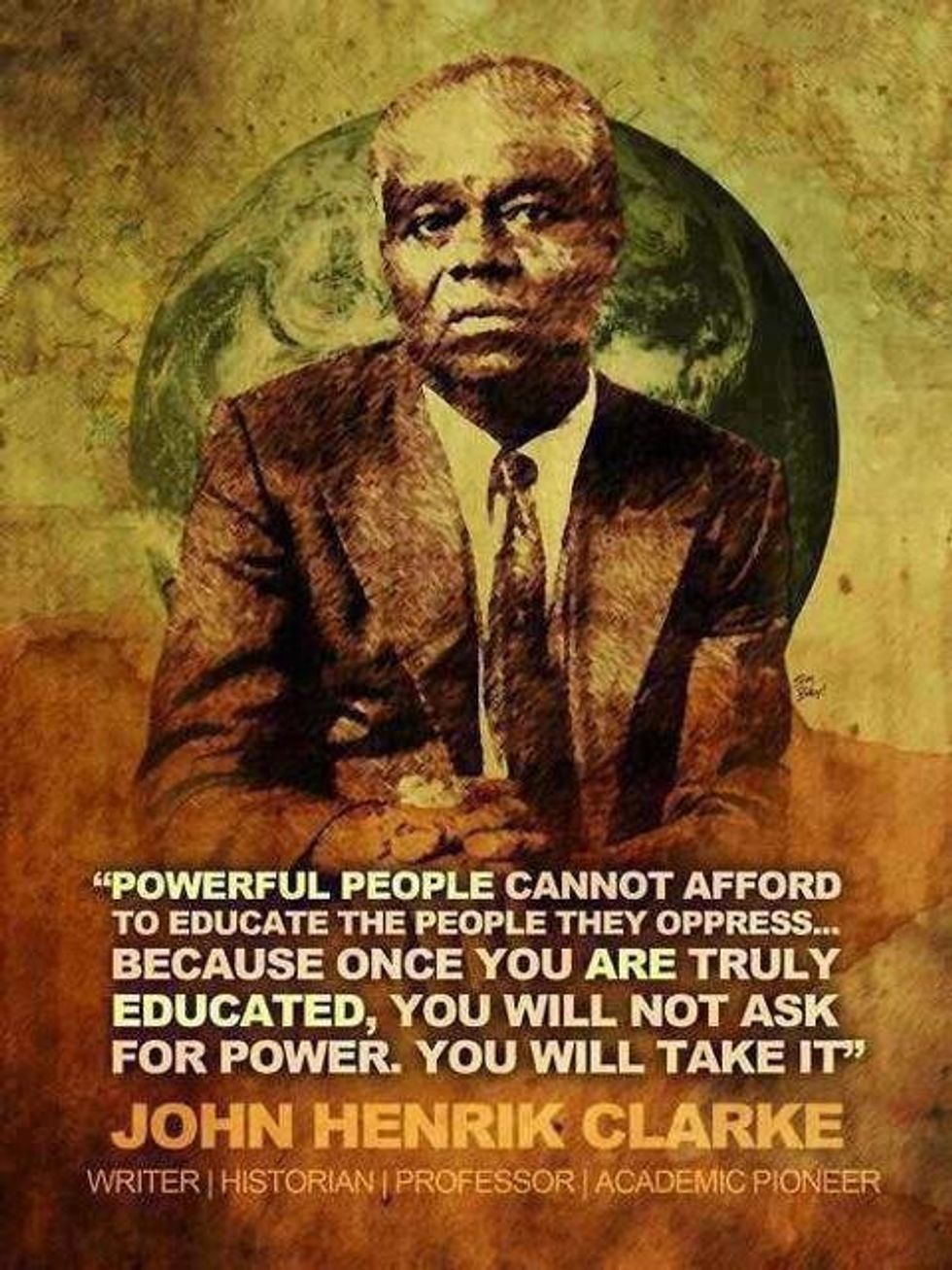
In the late 1960s through the late 1980s, the late John Henrik Clarke (1915-1998) was one of the foremost architects of the emerging discipline of Africana Studies/Africalogy. The study explores Clarke’s development and conceptualization of Afrikan World History by examining his intellectual influences and training. His approach to teaching Afrikan World History, notions regarding Afrikan agency and Afrikan humanity, explorations of themes of Pan Afrikanism and national sovereignty, ideas concerning the relevance of Afrikan culture in historical perspective, and the legacy in Afrikan intellectualism and culture, including his contribution to the Afrocentric paradigm is the core of the discipline of Africana Studies/Africalogy.
As an academician and intellectual, Clarke emerged as one of the leading theorists of Afrikan liberation and the uses of Afrikan history as a foundation and grounding for liberation. Under Clarke's formulation, liberation was defined not simply as freedom from European domination, but fundamentally as the restoration of Afrikan sovereignty.
Why must we study Africana Studies can be summarized with a quote by Dr. John Henrik Clarke, "History, is a clock that people use to tell their political time of day. It is also a compass that people use to find themselves on the map of human geography. History tells a people where they have been and what they have been. It also tells a people where they are and what they are. Most importantly, history tells a people where they still must go and what they still must be." This holds true specifically for the study of Africana studies.
To understand fully any aspect of African-American life, one must realize that the African-American is not without a cultural past even though he was many generations removed from it before his achievements in American literature and art was recognized by western culture. Africana or Black History should be taught every day, not only in the schools but also in the home. African History Month should be every month. We need to learn about people of the African diaspora people of the world including those who live in Asia and the islands of the Pacific.
In the 21st century, there will be over one billion African people in the world. We are tomorrow's people, of course we were yesterday's people too. With an understanding of our new importance we can change the world if first we change ourselves.