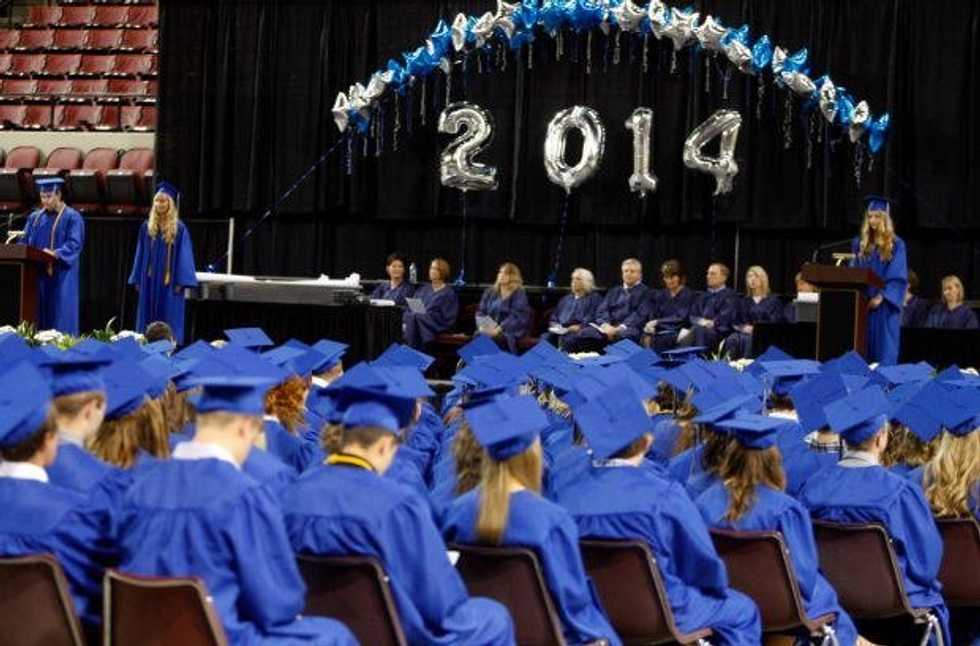
High school graduation speeches are impressively obnoxious. At my sister’s graduation, I remember thinking that all of these class presidents and valedictorians and school spirit guides needed to put away the Dr. Seuss books and burn every cliche out of their brains.
Of course, it’s hard to get up in front of one’s peers and deliver a speech that will be inspiring and uplifting. But why on earth did every single one of those speakers have to end his or her speech with “Congratulations class of 2013, we did it.”? What did you do?
“This is not the end, but the beginning”. I pursued my education after high school and now I am halfway through college. A fact that I believe makes me deeply incapable of explaining the purpose of education but also makes me the number one candidate to justify it. Being knee-deep in a classical school system makes it hard to look at it from a bird’s eye view.
With deadlines and never-ending to-do lists, I don’t have time to look away from school long enough to understand why I’m doing it. Every now and then a class or assignment will click in my mind and a new understanding will dawn on me. And then it’s back to work, but with a new outlook. And so I trudge through my courses, working from epiphany to epiphany.
One such epiphany happened in my freshman year. I was in a liberal arts seminar about selfies in which I had to take a lot of selfies. I did not think about this requirement when I was enrolling.
Before this class, I did not take pretty selfies. Society has branded self-portraiture as vain and narcissistic as if it hasn’t been done and considered fine art for centuries, so I didn’t allow myself to take part. For class, each week we had to post one or two selfies that followed the theme for the week.
For some reason, I took these challenges very seriously and composed self-portraits meticulously and creatively. One day I was looking through the exhibition I had amassed on my Instagram account and I realized that I was taking serious pictures of myself. There was a severe lack of double chins, crossed eyes, and general stupidity.
Somewhere along the three months of taking selfies, I began to take myself more seriously and become comfortable with looking nice and not having to make a joke of myself. I didn’t have to hide behind an expertly crafted horrendous facial expression. It might not have been the goal of the class, but at a time when I was feeling most self-conscious, I learned how to appreciate my appearance.
“Never stop learning.” When people talk about not agreeing with the high standards of a college education, they tend to favor the idea of sleepless nights in a dusty old library. According to these educated people, gaining a degree means hours upon hours of sitting in libraries and writing papers the length of novels.
As an acting major, I feel I have a completely different view. Acting is interpretation. There is no wrong way to play Romeo Montague. There are very bad ways to play him, but never a wrong way.
Students can’t be taught how to perform each and every play correctly, so instead we are taught techniques. Theatre programs revolve around creating a base knowledge that an actor can apply to any show or project. An education in acting means an understanding of an art, how to manipulate one’s mind and body to better interpret and portray a scene.
Perhaps that’s the point of an education in anything, building a base of knowledge that can be used to understand homework, jobs, or even violent city-wide riots.
As Dr. Seuss once wrote, "It’s better to know how to learn than to know.’” Going to a liberal arts college basically means taking a lot general education credits. There are plenty of classes we have to take that we have no interest in, but it’s important for us to have a balanced education. I agree with that, though I don’t think I can tell you why.
I know there’s a purpose for math and science in my education, just like I know that there’s a purpose for spiders in this world. I cringe every time I think about it, but it’s an important piece of a balancing act.
The president of Goucher College, Sandford J. Ungar explained what he believes to be the purpose of a balanced education in his essay, "The New Liberal Arts" when he concludes, “Through immersion in liberal arts, students learn not just to make a living, but also to live a life rich in values and character.
They come to terms with complexity and diversity, and otherwise devise means to solve problems -- rather than just complaining about them. They develop patterns that help them understand how to keep learning for the rest of their days.” (Ungar)
According to Ungar, education means the development and improvement of self. A comprehension of an array of subjects leads to more interested and understanding individuals. There hasn’t been a single class in my liberal arts education that I haven’t found some value in.
Each subject has affected me and changed the way I see the world, something I never got out of my high school curriculum.
“The best and brightest.” Geeks get it. Those weirdos that write pages upon pages analyzing the symbolism of the color of each Doctor’s sonic screwdriver on "Doctor Who" have consumed something from years of AP English.
Nerds that sit around discussing the realistic side-effects of Barry Allen’s super speed as The Flash have transferred their biology notes over into their interests. Education really shows through when people begin to talk about things they actually care about.
Learning ratios and proportions is meaningless until one has to get the dimensions of one’s Excalibur sword accurate.
A good education should mean that the world is changed by your knowledge. When facts and information transfer over into the real world and the way you solve problems and ask questions, you’ve been educated.
“We did it.” In high school, I wrote one English paper that I was genuinely proud of. It was my final for AP English and it was incredibly badass.
I realized that last period of the last day of my senior year of high school that writing papers should be like everything else I write. It should be fun and challenging and intriguing. So that’s what I wrote about.
My entire honors English curriculum up until then had me writing formal papers for grades on things that I didn’t think I cared about.
But that day I saw that I should have an opinion on the things I consume, that I shouldn’t mirror my teacher’s opinions, but discover and own mine.
At the last minute of my high school career, I had the epiphany that made me look at education differently. I took a second and stepped out of the tide of homework and tests and critically analyzed what I was doing.
I didn’t have the perfect answer to the writing prompt, but I actually had an opinion that I cared about for once. I began to figure out what the point of education was that day, and I’m still working on forming my opinion. Education will mean something different to everybody, but for those who get an education, the answer is in the results which can take a lifetime to see.