


It was my first class back from winter break. I walk in, bundled against the cold, but happy because I had a hot chocolate in my hand. Exhaustion left over from my wonky sleep schedule held a heavy hand over my entire body, but excitement still coursed through me as the class began. This will be my first class relating to my major. The chatter of the class was silenced as a woman, nearly 70 years old, struts into the classroom and tosses her bag onto the table in front of us. Throughout the class, she zipped back and forth with the energy of a five-year-old on coffee. She wavered between humorously impersonating her husband and her son as she shot out her life story at lightning speed. That first period left me completely oblivious to the aggravation that this woman would cause. I felt comfortable and content in my ability to analyze text well enough to write a passing essay. I kicked my feet back while I wrote my first assigned essay.
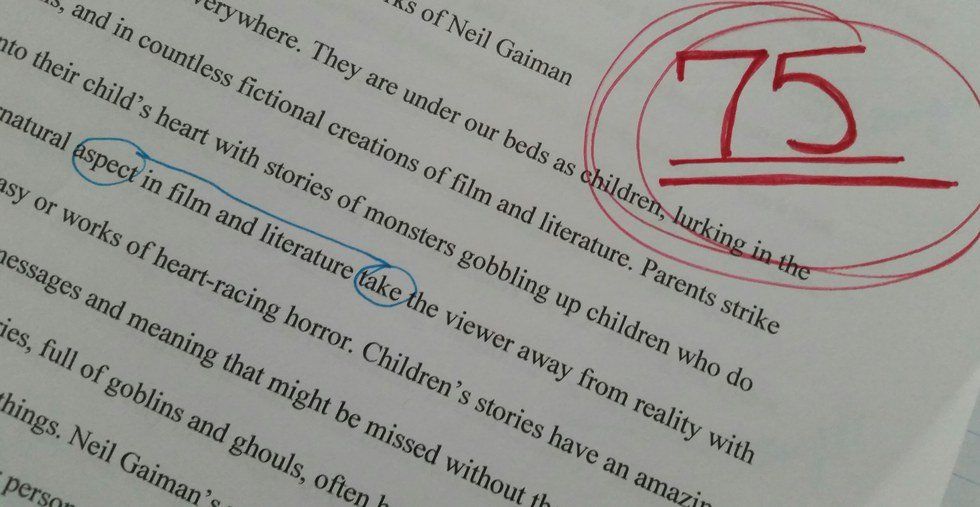
I received a 75.
I had never received a C in my life.
Classes in high school are a chore. It always feels like there’s no point to them and that the information will never be put to use in the real world, but they’re something that has to be done. Classes in college are completely different! These classes pertain to your degree and, ultimately, your career. I understood that, but it just didn’t click. I went through my first semester of college much like I went through high school — rolling my eyes and doing as little of the work as possible to keep my GPA for my scholarship.
That was before I hit my literature class, and everything started to change.
I nearly dug a hole to hide my head the next time I had a writing assignment. I found out that I have a very fixed mindset when it comes to my writing being criticized. My stroll through high school had made me arrogant and made me believe that I had nothing left to learn. When, in fact, my arrogance stifled my learning. My literature professor had thrown down the gauntlet. She had directly challenged me to make a stand for my writing, to learn from my mistakes.
As soon as I recognized this, my heart burned with a fire unknown to me — I craved to improve my writing. I began to let the corrections on my essay push me to do better, and I began to learn. I had almost let my mistakes cause me to believe that I was an incompetent writer. Instead of letting myself believe that I would fail and backing down from the challenge, I let my mistakes become the teachers.
My writing isn’t flawless, and it never will be. But I will not be able to learn and grow as a writer if I don’t learn from my mistakes, if I don’t pick up the gauntlet every time I get a low score.
What did I learn during school today? It is a simple question and easy to understand. I have been asked derivatives of that question by my parents, teachers, and scholarship applications for years. It is almost too easy to fill in the blank of “I learned _____ in school today!” Too often, I feel as if I go through my classes and leave without learning anything at all. Most of the lessons in the classroom go in one ear, out on the exam, and are gone for the rest of eternity. High school taught me how to properly regurgitate information onto an exam to receive a tolerably high grade without the information becoming a lasting burden on my mind. Occasionally, there is a teacher who transcends the standard lessons of the classroom, one that is capable of teaching his or her students a life lesson that will continue to be valuable after the exam.
For me, that was my literature professor. The woman who gave me my first C.
My Literature professor taught me to have an open mind to corrections of my work, and this is a lesson that I can apply to every aspect of my life, not just my writing. I have learned that mistakes are like humbling professors: they are there to learn from, and it is the refusal of these lessons that causes me to see my failures.
Take a closer look at the lessons that your professors have to offer, especially the ones who challenge you and point out your mistakes. Those are the professors who will teach you something truly valuable, not something you just memorize for the next exam.

















