

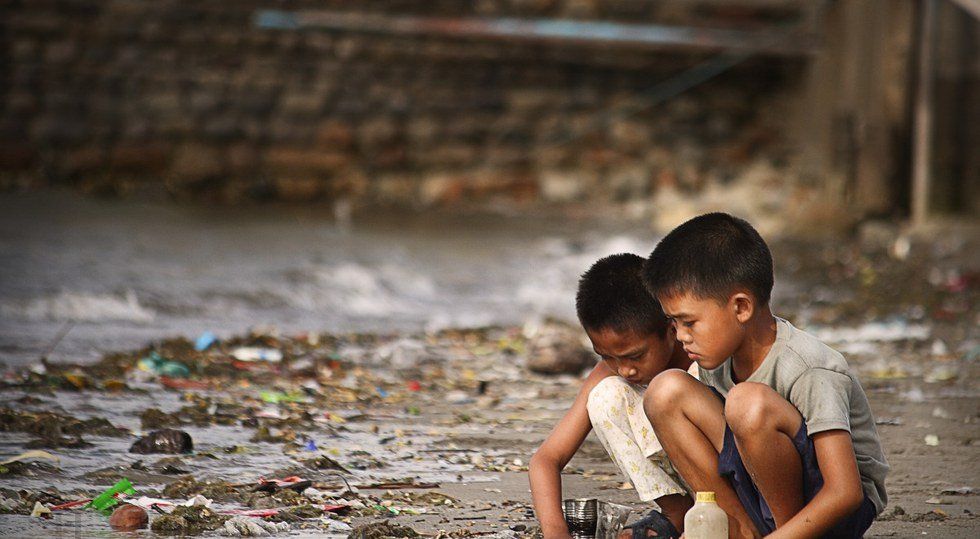
We hear about poverty every day in our lives. Anywhere we go, we seem to be reminded of it: billboards, tree stumps, stop signs and even people on the street. We all sympathize for those who fall victim to poverty. Why isn't that enough? Why isn't poverty going away?
I used to believe that the root cause of poverty was something called overpopulation. I learned this in my high school environmental science class. What I later learned was that my teacher did not expand on the other, often related, causes. More and more, I found myself looking into the things that he said; doing my own research. I found that overpopulation does, indeed, pose many issues in our world: less potable water, less nutrients and less resources that people need to survive. Of course, our world population is exponentially growing and our ability to feed all of these people is not growing quite as rapidly. Developing countries whose economies are struggling due to various reasons such as war, history, lack of regulation and overpopulation itself, do not have the resources to put every child through school, feed every child or provide reliable shelter. So, why is overpopulation such an issue?
It is true that death rate and birth rate are connected in a way where cultures who believe that their children will survive, have less children. This is why in America, less babies are being born. Americans are fairly certain that children raised here have a high chance of survival — we have solid health care, economic opportunity and live in a country with fairly predictable levels of safety, stability and security. Yet, in developing countries, there is a baby boom. In countries plagued with health problems, there is often a steeper population increase. It is believed that the baby boom in these countries is because mothers strive to have at least a certain number of their children survive, but realize that the chances are slim, so they overcompensate. There, they feel the effects of poverty the most, while in places like America, we hardly feel it at all. Bill Gates said during a TED Talk on Global Poverty, “The key thing you can do to reduce population growth is actually improve health.” An improvement in health would seemingly mean less babies in developing countries. Overpopulation in and of itself is not the true cause of poverty. In fact, a largely contributing cause is lack of empathy, which may be fueled by lack of understanding. What we need to do is help the living and health conditions in developing countries improve, so that their people can trust that their children will survive, and therefore, population growth will stabilize.
We can help by widely educating about global issues and poverty. Why are things the way they are? What kinds of things can I do to lessen the hurt in struggling countries? The more we care about each other, the more stable we can be. Better health leads to a more controllable population size, a more controlled population size leads to more readily available resources for the future, more opportunity and better economic growth throughout the world.
Sure, we all sympathize, but that is simply not enough. Feeling bad is not enough to actually make a difference. Next time you are out, consider buying a burger for the sad man on the corner of the street, instead of responding passively. Maybe even strike up a conversation and learn about what has led to where he is today. If you find yourself sympathizing, take the next step. Move toward greater compassion for others and those around you. Try to understand what types of poverty are occurring in the world and the causes. Additionally, find out how you can have an effect on someone's life, whether they are in your town, country or on the other side of the world — the end to poverty starts with a greater sense of understanding, and ultimately, compassion.