Not to get deep up in here, because I'm trying to write a humorous article, but I'm about to get just a little deep up in here. Bear with me: the internet is a lot like humanity as a whole.
It is, at least, a microcosm of society, of the different societies in which it's a phenomenon. I'm only casually acquainted with global policies, but it's common enough knowledge that Russia and China both censor their internet content to a pretty explicit degree; the stringency of censorship laws aligns with how much a government cracks down on its citizens' freedom of expression. Even North Korea, interestingly enough, has internet access for a select few, though their setup is by far the most severe. The United States is more even-handed in their methods, but where they cannot censor, they surveil. I'm sure if our government could get away with it, they would implement more controlling laws. (I mean, they've tried, haven't they?)
Real
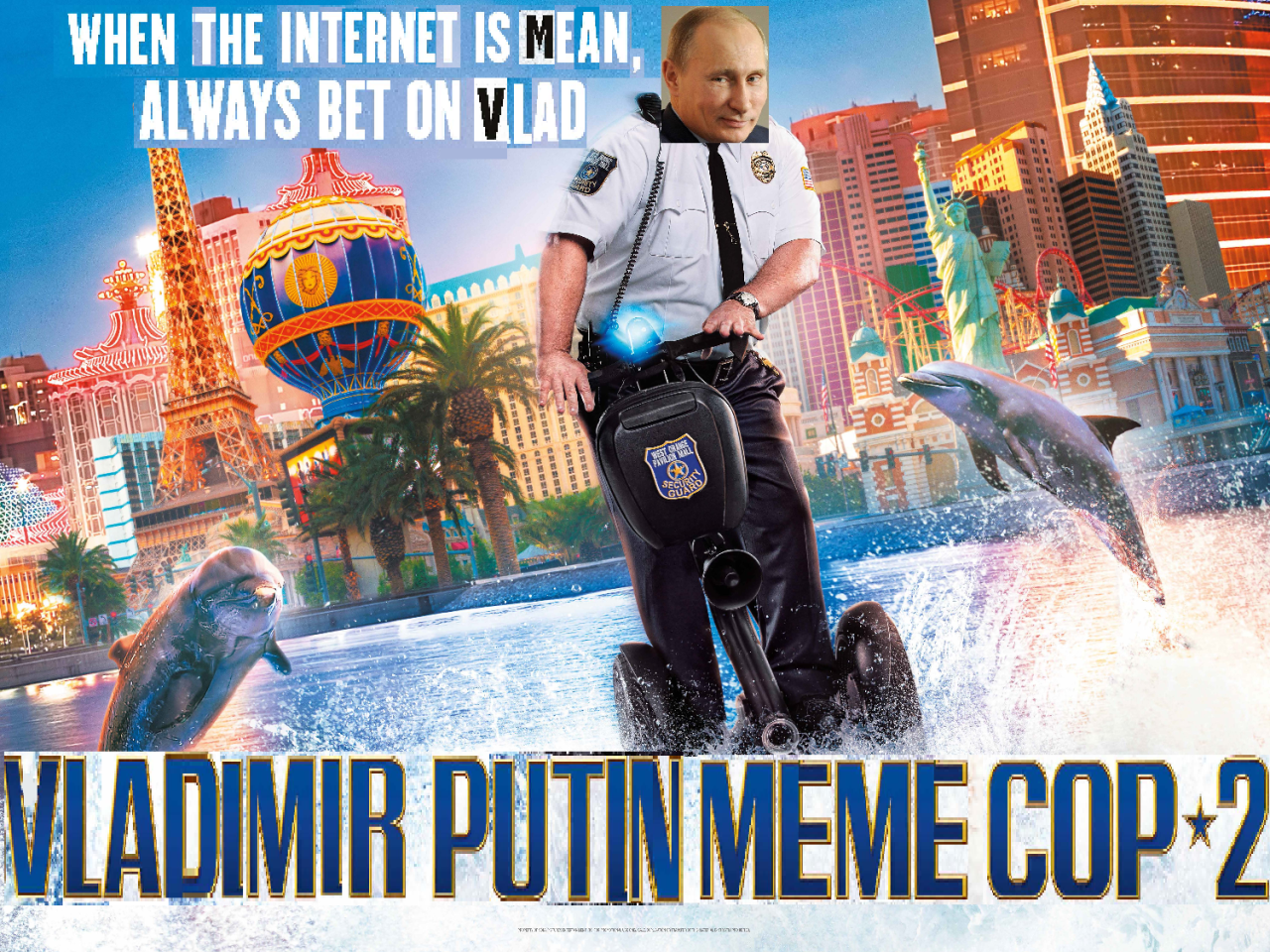
Talk: if a Russian citizen made and posted this, Vladimir Putin, Meme
Cop, could sue them on defamation claims. Or maybe he'd be into this.
Who knows.
Point being, the internet has power, and everyone knows it. The internet is put to use by proletariat and bourgeoisie alike, by feminist and meninist, for information transmission and fear-mongering. To match every debauched pit of sin and each unnecessary cyberbully, there are in equal parts close-knit communities and deserving people who are rallied behind and brought to attention. Social media plays a huge part in this binary, of course. And what an excellent jumping off point to stop being so deep and say this:
There is a fifth dimension beyond that which is known to man. It is a
dimension as vast as space and as timeless as infinity. It is the middle
ground between light and shadow, between science and superstition, and
it lies between the pit of man's fears and the summit of his knowledge.
This is the dimension of imagination. It is an area which we call the Discourse Zone.

Follow me here. I know we're going to a lot of places in this article, but this is the modern day, and in the modern day, this is just how The Discourse works. Discourse is basically discussion, and whenever you gather enough vocal people in the same place, it's bound to happen. Forget all the other tangentially-related-but-included-as-citations links in this article and skim over this Wikipedia excerpt, which is directly related to the article. Look at the little titles in the bubbles of that colorful, strangely specific infographic.
And now try tell me this model for "online discourse communities" doesn't sound like every social media endeavor that's ever gained popularity. All the Big Names in social networking--Twitter, Tumblr, Reddit, Facebook, heck, even the old school sites--are delineated by their user bases, then subsequently by the social interactions said user bases accept and perpetuate. Each is its own self-sustained community, with different standards, a different atmosphere, and a separate (but fundamentally integrated) culture.

DeviantArt is a Big Name in and of itself, but the only reason it's on this chart is because it came from a DeviantArt user and even internet culture is nationalistic.
Even further, social media is segregated by their meme currencies. And Lord, the language barrier! Unless you're familiar with both the equivalent exchange rate and the local lingo because you travel between territories all the time, navigating an unfamiliar social platform can be downright impossible. I'm on Tumblr all the time--mindlessly absorbing photo sets and offbeat humor to distract me from reality--so I know how the gears grind there. The turnover rate of Tumblr memes is monumental; for example; inflation has rendered meming near worthless in value, but still there are wheelbarrows worth of new memes being produced and circulated. Some fear a memeconomic collapse in the future.