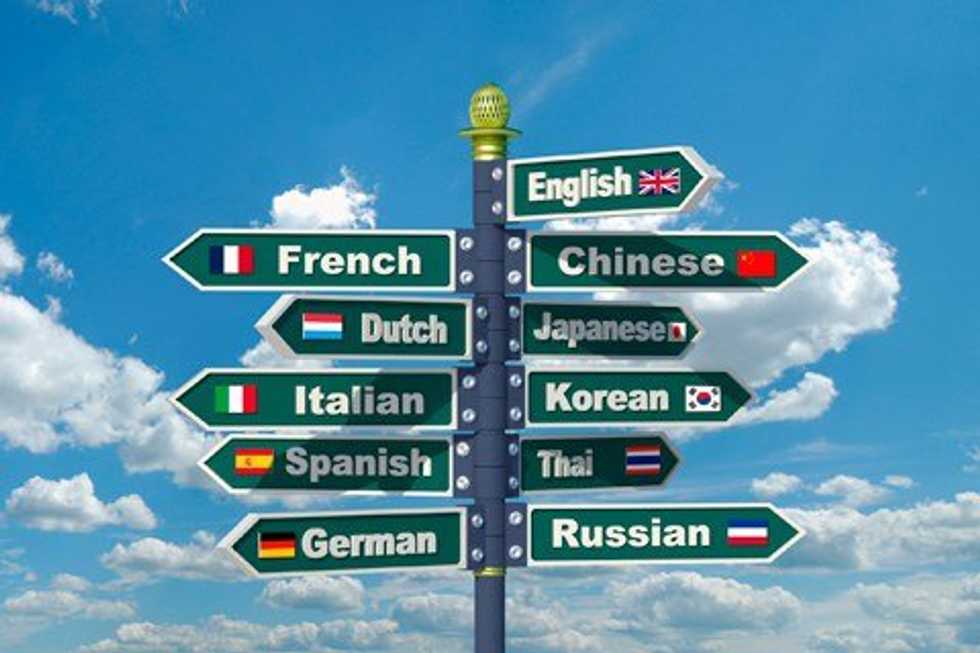
Each school is unique, but the criteria is usually the same – you need to take a foreign language before you graduate high school. The reason as to why we must learn them is up to the interpretation of the students, most of which seem to think that it’s a cruel form of torture. It’s arbitrary and unnecessary – everyone speaks English, right?
It was September of 2008 when I stepped into the first foreign language class that I’d ever taken. My language of choice was Spanish, but I was lucky to have the choice between three separate languages (Spanish, French or German), something that was rare for a small school in Upstate New York. I didn’t expect much; I was in seventh grade and I was much more intrigued by the thought of having a schedule where I could switch classes than the classes themselves. I didn’t expect to love Spanish, nor did I think that I would be any good at it, though I was admittedly excited to have the class with my best friend. However, things changed.
I was overwhelmed with the concepts of conjugations and strange pronunciations, with the slew of vocabulary that was thrown my way, but something inside me had begun to change. The language didn’t just consist of hundreds of rules and “foreign” words, I learned as my teacher introduced us to details particular to the lives of Latinos, but instead was an embodiment of those who spoke it. Inside language, there rests a culture, something living, growing, thriving that can only be ignored by closed eyes.
For the remainder of my high school career, I continued my studies of Spanish, realizing that language comes naturally to me along the way, but I still felt as though there was something I was missing. And sophomore year, I enrolled in my first French class.
French and Spanish, though both romance languages, are more different than one would think. The culture that nurtures the language has an incredible amount of impact on the final product, and through studying them both, I grasped a clearer understanding of how important history is. The United States is still infantile – we’ve only been around since the late eighteenth century. However, cultures like those of France and Spain have thrived for over a millennium. The history, whether it be military, social or religious, allowed for the transformation of the language.
Yet, I still wasn’t finished. The following year, I enrolled in my first German class. German, a Germanic language like English, is another battle entirely. Everything was so different than what I’d previously been taught, and I struggled to rewire the way that I thought in order to satisfy the requirements of learning German. At this point, I was no longer worried about the grade – I truly wanted to learn— and I found it more difficult than I should have.
And two years later, I graduated high school, unfortunately discontinuing my studies of French and German (or so I thought) as an Adolescent Education major with a concentration in Spanish. I’d given the two secondary foreign languages a go, but it just didn’t seem to be in the cards to continue my studies.
With a stroke of chance and a very dedicated foreign language program, I’m now a double major in Spanish and French, and it has changed my life. Knowing a second (or a third or a fourth…) language has shaped who I am. I understand now, first hand, the importance of speaking more than English. It’s true – very much of the world has adopted English as their second language—but as an English speaker, we miss out on a lot of lessons that we need to have. Collectively, we cast judgement on the immigrants, either legal or not, who speak anything other than English in public. However, if we were dropped in Chile and were forced to communicate in a language that we were not comfortable using, we would revert back to English and assume that everyone spoke our mother tongue. It has made us insensitive to the fact that there are cultures that don’t use English as their primary language.
Learning another language has taught me the key to understanding the aforementioned culture is not through Google or Wikipedia, but through speaking the language of the people who we want to learn about, through reading authentic works, through hearing the history from someone whose history it is.
So many doors have been opened for me by allowing myself to obtain another language, and I wouldn’t change it for the world. One of my professors said, “Nosotros somos el lenguaje” (We are language), and it has stuck with me. Language will never be a crutch. With language, we gain the power to understand through the lens of another and to see in a unique and wonderful way. Every last exasperated sigh that’s made when you fight to translate a simple sentence, they will all be worth it. If you let it be, language can be your greatest asset.