
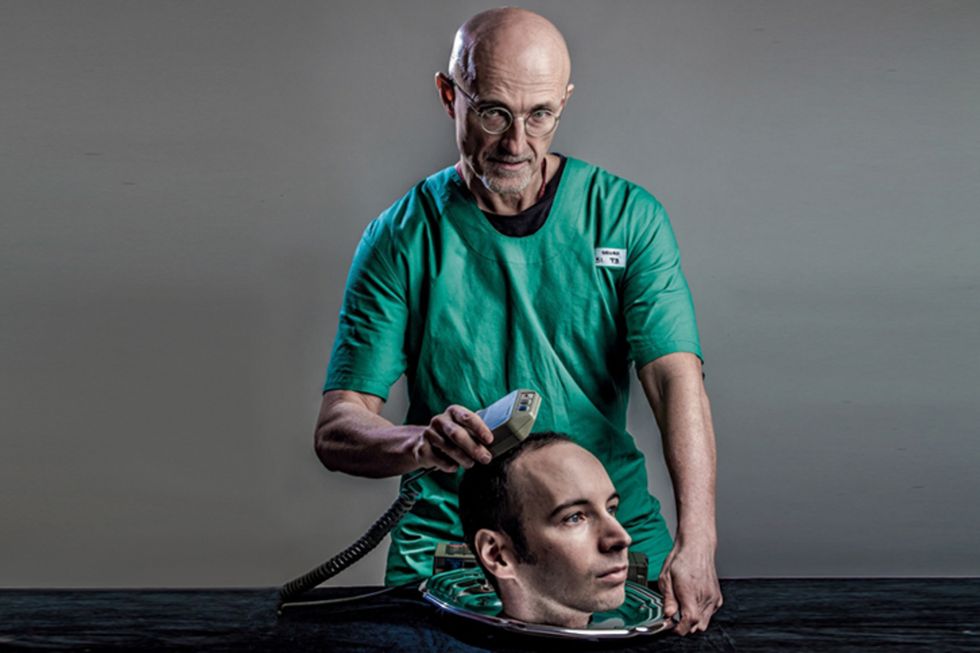
In December of 2017, 31-year-old Russian-born patient, Valery Spiridonov has volunteered to undergo a procedure that would make him the world’s first-ever head transplant recipient.
Spiridonov suffers from Werdnig-Hoffmann disease, which is a form of muscle atrophy. Despite modern medicine and technology, only the heart, brain, internal organs and other parts of the body have been transplanted among humans, until now.
The operation will be led by a team of two surgeons. Italian neurosurgeon Sergio Canavero and Chinese neurosurgeon Xiaoping Ren. The surgery consists of removing Spiridonov's head, cooling it to less than negative 15-degrees Celsius and reattaching it to a headless body from a donor. The identity of the donor body remains unreleased to the public.
If all things go as predicted, Spiridonov will regain muscle control in the new body. A special operation knife, using a blade made from diamond will be used to remove the head from the spinal cord. The cutting tool containing the knife was developed by Professor Farid Amirouche at the University of Illinois and can make cuts down to a micrometer. Afterward,
The two plan to use the Frankenstein effect, causing the muscles of a dead body to be reanimated using electrical or magnetic stimulation. Following the procedure, Spiridonov will be placed in a coma for 4-6 weeks while new nerve networks and blood revitalize. In order for the surgery to be a success, the donor body will have to accept Spiridonov’s head.
Critics question the possibility of the head being rejected by the new body. In response to many questioning on the psychological response of the patient, Dr. Canavero unveiled a psychologically ready Spiridonov for life in a new body. The virtual reality training will take place for several months, leading up to the surgery.
The two surgeons claim that all the technology they need is available and predict that the procedure will take about 36 hours, will need the services of 150 medical professionals and will cost between 10-12 million dollars. The location of the surgery will allegedly be in either England or Vietnam. Canavero expects a 90% chance of success, saying that the patient will be expected to be up and walking 6 months after the completion of the procedure.














